...

By Maria Azzurra Volpe
Reporter
0
Share
Newsweek is a Trust Project member
See more of our trusted coverage when you search.Prefer Newsweek on Googleto see more of our trusted coverage when you search.
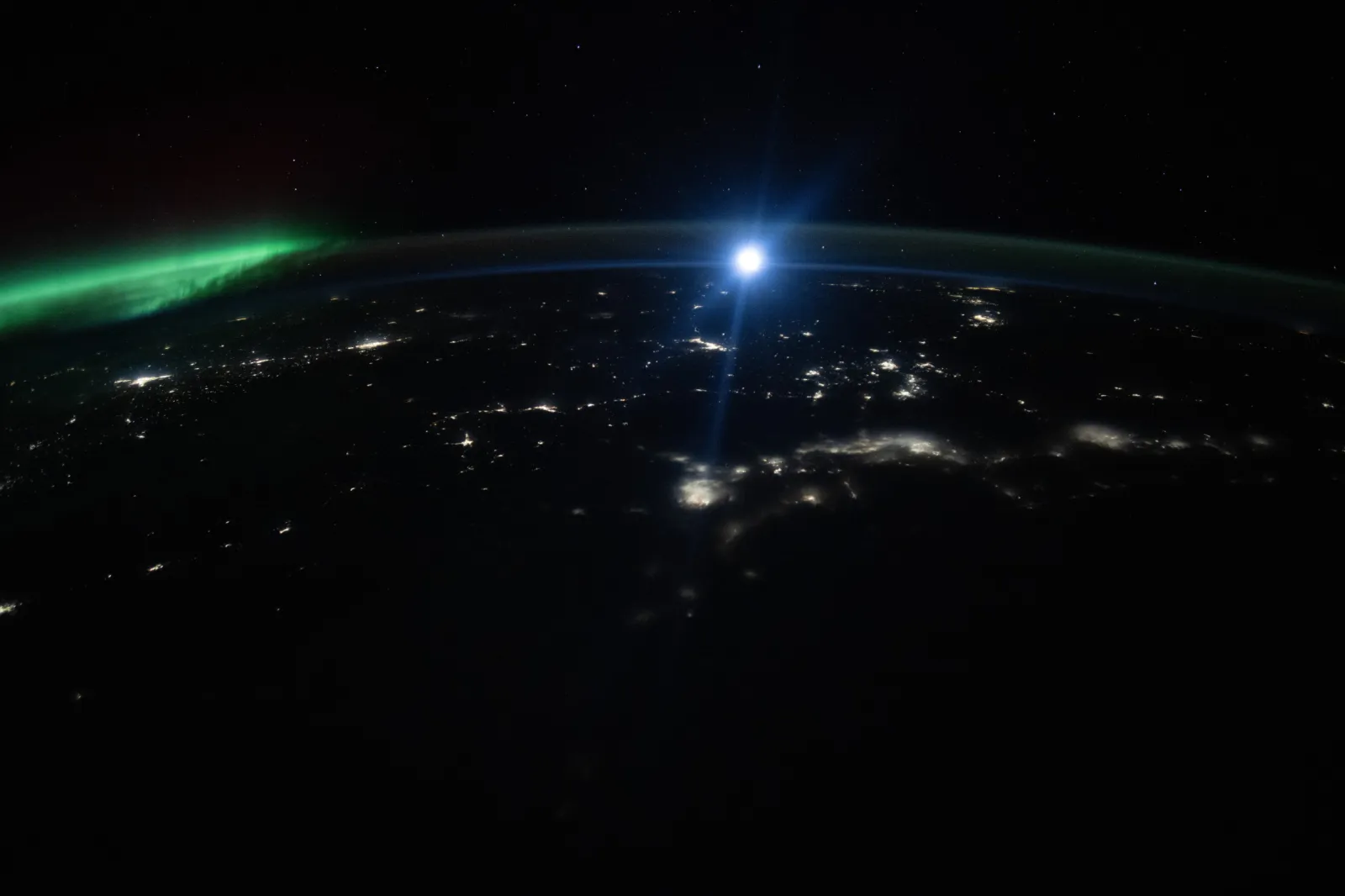
An astronaut aboard the International Space Station captured a stunning image showing both the moon and the aurora borealis illuminating the skies of the northern part of the U.S. West Coast and Canada.
The picture, taken on March 19, shows bright clusters of light from major cities located just below, including Calgary, Edmonton, Portland, Seattle and Vancouver. The lights of Seattle and Vancouver appear slightly blurred—likely, NASA says, due to inclement weather.
Near the center of the image, the moon is seen just beginning to rise above Earth's limb.
Read More on Science
Astronauts on the space station, orbiting the Earth at around 17,500 miles per hours, witness this phenomenon multiple times a day—they experience some 16 moonrises and moonsets within each 24 hours period.
Also visible in the picture is a bright green aurora, illuminating the Canadian sky near Edmonton. The northern lights are produced when charged particles from the Sun interact with molecules in the Earth's upper atmosphere.
...
The color of the aurora is determined by the type of gas excited and their location in the atmosphere. Oxygen can produce green or red, while nitrogen emits blue or purplish hues. Varying gas amounts and altitudes create blends like pink, purple and white.
These displays are typically stronger near the planet's poles, but during period of intense solar activity, they can extend to lower latitudes. In mid-2024, auroras were observed as far south as central Mexico. This activity comes amid the Sun's maximum phase, which is set to continues all through 2025.
NASA explains that roughly every 11 years the sun's magnetic field completely flips, and its poles invert. Around the time of this flip, solar activity gradually ramps up, causing more solar eruptions like solar flares and coronal mass ejections.
The solar maximum is the peak of this activity, which marks the half way point of the solar cycle. This usually means a year or two of high solar activity, which may trigger auroras.
The current cycle, Solar Cycle 25, reached its peak in October of 2024, and activity is expected to lower ahead of the start of Solar Cycle 26, which could begin any time between 2029 and 2032.
Do you have a tip on a science story that Newsweek should be covering? Do you have a question about the aurora? Let us know via science@newsweek.com.
View 0 Comments
Submit Correction
View Editorial & AI Guidelines