
By Rosie McCall
News Reporter
0
Share
Newsweek is a Trust Project member
See more of our trusted coverage when you search.Prefer Newsweek on Googleto see more of our trusted coverage when you search.
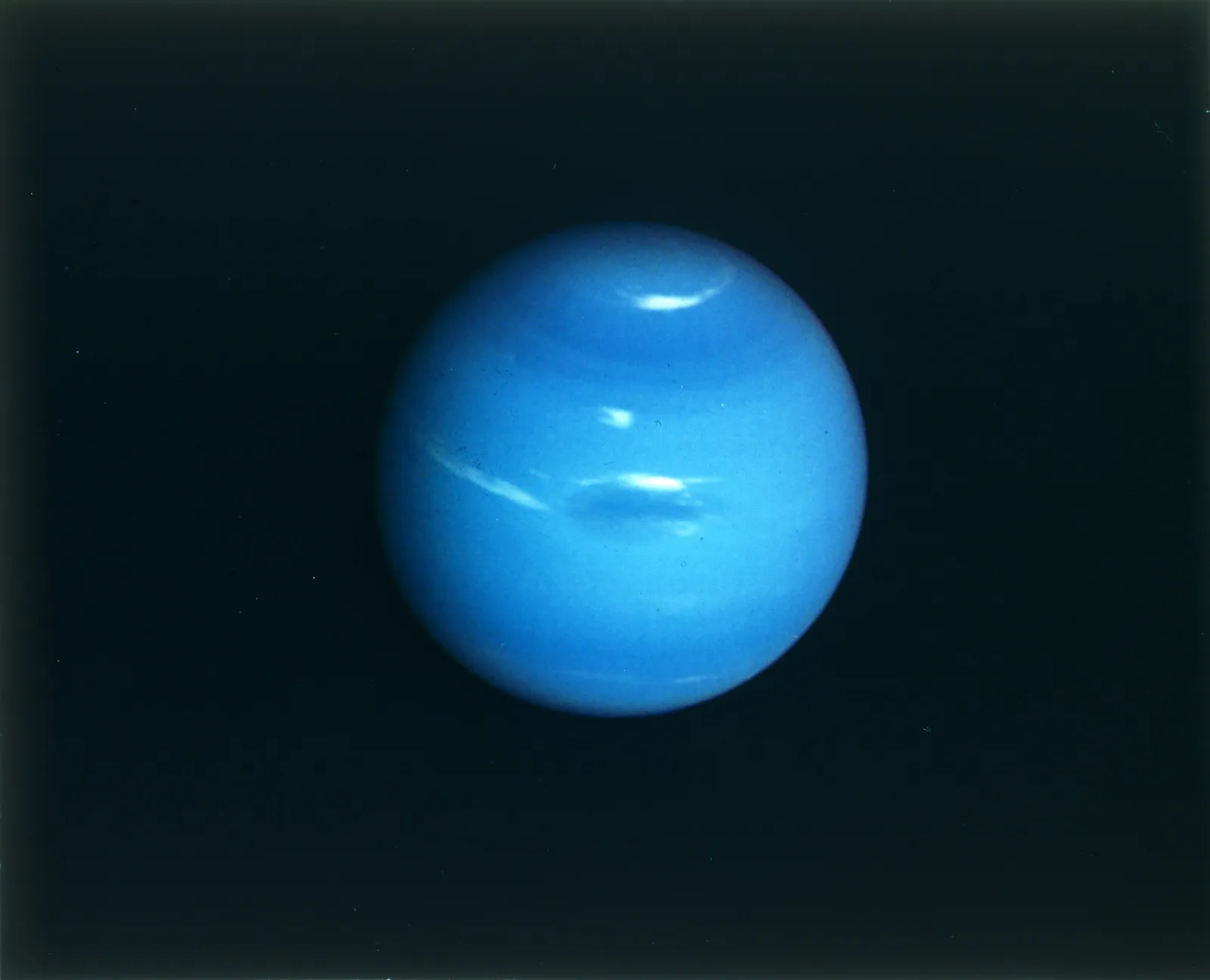
Astronomers have discovered a moon with a unique orbit consisting of oscillating patterns. This allows it to avoid collision with a neighboring satellite as they whirl around Neptune—a process they have dubbed a "dance of avoidance."
Neptune has 14 moons that we know of, including 7 inner moons that are in relatively close proximity to one another. Two of those inner moons, Naiad and Thalassa, were discovered in 1989 during the Voyager 2 spacecraft flyby.
Measuring just 60 miles or so in length, they would be considered small as far as satellites go—the Earth's moon, in comparison, is 2,159 miles in diameter. More importantly, however, the pair are incredibly close together, celestially-speaking, with orbits that are only 1,150 miles apart.
Read More
Scientists Narrow Down Number of Exoplanets Which Could Host Alien Life4 min read

Supermassive Black Hole Ejected a Star That Will ‘Leave the Galaxy and Never Return’4 min read

NASA Space Image Reveals Vast Amounts of Smoke Being Produced by Devastating Australia Wildfires3 min read

Researchers writing in the journal Icarus describe the unusual—and seemingly unique—shape of their orbits and how this prevents them from colliding. The orbits were calculated from data collected by the Voyager 2 spacecraft and Hubble Space Telescope between 1981 and 2016.
"We are always excited to find these co-dependencies between moons," co-author Mark Showalter, a planetary astronomer at the SETI Institute in Mountain View, California, said in a statement.
"Naiad and Thalassa have probably been locked together in this configuration for a very long time, because it makes their orbits more stable. They maintain the peace by never getting too close."
...
The choreography between the two moons as they weave in and out of each other's orbit is being called a "dance of avoidance"—a phrase that describes the way Naiad's tilt and timing ensures each time the satellite passes its neighbor Thalassa, the pair do not come into contact. At the point the two orbits cross paths, the moons remain 2,200 miles or so apart.
Naiad is the faster moving of the two, taking 7 hours to orbit Neptune. Thalassa, in contrast, takes 7.5 hours. The former avoids the latter by moving in a zigzag pattern, crossing Naiad's orbit twice from above and twice from below, and then repeating the pattern over and over again.

...
"We refer to this repeating pattern as a resonance," lead author Marina Brozović, an expert in solar system dynamics at NASA's Jet Propulsion Laboratory in Pasadena, California, said in a statement.
"There are many different types of 'dances' that planets, moons and asteroids can follow, but this one has never been seen before."
Brozović and her colleagues believe these complementary orbits—or dances—have taken place since Neptune captured Triton, which at 1,680 miles is the planet's largest satellite.
"We suspect that Naiad was kicked into its tilted orbit by an earlier interaction with one of Neptune's other inner moons," said Brozović. "Only later, after its orbital tilt was established, could Naiad settle into this unusual resonance with Thalassa."
View 0 Comments
Submit Correction
View Editorial & AI Guidelines