
...

By Giulia Carbonaro
Senior Reporter
0
Share
Newsweek is a Trust Project member
See more of our trusted coverage when you search.Prefer Newsweek on Googleto see more of our trusted coverage when you search.
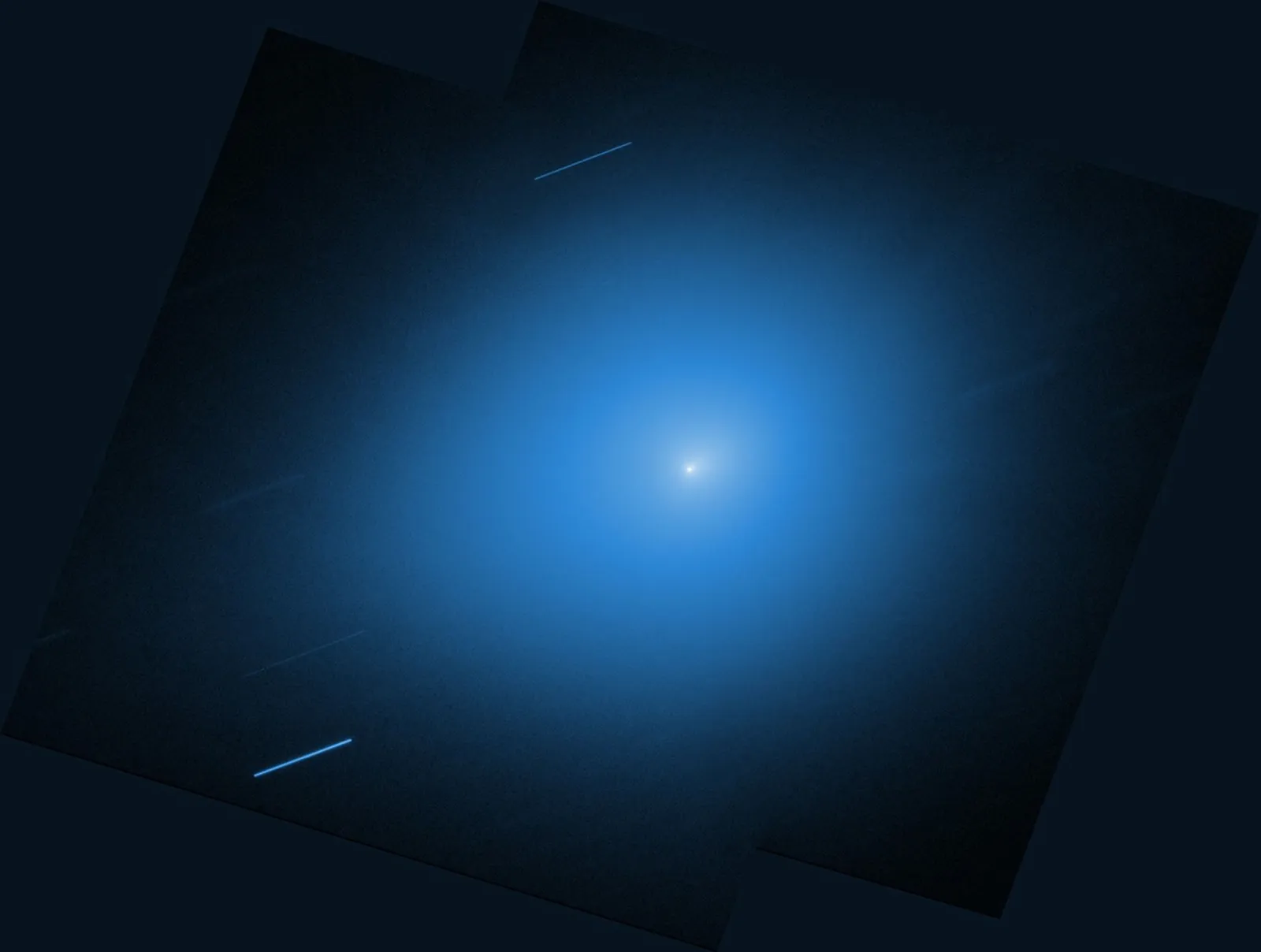
NASA shared some new infrared images of the 3I/ATLAS interstellar comet this week, showing the visitor brightening up in a dramatic outburst while exiting a solar system.
The images were taken by the space agency’s infrared space telescope, SPHEREx (short for Spectro-Photometer for the History of the Universe, Epoch of Reionization and Ices Explorer) in December 2025.
Why It Matters
Interstellar comet 3I/ATLAS is quite rare for us, as it is only the third known object to pass through our solar system from outside it, according to NASA.
Read More on News
As it is different from the comets in our solar system, 3I/ATLAS could help scientists on Earth understand the composition of other solar systems.
...
What To Know
The comet was first observed on July 1, 2025, by the NASA-funded ATLAS survey telescope in Rio Hurtado, Chile. When it was discovered, it was traveling at roughly 137,000 miles per hour, but it sped up the closer it got to the sun, pulled by its gravity.
At its closest to the sun—known as perihelion—on October 30, 2025, the comet was traveling at a stunning 153,000 miles per hour. Leaving our solar system, it was traveling at the same speed it came into it.
Like all comets, 3I/ATLAS had an icy nucleus and a coma—a bright cloud of gas and dust surrounding the comet which is emitted at increasing rates as it approaches the sun.
It simply passed through our solar system, without posing any threat to our planet or being bound by the sun’s gravity.
...
In December, the SPHEREx telescope captured infrared images of the comet leaving our solar system in a bright outburst, revealing organic molecules, such as methanol, cyanide, and methane.
On our planet, these molecules are the foundation of life—but NASA scientists said that they can be created by non-biological processes as well.
The images captured also make for beautiful pictures: after passing its closest distance to the sun, the comet became particularly bright as it vented water, carbon dioxide, and carbon monoxide into space in a delayed effect of peak overheating.
What People Are Saying
Phil Korngut, the mission’s instrument scientist at the California Institute of Technology in Pasadena, said in a statement shared by NASA: “The comet has spent ages traversing interstellar space, being bombarded by highly energetic cosmic rays, and has likely formed a crust that’s been processed by that radiation.
“But now that the sun’s energy has had time to penetrate deep into the comet, the pristine ices below the surface are warming up and erupting, releasing a cocktail of chemicals that haven’t been exposed to space for billions of years.”
Carey Lisse of Johns Hopkins Applied Physics Laboratory in Laurel, Maryland, said in a statement reported by NASA: “Comet 3I/ATLAS was full-on erupting into space in December 2025, after its close flyby of the sun, causing it to significantly brighten. Even water ice was quickly sublimating into gas in interplanetary space.
“And since comets consist of about one-third bulk water ice, it was releasing an abundance of new, carbon-rich material that had remained locked in ice deep below the surface. We are now seeing the usual range of early solar system materials, including organic molecules, soot, and rock dust, that are typically emitted by a comet.”
What Happens Next
The images of comet 3I/ATLAS are only one of the many the SPHEREx telescope is expected to deliver.
It was launched on March 11, 2025, with a two-year mission to collect data on more than 450 million galaxies, along with more than 100 million stars in the Milky Way.
Its goal, according to NASA, is to explore the origins of the universe.
View 0 Comments
Submit Correction
View Editorial & AI Guidelines