...

By Soo Kim
Reporter
0
Share
Newsweek is a Trust Project member
See more of our trusted coverage when you search.Prefer Newsweek on Googleto see more of our trusted coverage when you search.
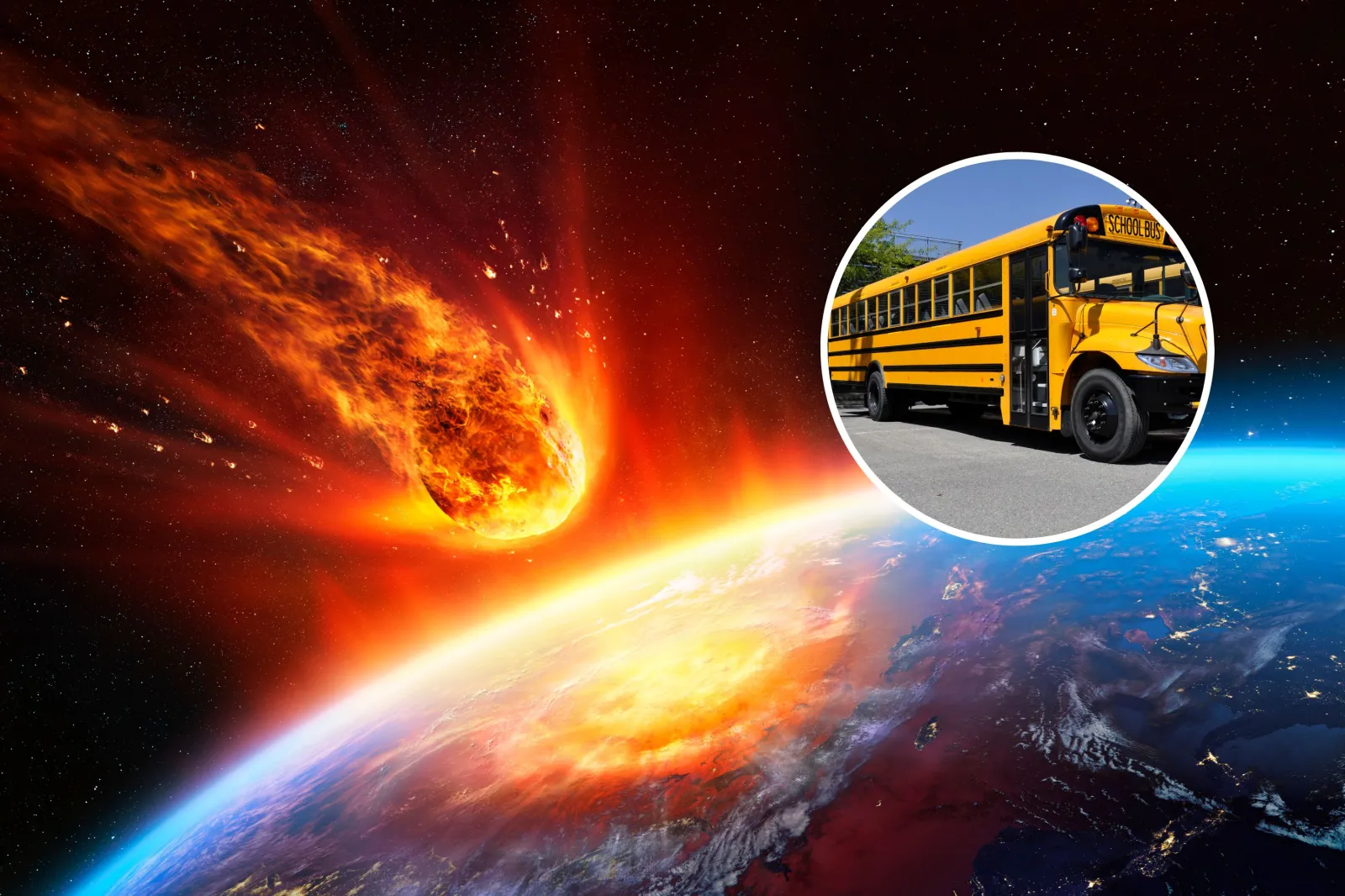
NASA is monitoring a bus-sized asteroid that is speeding toward Earth at nearly 20,500 miles per hour, according to the Center for Near Earth Object Studies (CNEOS).
Measuring around 40 feet in diameter, the asteroid known as "2026 AJ" is expected to come as close as around 961,000 miles from our planet on Monday, according to NASA’s Jet Propulsion Laboratory (JPL).
2026 AJ is one of five asteroids approaching Earth today that are being tracked by NASA, and it is forecast to come closest to our planet among the five.
Read More on Science
Three asteroids, ranging from 73 to 130 feet in diameter, are also being monitored, including one named "2026 AO" that is coming as close as 990,000 miles from our planet. Another space rock, known as "2022 GR3” and 29 feet in diameter, is projected to make its closest approach at 3.45 million miles from the Earth, the JPL notes.
...
Asteroids are small, rocky masses left over from the formation of the solar system about 4.6 billion years ago. They are found concentrated in the main asteroid belt, which lies around the sun between the orbits of Mars and Jupiter.
These so-called "near-Earth objects" are asteroids whose orbits bring them within 120 million miles of the sun and into the Earth’s "orbital neighborhood."
Last week, scientists revealed they had discovered the fastest-spinning asteroid, measuring over 0.3 miles in diameter and rotating about once every two minutes. Known as "2025 MN45," this asteroid is around 2,300 feet across and spans nearly the size of eight football fields.
The record-breaking space rock is one of 19 "super- and ultra-fast-rotating" asteroids found among around 1,900 asteroids that were detected for the first time last June.
Last year in February, data from the CNEOS showed that the impact probability of an asteroid known as "2024 YR4” in 2032 was at 3.1 percent, which was "the highest impact probability NASA has ever recorded for an object of this size or larger," the space agency said at the time.
Further studies led NASA to conclude that "the object poses no significant impact risk to Earth in 2032 and beyond," according to NASA.
"The majority of near-Earth objects have orbits that don’t bring them very close to Earth, and therefore pose no risk of impact," the space agency advises.
However, a small portion of them, known as potentially hazardous asteroids (PHAs), do require closer tracking. Measuring over 460 feet in size, PHAs have orbits that bring them as close as within 4.6 million miles of the Earth’s orbit around the sun, NASA notes.
Despite the number of PHAs out in our solar system, none is likely to hit our planet any time soon.
"The 'potentially hazardous' designation simply means over many centuries and millennia the asteroid's orbit may evolve into one that has a chance of impacting Earth. We do not assess these long-term, many-century possibilities of impact," Paul Chodas, manager of the CNEOS, previously told Newsweek.
Do you have a tip on a science story that Newsweek should be covering? Do you have a question about asteroids? Let us know via science@newsweek.com
View 0 Comments
Submit Correction
View Editorial & AI Guidelines