...

By Ed Browne
Reporter
0
Share
Newsweek is a Trust Project member
See more of our trusted coverage when you search.Prefer Newsweek on Googleto see more of our trusted coverage when you search.
NASA has confirmed that its Parker Solar Probe managed to capture the first visible light images of Venus' surface from space after the spacecraft flew past the planet in 2020 and 2021.
As its name suggests, the Parker Solar Probe, which was launched in August 2018, is not primarily built to study Venus. The instruments on board are designed to observe the sun as the probe circles close to Earth's nearest star, peering into its fiery depths. NASA said in 2021 that the probe got close enough to touch the star's atmosphere.
In the past couple of years, the probe has also proven useful for observing Venus with its on-board Wide-Field Imager for Parker Solar Probe (WISPR) camera. This camera has been able to detect thermal emission from the Venusian surface.
Read More
Artificial Sun Breaks Record in ‘Landmark’ Moment for Clean Fusion Energy6 min read

Saturn Has Its Own Northern Lights—Scientists Finally Know How They Happen5 min read

Fact Check: Did NASA Rover Photograph Alien Lying on Martian Rock?5 min read

Such images are significant because while images of Venus' surface have been taken before in previous missions, such as by Russia's Venera 9 lander which touched down on the planet back in 1975, it is often shrouded in a thick cloud layer that makes it hard to see the surface from space.
On Thursday, NASA shared the below images of Venus' surface, taken during a fly-by in February 2021, which were compiled in a video.

"The images and video just blew me away," said Brian Wood, lead author of a new study into Parker's Venus images and physicist at the Naval Research Laboratory in Washington, D.C., in a NASA press release.
"The surface of Venus, even on the nightside, is about 860 degrees," Wood said. "It's so hot that the rocky surface of Venus is visibly glowing, like a piece of iron pulled from a forge."
The probe has seen more than just Venus in its years of operation. It has also captured mesmerizing images of solar wind—a constant stream of plasma and particles sent into space from the sun.
Such images, taken during the spacecraft's first encounter with the sun in November 2018, where compiled into a video and shared to YouTube by NASA the following year. The video, posted below, shows the probe rotating through space as solar radiation shines into view on the left-hand side. It can also be seen here.
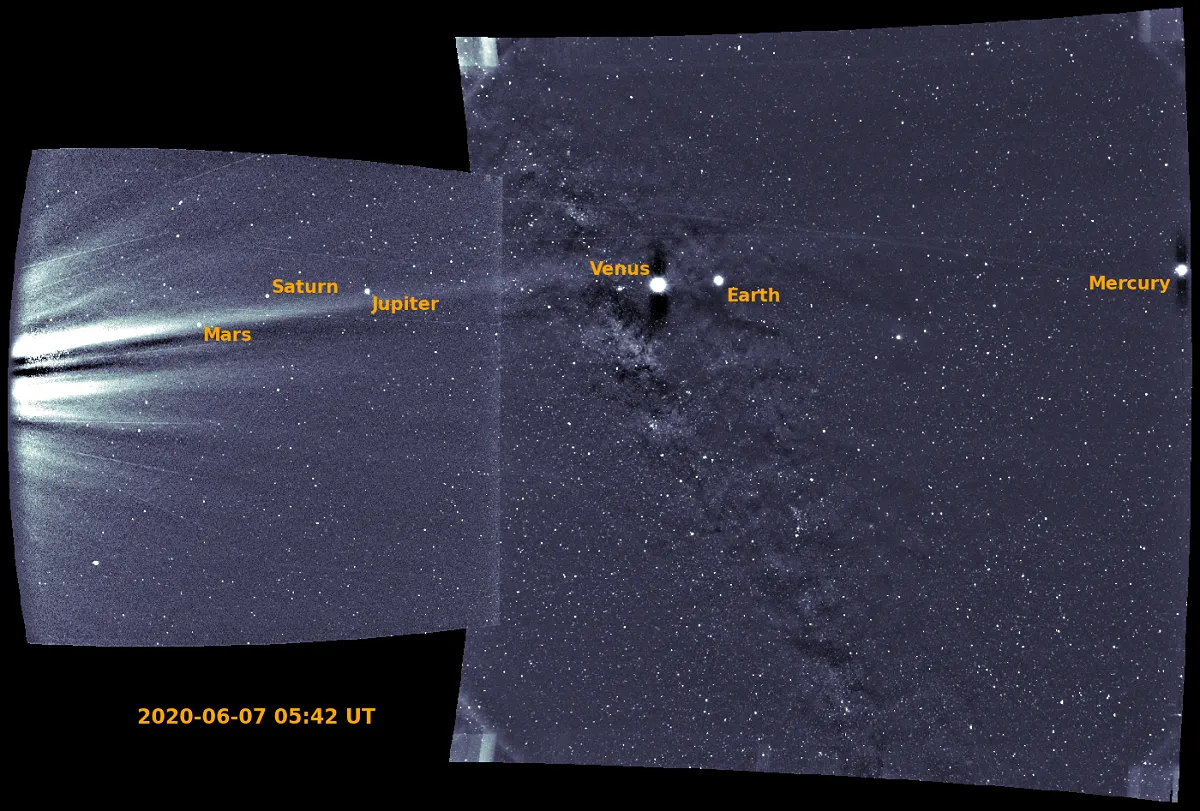
Then, in 2020, the probe managed to take a serendipitous photo of six of the solar system's planets in one shot.
The probe was flying past the sun in June of that year in what was its closest approach at the time, positioned just 11.6 million miles from the sun and about 100 million miles from Earth.
In the photo below, the planets of Mars, Saturn, Jupiter, Venus, Earth, and Mercury can be seen from left to right respectively.
...
The Parker Solar Probe is not the only spacecraft currency studying the sun; indeed, it is not even the newest. In 2020, NASA and the European Space Agency (ESA) launched the Solar Orbiter probe which set out to answer questions like how the sun creates the constantly changing space environment throughout the solar system.

...
View 0 Comments
Submit Correction
View Editorial & AI Guidelines