...

By Jess Thomson
Science Reporter
0
Share
Newsweek is a Trust Project member
See more of our trusted coverage when you search.Prefer Newsweek on Googleto see more of our trusted coverage when you search.
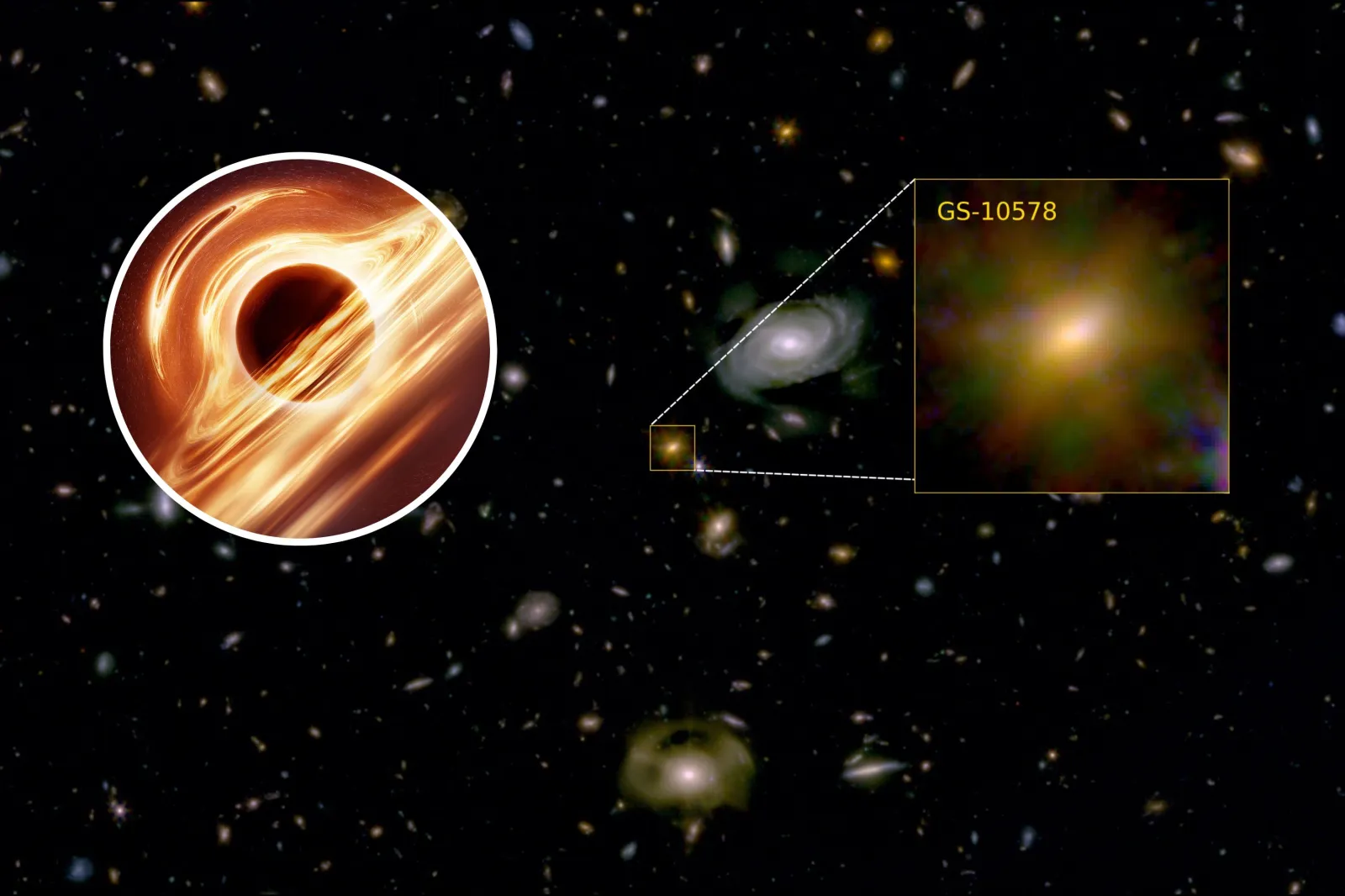
A Milky Way-sized galaxy from the early universe appears to have stopped producing any new stars because a supermassive black hole at its center is blasting out all the material needed for stars to be forged, researchers suggest.
Nicknamed Pablo's Galaxy, it existed about two billion years after the Big Bang and has previously been observed by astronomers to have birthed very few stars.
Now, thanks to the NASA/ESA James Webb Space Telescope, the reason appears to be the supermassive black hole in its center, according to a new paper in the journal Nature Astronomy.
Read More on Science
...
"This study shows that supermassive black holes keep working in 'dead' galaxies, that is in galaxies that have stopped forming new stars. Before falling into the supermassive black hole, gas heats up and releases enormous amount of energy, capable of outshining the entire host galaxy," study co-author Francesco D'Eugenio, a researcher at the University of Cambridge's Kavli Institute for Cosmology, told Newsweek.
"With JWST, we can now see that these monsters keep removing cold gas from their host galaxy, explaining how massive 'dead' galaxies can stay dead when the universe around them is teeming with cold gas—the fuel for forming new stars."
Supermassive black holes are the largest type of black holes, with masses ranging from hundreds of thousands to billions of times that of the Sun. They are typically found at the centers of most large galaxies. The supermassive black hole at the center of the Milky Way, known as Sagittarius A*, has a mass of about 4 million times that of the Sun.
According to the paper, most of the stars in Pablo's Galaxy—officially named GS-10578—formed between 12.5 and 11.5 billion years ago.
"In the early universe, most galaxies are forming lots of stars, so it's interesting to see such a massive dead galaxy at this period in time," co-author Roberto Maiolino, also from the Kavli Institute for Cosmology, said in a statement. "If it had enough time to get to this massive size, whatever process that stopped star formation likely happened relatively quickly."
In the paper, the astronomers describe how they used the JWST to spot that a huge amount of gas is being ejected from the galaxy at speeds fast enough to escape its gravity. The researchers suggest that the supermassive black hole may be pushing out these super-fast and cool winds, ripping away the gas needed for stars to form and starving the galaxy to death.
"Star formation requires dense and cold gas, conditions that can only happen inside galaxies, where the gravitational pull of other stars and gas can squeeze the gas together. However, supermassive black holes heat the gas and [as we show] eject it from the galaxy, where it can no longer form significant numbers of stars," D'Eugenio said.
This phenomenon had been suspected to exist but had not been observed before the JWST.
"We knew that black holes have a massive impact on galaxies, and perhaps it's common that they stop star formation, but until Webb, we weren't able to directly confirm this," said Maiolino. "It's yet another way that Webb is such a giant leap forward in terms of our ability to study the early universe and how it evolved."
Update 9/18/24, 1:49 p.m. ET: This story was updated with comments from study co-author Francesco D'Eugenio.
Do you have a tip on a science story that Newsweek should be covering? Do you have a question about supermassive black holes? Let us know via science@newsweek.com.
References
D'Eugenio, F., Pérez-González, P. G., Maiolino, R., Scholtz, J., Perna, M., Circosta, C., Übler, H., Arribas, S., Böker, T., Bunker, A. J., Carniani, S., Charlot, S., Chevallard, J., Cresci, G., Curtis-Lake, E., Jones, G. C., Kumari, N., Lamperti, I., Looser, T. J., ... Willott, C. J. (2024). A fast-rotator post-starburst galaxy quenched by supermassive black-hole feedback at z = 3. Nature Astronomy. https://doi.org/10.1038/s41550-024-02345-1
View 0 Comments
Submit Correction
View Editorial & AI Guidelines