
By Anna Skinner
Associate News Editor
0
Share
Newsweek is a Trust Project member
See more of our trusted coverage when you search.Prefer Newsweek on Googleto see more of our trusted coverage when you search.
Temperatures could drop as far as 30 degrees below average for several states this week as "unseasonably cool" air dips into the country.
Why It Matters
The summer months have brought countless heat-related warnings from the National Weather Service (NWS), but now most states are expecting below-average temperatures as more autumnal weather rolls in.
Read More on U.S.
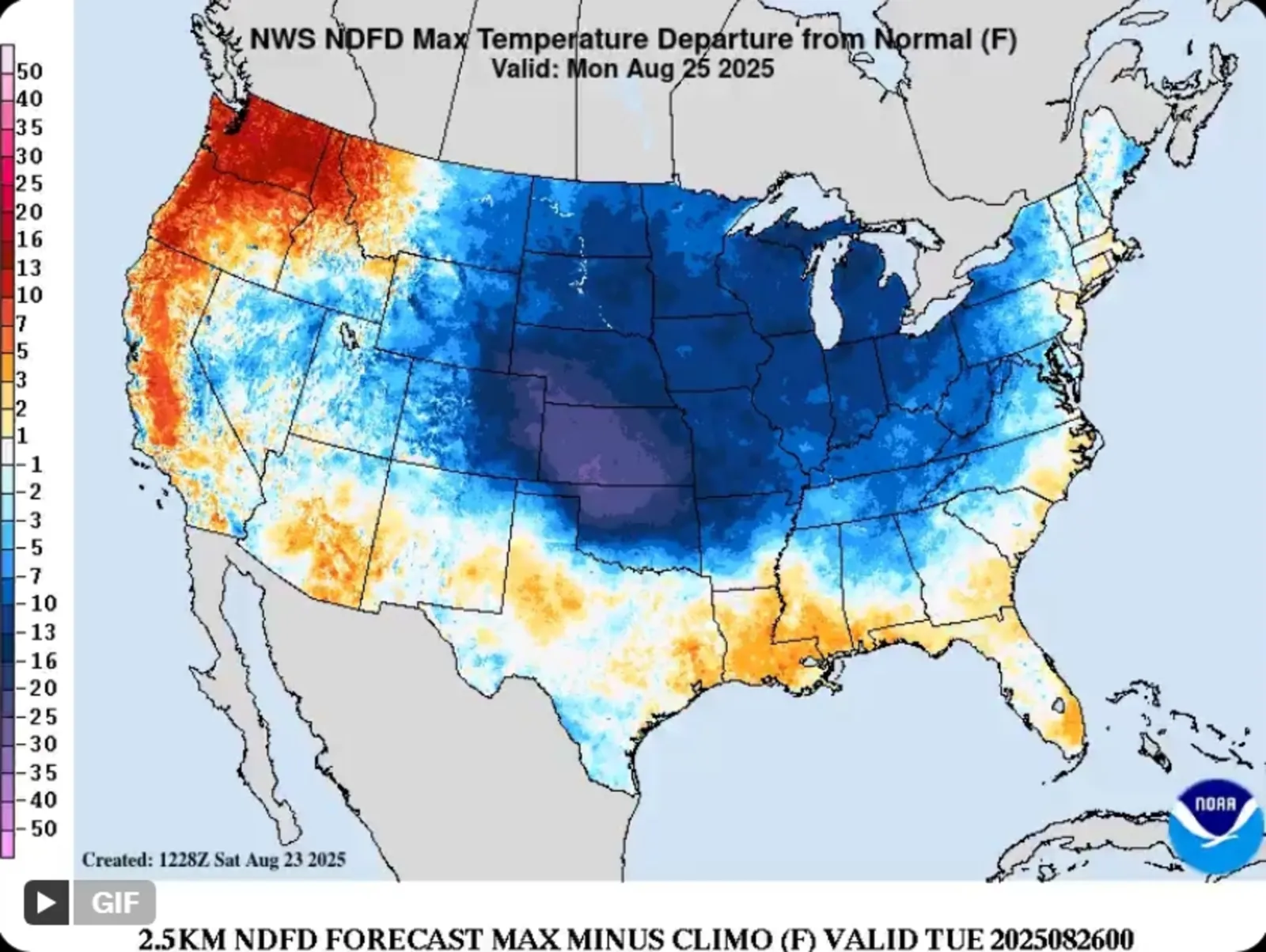
As heat persists across the Pacific Northwest, sparking extreme heat warnings and advisories, states like Wisconsin and Minnesota are issuing frost advisories as the NWS Weather Prediction Center shares a forecast that shows most states seeing a significant dip in their high temperatures this week.
...
What To Know
Northeast Minnesota was under a frost advisory for Sunday night, with a hazardous weather outlook in Wisconsin warning of patchy frost on Monday night as temperatures dropped.
On Saturday, the NWS Weather Prediction Center shared a timelapse to X that showed where the most severe temperature departures would occur this week.
"Fall preview! A strong cold front will bring an unseasonably cool air mass to much of the Lower 48 through the weekend & into next week," the post said. "Forecast high temperatures are expected to be roughly 10 to 30 degrees below average for this time of year."
The timelapse accompanying the post showed that temperatures of around 30 degrees below average could occur in Oklahoma, Kansas, Nebraska, and Colorado on Monday, with widespread temperature departures of around 16 degrees below average for much of the Central, Northern and Midwestern U.S.
By Tuesday, temperatures that are around 30 degrees below average could hit northern Texas and parts of Arkansas, as well as persist across Oklahoma, Kansas, and Texas.
"Some of the coolest weather will definitely be across the central to eastern U.S. this week," NWS Weather Prediction Center lead forecaster Bob Oravec told Newsweek. "Some of the biggest below-average temperature anomalies will be across the Central and Southern Plains, mostly because it's going to be wet there."
He added: "Most of the areas east of Rockies this week will have below average temperatures."
Cool temperatures will persist in the Eastern U.S. into next week, Oravec said.
The most significant temperature variations will remain in that area through Friday, which is as far out as the timelapse goes, with nearly the entire rest of the country experiencing high temperatures that are at least 5 degrees below average.
In addition to cooler temperatures, the cold front is causing heavy rain across parts of the Southeast.
"Having trouble seeing the road? You're not alone," WeatherNation posted on X with a video of heavy rain near Tampa, Florida. "The same cold front that's bringing us refreshing temperatures is also causing heavy rainfall across the Southeast, creating scenes like this and making visibility a major challenge."
What People Are Saying
A hazardous weather outlook issued by the NWS office in Green Bay, Wisconsin: "Patchy frost will be possible in north central Wisconsin late tonight."
NWS Greenville-Spartanburg posted on X: "A cold front will push east of the area later this morning, ushering in a much drier air mass than we are used to. This will be the warmest day of the week as the cooler air settles in behind the cold front. Expect the cooler, drier air mass to stick around."
Meteorologist Max Velocity posted on X: "MASSIVE pocket of cold air is moving into the Ohio Valley and Midwest tonight! Temps are falling 10-20+ degrees behind this strong August cold front!"
The Weather Channel in a post on X: "Record-breaking cold temperatures for the month of August provide many their first taste of fall."
What Happens Next?
People are urged to follow local weather forecasts to know when they should take action to protect tender plants from the cold.
View 0 Comments
Submit Correction
View Editorial & AI Guidelines