...

By Theo Burman
Live News Reporter
0
Share
Newsweek is a Trust Project member
See more of our trusted coverage when you search.Prefer Newsweek on Googleto see more of our trusted coverage when you search.
Geothermal energy from Nevada's Great Basin could supply as much as 10 percent of the United States' electricity needs, according to a newly released assessment by the U.S. Geological Survey (USGS).
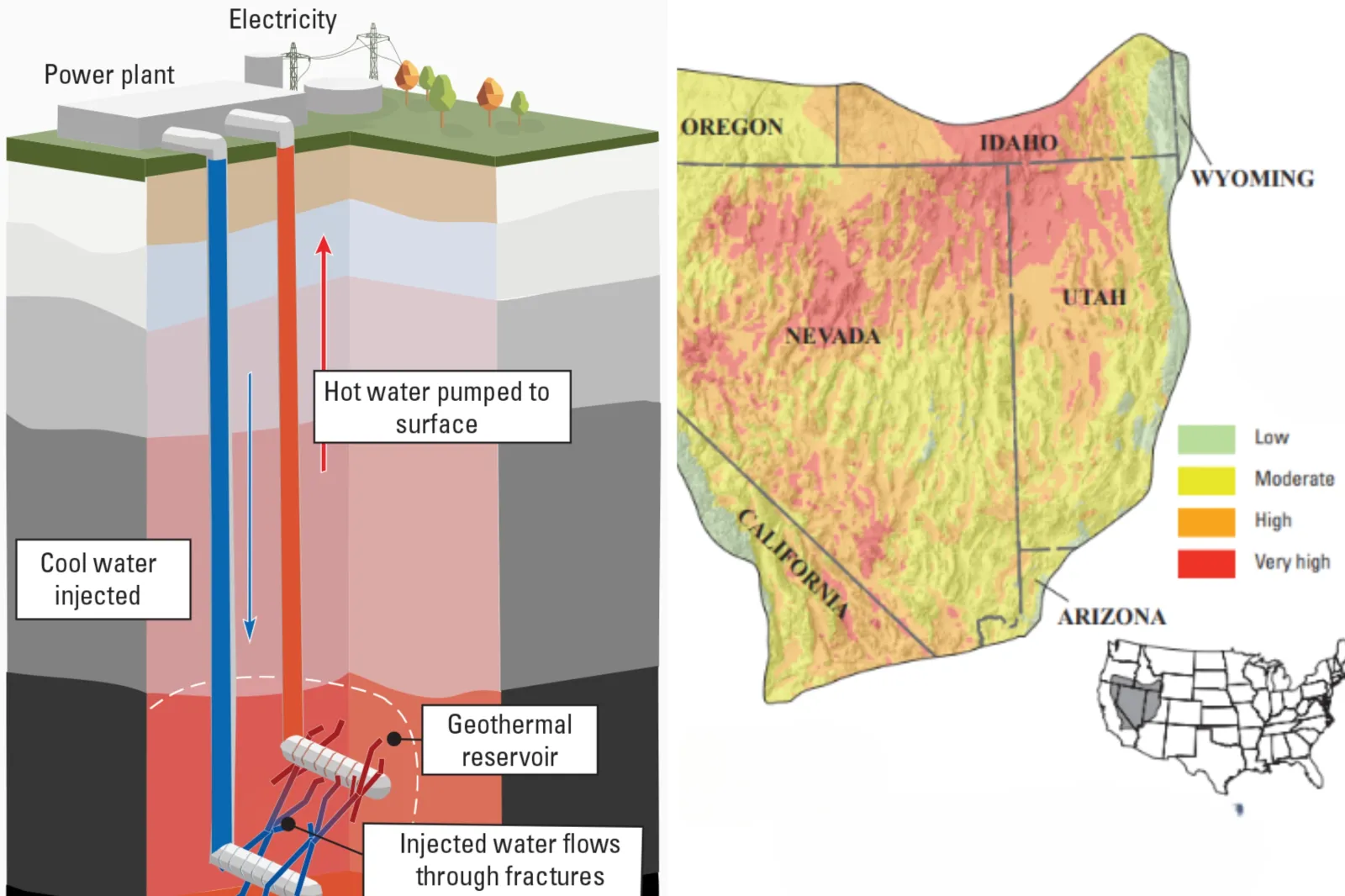
The report estimates the area, which covers the majority of Nevada and extends into parts of Arizona, California, Idaho, Oregon, Utah and Wyoming, could generate 135 gigawatts of baseload power, if enhanced geothermal systems are deployed at scale.
What To Know
The U.S. currently generates about 3.9 trillion kilowatt-hours of electricity annually. A geothermal contribution of 10 percent, as projected, would mean the Great Basin alone could provide the equivalent of 390 billion kilowatt-hours, which would roughly match the current output of the U.S. nuclear sector.
Read More on News
Why It Matters
The USGS evaluation was conducted under the 2020 Energy Act, which saw the agency explore new ways of generating efficient energy from untapped resources.
It was part of the Joe Biden administration's goal of a zero-emissions grid by 2035.
The report, published on Wednesday, includes newly developed maps of underground heat flows and refined extraction models that suggest geothermal deployment could increase the basin's productivity.
Under the proposed model, water would be pumped as deep as 3.7 miles underground, heated by natural geological formations, and returned to the surface to generate electricity.
...
In addition to the mapping effort, the USGS used artificial intelligence and machine-learning techniques to improve data modeling and resource estimation speed. The agency said it plans to apply these methods next in North Dakota, to the Williston Basin.
However, fully realizing the energy output would require significant investment in geothermal energy technology.
This type of energy was one of the only renewable resources to be included in President Donald Trump's initial energy policy change, which saw fossil fuels like oil and gas receive new priority.
The Great Basin spans portions of Arizona, Nevada, Utah, California, Oregon, Idaho, and Wyoming. It was one of the last contiguous U.S. regions to be mapped in the 19th century.
What People Are Saying
Sarah Ryker, acting director of the USGS, said in the report: "USGS assessments of energy resources are about the future. We focus on undiscovered resources that have yet to be fully explored, let alone developed.
"We launched this work in the Great Basin because of the area's history of geothermal activity—and we found even more potential for baseload power than had previously been known. Leveraging this work along with artificial intelligence and machine-learning techniques will help us assess the entire nation's potential for geothermal energy with greater speed and accuracy."
What Happens Next
Following the Great Basin study, the USGS will conduct a similar geothermal resource assessment in North Dakota's area of the Williston Basin.
View 0 Comments
Submit Correction
View Editorial & AI Guidelines