...

By Ellie Cook
Senior Defense Reporter
0
Share
Newsweek is a Trust Project member
See more of our trusted coverage when you search.Prefer Newsweek on Googleto see more of our trusted coverage when you search.
The U.S. has tested out new drones and missiles in combat for the first time since launching the initial strikes on Iran more than four weeks ago.
At least one new ballistic missile, plus an attack drone modeled on one of Iran's designs, have been debuted by U.S. forces in battle since the opening salvos of the U.S.-Israeli bombardment of Iran from February 28.
American troops may have also used two newly developed anti-drone systems in the face of persistent Iranian attacks, experts suggest.
Read More on World
U.S. and Israeli operations are well into their fifth week, strikes continuing on the capital, Tehran, in the early hours of Wednesday. Iranian media also reported attacks on steel facilities in central and southwestern Iran.
...
At least 14 people were injured in Israel after several Iranian missile barrages into Wednesday, emergency services said, while Iran launched fresh attacks on the United Arab Emirates (UAE), Qatar and Bahrain.
President Donald Trump suggested the U.S. could finish operations against Tehran in "two weeks, maybe three," telling reporters on Tuesday a deal with Iran to end the war is "irrelevant" despite his repeated threats of overwhelming assaults on Iran if its top officials don't ink an agreement.
Trump has said the U.S. is engaged in negotiations with Iran, which Tehran has denied. Iranian Foreign Minister Abbas Araghchi told broadcaster Al Jazeera he was in contact with Trump's special envoy, Steve Witkoff.
Meanwhile, thousands of elite U.S. soldiers and Marines arrived in the Middle East this week on top of the roughly 50,000 troops already deployed in the region, which observers see as a sign the U.S. could dramatically escalate the war by launching ground operations on Iranian territory.
With no clear path to a resolution, the war has forced a wedge between the U.S. and its allies in Europe keen to stay out of the conflict, attracting the White House's ire.
Precision Strike Missile (PrSM)
Just days into the war, the commander of U.S. forces in the Middle East, Admiral Brad Cooper, hailed the use of the Precision Strike Missile (PrSM) in combat as a "historic first."
The ground-launched ballistic missile also appeared to star in a montage posted by the U.S. Central Command (CENTCOM) in early March.
The PrSM replaces the decades-old Army Tactical Missile System (ATACMS), designed to hit valuable targets like airfields up to 300 kilometers (186 miles) away.
Batches of these older missiles have been funneled to Ukraine to use against Russian assets, and like other types of ballistic missile, the weapon's trajectory after it's launched makes it difficult for air defenses to intercept.
Defense giant Lockheed Martin, which manufactures the PrSM, says the missile can strike targets more than 300 miles away, significantly further than the distance ATACMS missiles can travel.
Different variants are under development, with a version able to travel upward of 600 miles in the pipeline.
The U.S. military can change whether the missile detonates when it hits the target, or just before. If the warhead explodes just before it slams into a target, the fragments are scattered over a wider area, causing more damage.
A spokesperson for Lockheed Martin referred queries about the deployment of PrSM to the U.S. government. The Pentagon directed questions toward CENTCOM, which only referred to publicly available updates.
Analysis published on Sunday claimed the U.S. had used a PrSM in an attack that struck a school and sports hall next to a military site in southern Iran on February 28.
Footage showing a pair of strikes on the small city of Lamerd, set just back from the Persian Gulf, was consistent with the physical features of PrSM, The New York Times reported.
More than 20 people were killed in Lamerd, local media reported at the time. The attack coincided with a deadly strike that killed at least 168 people at a school in the city of Minab on the same day, after which a preliminary investigation reportedly found U.S. Tomahawk cruise missiles responsible.
CENTCOM spokesperson, U.S. Navy Captain Tim Hawkins, said the military said the reports a PrSM had hit Lamerd were "false," and U.S. forces had not carried out any strikes on February 28 within 30 miles of the city.
Footage circulating online did not show a PrSM but likely depicted an Iranian cruise missile, Hawkins said.
The U.S. has relatively small stockpiles of PrSMs, which have only been in production for a few years, said Mark Cancian, a retired U.S. Marine Corps Reserve colonel and a senior adviser with the U.S. think tank, the Center for Strategic and International Studies.
Low-Cost Uncrewed Combat Attack System (LUCAS)
Also put to the test in real-life conditions for the first time is the Low-Cost Uncrewed Combat Attack System, often referred to by its snappier acronym, LUCAS.
LUCAS, made by the Arizona-based SpektreWorks, is a cheap drone filled with up to 40 pounds of explosives that detonate when the drone hits targets like power grids or buildings that are not heavily fortified, as major military sites often are.
It's modeled on Iran's own Shahed drones, which Tehran has used against American allies across the Gulf since late February. Russian forces have for years carried out Shahed drone attacks on Ukrainian cities, menaced by the low buzzing sound the drones make as they swoop toward their target. Russia also now manufactures its own version.
The U.S. military announced a squadron dedicated to LUCAS back in early December, part of a new drone-focused task force investigating how best to use cheap unmanned systems, dubbed Scorpion Strike.
The U.S. Navy said it had successfully launched a LUCAS one-way attack drone from a ship for the first time little over two weeks later.
In a nod to their performance in the Middle East, Emil Michael, the Pentagon's top official for defense research and engineering, said the LUCAS had worked "very well so far."
"It's proven out to be a useful tool in the arsenal," he said in mid-March.
But it's still hard to tell how widely LUCAS is currently being used, Robert Tollast, a research fellow for land warfare at the U.K.-based Royal United Services Institute (RUSI) think tank in London, told Newsweek.
Counter-Drone Tech
U.S. forces may have also used two anti-drone systems for the first time in combat during the war, Cancian told Newsweek.
The Coyote, developed by defense company Raytheon, and a similar system called Roadrunner, manufactured by defense startup Anduril, are both touted as cheap ways of intercepting enemy drones.
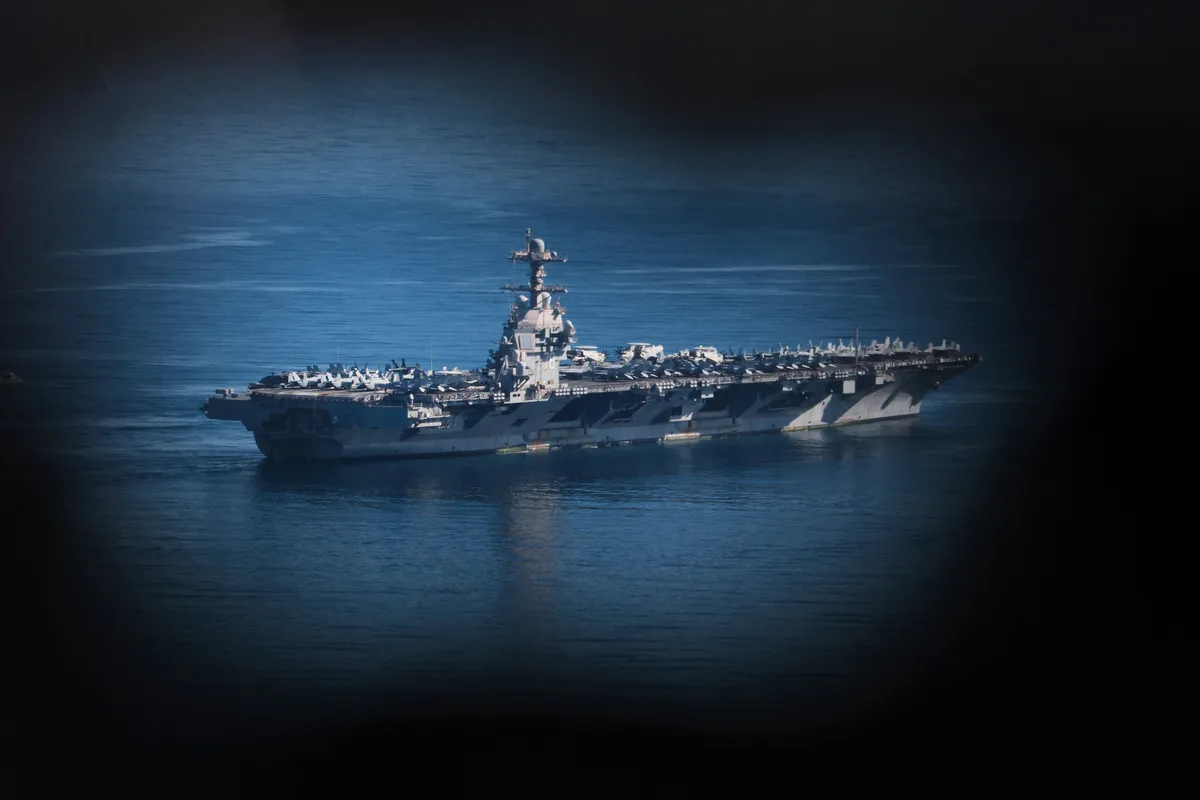
The U.S. Navy said last year several warships that travel with the USS Gerald R. Ford—one of two aircraft carriers the U.S. deployed to the Middle East weeks ago—would be fitted with Coyotes and Roadrunners.
However, specialist outlet, Air and Space Forces Magazine, reported in early 2023 the Coyote had shot down two drones attacking a U.S. base in southeastern Syria, citing an anonymous U.S. official. Newsweek has not been able to independently confirm this report, but some experts point to footage appearing to show Coyote in action in Syria and Iraq since 2022.
CENTCOM has also acknowledged Coyote is being used by its troops in the Middle East.
Anduril has said it is a "heavy" participant in the Iran war, mostly for defending against Iranian threats. But the company's chief business officer, Matthew Steckman, has publicly declined to say which systems are deployed to tackle Iranian Shahed drones.
Anduril declined to comment. Raytheon has been contacted for comment.
View 0 Comments
Submit Correction
View Editorial & AI Guidelines