10
Loading video...

By Pandora Dewan
Senior Science Reporter
0
Share
Newsweek is a Trust Project member
See more of our trusted coverage when you search.Prefer Newsweek on Googleto see more of our trusted coverage when you search.
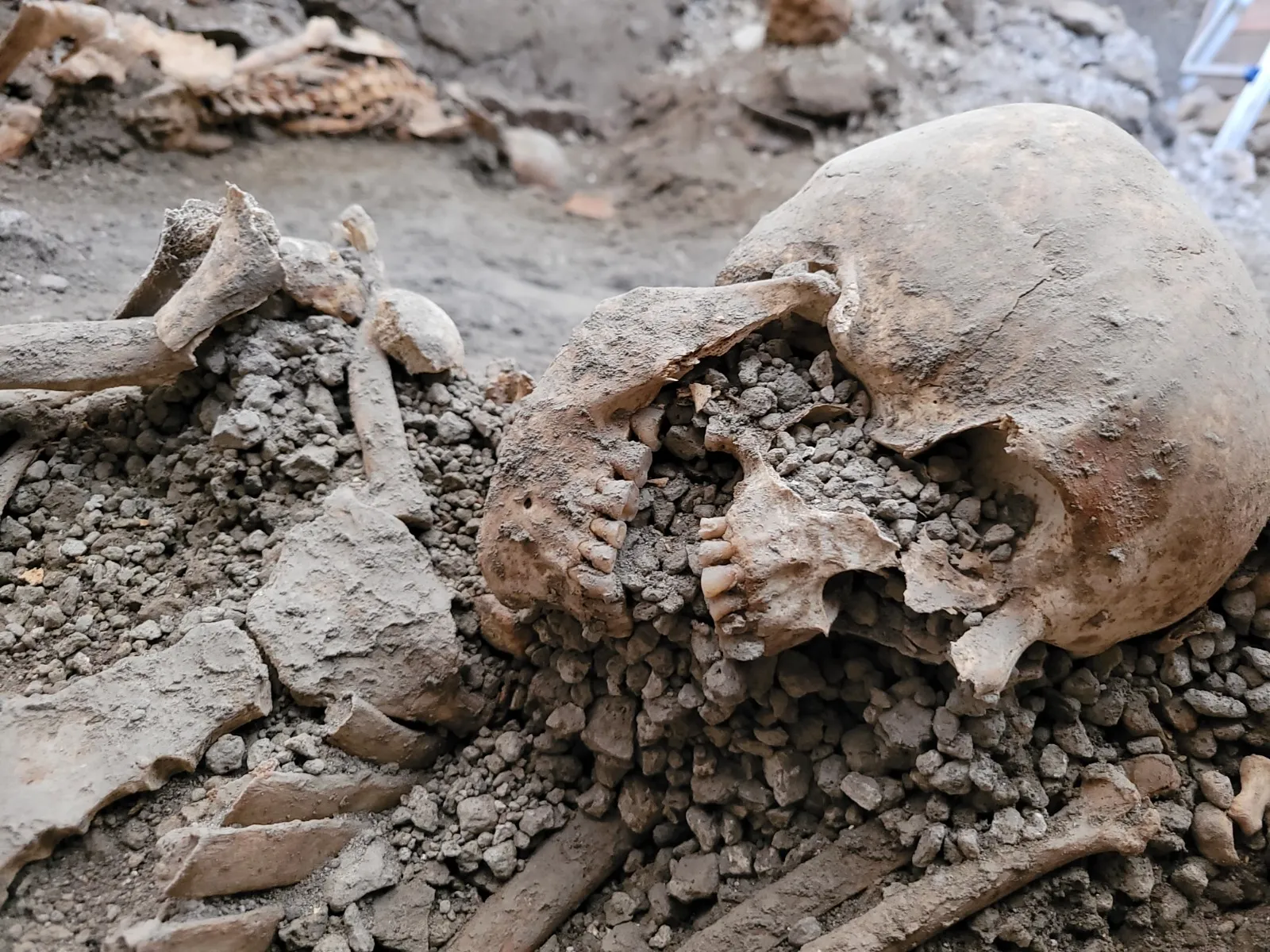
Archaeologists have shed new light on the destruction of Pompeii after finding two human skeletons crushed beneath the ruins of a fallen building.
The two men are believed to have died in an earthquake that accompanied the eruption of Mount Vesuvius nearly 2,000 years ago, before the onslaught of lava and volcanic ash pouring from the volcano buried the city for good.

...
Read More
Secrets of Sealed Egyptian Animal Coffins Revealed for the First Time4 min read

Hoard of Roman Coins Found After Hiker Stumbles Across Lost Ancient Site4 min read

Grave of Elite Bronze Age Brothers With Mystery Disease Discovered5 min read

"The discovery of the remains of these two Pompeians in the context of the construction site in the Insula of the Chaste Lovers shows how much there is still to discover about the terrible eruption of AD 79," Italian Minister of Culture Gennaro Sangiuliano said in a statement.
The two skeletons were uncovered during the excavation of a block of houses known as the Insula of the Chaste Lovers. Their bodies were found along one side of a utility room, buried beneath a collapsed wall. One of the men had raised his arm against the rubble, in an apparent vain attempt to protect himself from the falling stone.
After further examination, it became clear that the two individuals had likely died as a result of multiple traumas caused by the partial collapse of the building.
...
The eruption of Mount Vesuvius in 79 AD destroyed Pompeii in just over 24 hours, killing an estimated 15 to 20 percent of the city's population. The area was smothered in volcanic ash, which buried the Roman city for centuries.
The ruined city lay unseen and untouched until it was rediscovered in 1748 by a surveying engineer. Together with accounts from the time by Pliny the Younger, archaeologists have been able to piece together a rough timeline of the eruption, as well as a snapshot into Roman life.
"Modern excavation techniques help to shed light on the inferno that over two days descended on Pompeii and led to the complete destruction of the city, killing many of its inhabitants: men, women and children," Gabriel Zuchtriegel, director of the Pompeii Archaeological Park, said in a statement. "Using analysis and the latest methodologies, we can gain an insight into the final moments of those who lost their lives."

...
The earthquake that killed these two men likely took place during the early stages of the eruption, before the hailing pumice stones and pyroclastic flows from the volcano caused even further devastation.
Sangiuliano said that discoveries like this "confirm the necessity of continuing scientific investigation and excavations" in the area.
"Pompeii is an immense archaeological laboratory that has regained vigor in recent years, astonishing the world with the continuous discoveries brought to light."
View 0 Comments
Submit Correction
View Editorial & AI Guidelines