...

By Alice Gibbs
Senior Reporter
0
Share
Newsweek is a Trust Project member
See more of our trusted coverage when you search.Prefer Newsweek on Googleto see more of our trusted coverage when you search.
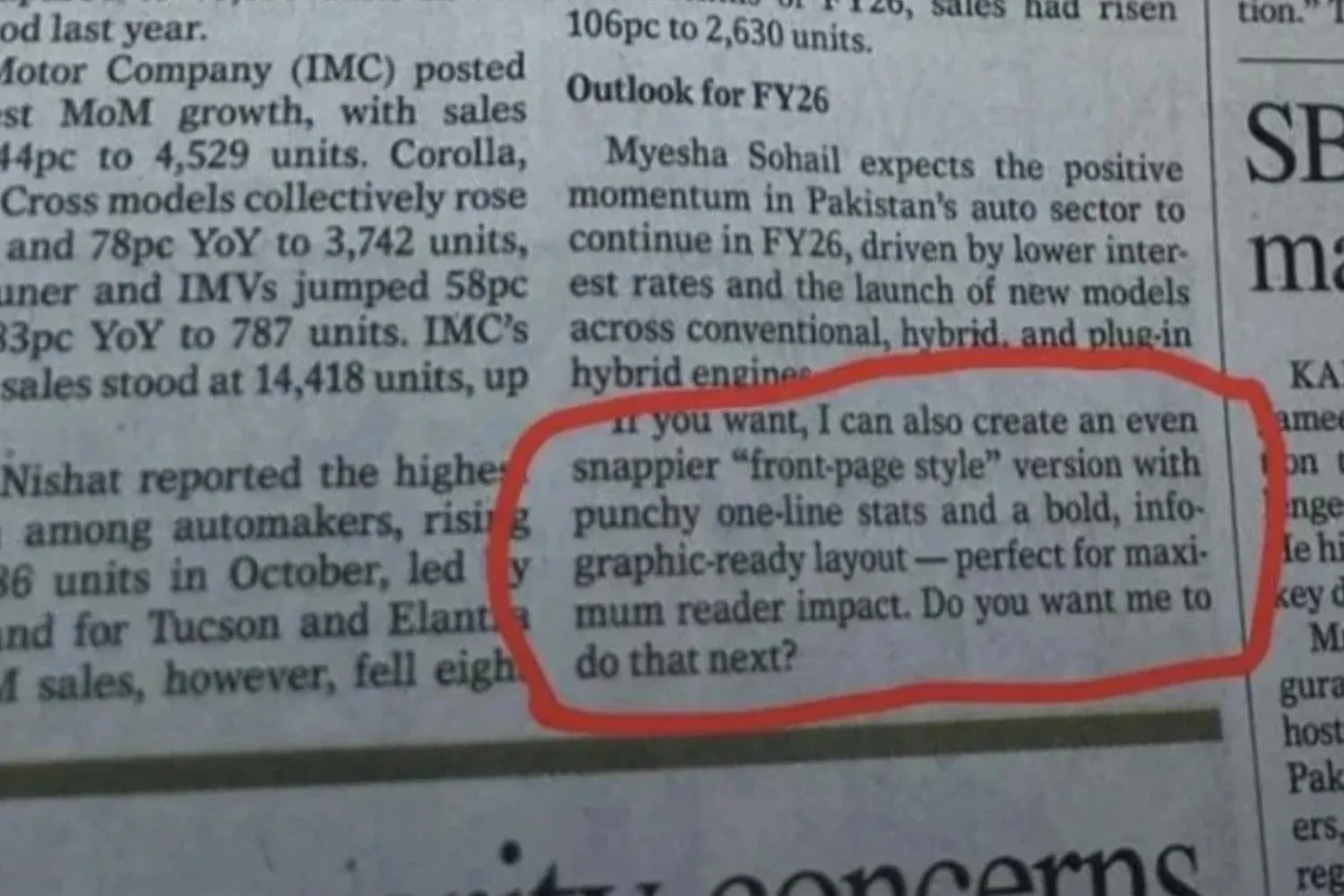
Pakistan’s leading English-language daily, Dawn, issued a public apology on Tuesday after accidentally printing an AI-generated editing prompt inside one of its business stories.
The mistake appeared in the November 12 print edition in a report titled "Auto sales rev up in October." The article’s final paragraph contained an unmistakable AI prompt: "If you want, I can also create an even snappier ‘front-page style’ version with punchy one-line stats and a bold, infographic-ready layout perfect for maximum reader impact. Do you want me to do that next?"
The mistake has gained viral attention online in posts across Reddit and X where people have expressed confusion and frustration about how it was printed in the paper.
Read More on Life
One Reddit user wrote that Dawn had "copied ChatGPT word for word," though this claim has not been independently verified.
The text, clearly not intended for publication, made it to print before being removed from the digital version where Dawn issued a full apology that read: "This report published in today’s Dawn was originally edited using AI, which is in violation of our current AI policy. The policy is available on our website and can be reviewed here.
"The original report also carried AI-generated artefact text from the editing process, which has been edited out in the digital version," it added.
"The matter is being investigated, and the violation of AI policy is regretted.—Editor"
They copied chat gpt word by word
byu/MediaDog69 inWellthatsucks
AI in the Newsroom
The mistake adds to a growing list of global newsrooms grappling with AI’s rapid integration into editorial workflows.
In May, both the Chicago Sun-Times and at least one edition of The Philadelphia Inquirer mistakenly published summer book lists filled with made-up books by famous authors. Only five of the 15 titles listed were real books.
Writer Marco Buscaglia accepted responsibility for the mistake, and said it was partly generated by Artificial Intelligence, according to 404 Media.
A recent report published by the Reuters Institute and University of Oxford shared the findings of a survey across six countries (Argentina, Denmark, France, Japan, the U.K. and U.S.) about the use of AI in news and journalism.
While 6 percent of respondents said that they regularly received news via generative AI, only 12 percent said they would be comfortable with fully AI-generated news. That rose to 21 percent when there was a "human in the loop" and 43 percent when a human led the process, with some help from AI. Some 62 percent of respondents said they were comfortable with entirely human-made news.
When asked if they thought newsrooms used AI, 75 percent of respondents said they thought news media always, often or sometimes used AI, only being outranked by search engine companies and social media companies.
Earlier this year, a Microsoft report identified the 40 professions considered most and least susceptible to disruption from generative AI.
Among these, several media and communication jobs, including news analysts, journalists and public relations specialists were also listed as jobs with tasks AI can perform effectively.
Newsweek’s AI Policy
Newsweek is experimenting with AI-based tools to help journalists work faster, smarter and more creatively.
But under Newsweek’s editorial guidelines, such tools must be used in an ethical way and under the full supervision of journalists at every step of the process.
Tools that Newsweek is evaluating include those that can sift through large databases quickly or spot news in the torrent of information. We are using tools that can speed the process of taking the verified information reported by journalists, refining the text to smooth out language and making additional checks to ensure the content is error free.
All text is rechecked by a human editor before publication, and as part of our commitment to responsible journalism, journalists are held responsible in exactly the same way as they would be for any other piece of journalism. AI is never accountable to our readers. We are.
You can read Newsweek's editorial guidelines and AI policy in full here.
View 0 Comments
Submit Correction
View Editorial & AI Guidelines