...

By Jess Thomson
Science Reporter
0
Share
Newsweek is a Trust Project member
See more of our trusted coverage when you search.Prefer Newsweek on Googleto see more of our trusted coverage when you search.
The mystery of a strange, milky-white streak of light that sometimes peeks out from the northern lights have finally been solved.
This light, formally named a "structured continuum emission", may actually be a result of heating in the atmosphere triggered by the auroras, according to a new paper in the journal Nature Communications.
This grey-white light has long been observed by scientists, but until now, had never been fully explained.
Read More on Science
"You'd see this dynamic green aurora, you'd see some of the red aurora in the background and, all of a sudden, you'd see this structured—almost like a patch—grey-toned or white toned-emission connected to the aurora," study co-author and University of Calgary physicist professor Emma Spanswick, said in a statement.
"So, the first response of any scientist is, 'Well, what is that?'"
...
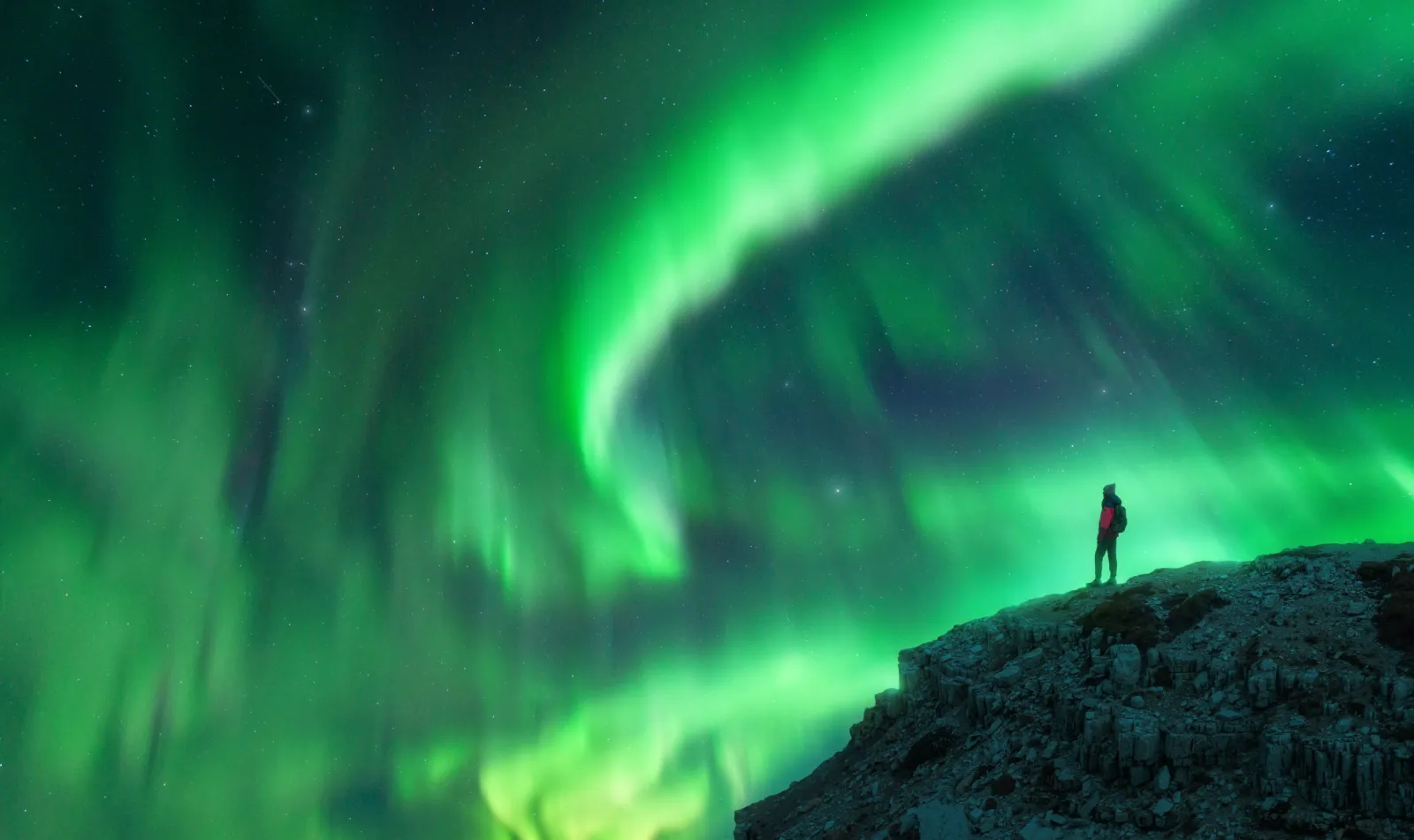
The northern and southern lights are caused by particles from the sun—either in the constant solar wind or in huge surges during a coronal mass ejection—hitting the atmosphere of the Earth.
Earth's magnetic field acts as a protective shield, deflecting most of the solar wind away from the planet, however, near the Earth's poles, the magnetic field lines converge and allow some of the solar wind particles to enter the Earth's atmosphere, especially during a geomagnetic storm.
"The more intense the storm, the further from the poles the aurora will be seen, as the Earth's magnetic field gets more overloaded with charged particles," Jonti Horner, an astrophysics professor at Australia's University of Southern Queensland, told Newsweek.
Once inside the atmosphere, these charged particles collide with gas molecules in the atmosphere. Green light is produced by oxygen molecules at lower altitudes, while red is made by high-altitude oxygen molecules. Blue and purple lights are produced by nitrogen molecules, often at lower altitudes.
Special new sensor technology enabled true-color imaging of the night sky, allowing the researchers to study the white light in detail.
"These grey-toned structures range in size from 10s to 100s of km. They are embedded in and/or preceded by active auroras (high contrast structures varying on a timescale of minutes less), and their spectra contain distinguishable auroral emission components, indicating that auroral energy deposition is a key factor in their formation," the researchers wrote in the paper.
The researchers suggest that these white lights arise due to a combination of heating in the ionosphere due to the surrounding aurora, as well as the chemiluminescence of some other gases in the atmosphere, possibly nitrogen dioxide.

...
Among the researchers was UCalgary undergraduate Josh Houghton who had initially been hired as an intern in the lab.
"I was still learning things at the time," he said in the statement. "I had just started my internship, and I very quickly got involved. It's just very, very cool."
These discoveries came after there was a fresh interest in researching another strange atmospheric phenomenon—a narrow band of purplish or white light across the sky named the 'Strong Thermal Emission Velocity Enhancement', or 'STEVE'.
"There are similarities between what we're seeing now and STEVE," said Spanswick. "STEVE manifests itself as this mauve or grey-toned structure.
"To be honest, the elevation of the spectrum between the two is very similar but this, because of its association with dynamic aurora, it's almost embedded in the aurora. It's harder to pick out if you were to look at it, whereas STEVE is separate from the aurora – a big band crossing the sky."
This study shows that the northern lights and the ionosphere may be much more complex than we initially assumed.
"The dynamic variation, meso-scale morphology, and contextualization with auroral structures, distinguish our observed continuum emission structures from those previously-studied ambient NO2 continuum or STEVE," the researchers wrote in the paper.
"Our findings demonstrate that the coupling among auroral processes, the plasma, and the neutral atmosphere can unfold at meso-scales and is more complex than previously reported."
Do you have a tip on a science story that Newsweek should be covering? Do you have a question about the northern lights? Let us know via science@newsweek.com.
References
Spanswick, E., Liang, J., Houghton, J., Chaddock, D., Donovan, E., Gallardo-Lacourt, B., Keenan, C., Rosehart, J., Nishimura, Y., Hampton, D., & Gillies, M. (2024). Association of structured continuum emission with dynamic aurora. Nature Communications, 15(1). https://doi.org/10.1038/s41467-024-55081-5
View 0 Comments
Submit Correction
View Editorial & AI Guidelines