10
Loading video...

By Dan Perry
0
Share
Newsweek is a Trust Project member
See more of our trusted coverage when you search.Prefer Newsweek on Googleto see more of our trusted coverage when you search.
Imagine a world in which Donald Trump runs for president in 2024 on an explicit platform of demolition. He openly campaigns on dismantling the administrative state, treating alliances as liabilities, discarding NATO, abandoning Ukraine, aligning with autocrats and burning down the global order the United States built and led for decades.
Imagine that this version of Trump wins decisively—by ten points in the popular vote. And that one action-packed year later, amid the smoldering ruins of the transatlantic alliance, he remains highly popular in the United States.
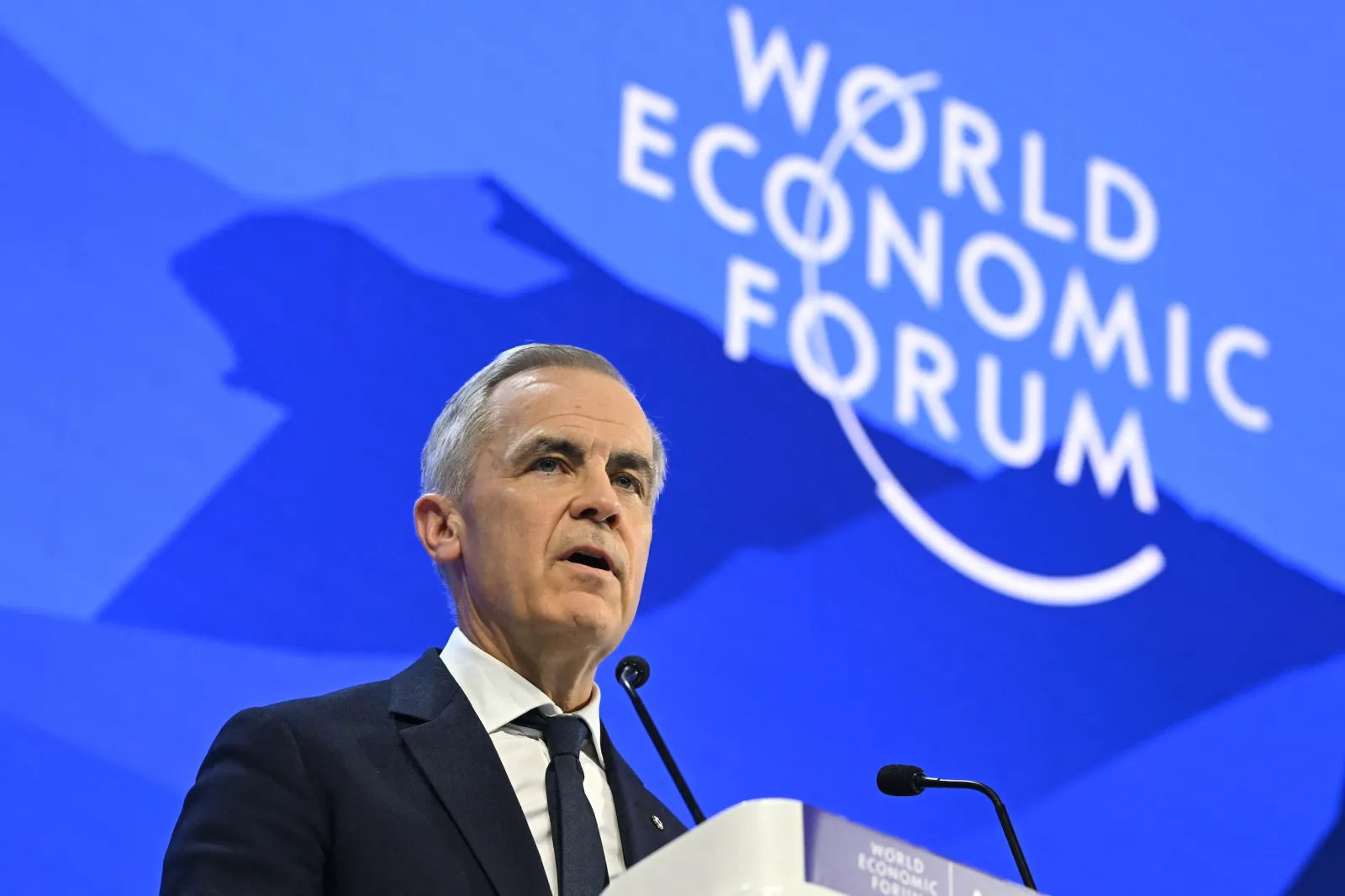
In that world, when Canadian Prime Minister Mark Carney stands up at the World Economic Forum in Davos, Switzerland, and declares that we are not living through a transition but a “rupture”—that the American-led order is finished, that the “middle powers” must band together and build something entirely new with which to confront America and China—his diagnosis is grim, but coherent and incontrovertible. America had clearly chosen to end the system it once upheld.
Read More on Opinion
...
That is a grim scenario, to be sure, but not the one we actually live in.
What actually happened is messier and murkier. Trump ran primarily on “wokeness,” grievance about the 2020 election and retribution against his many enemies. He ran against a weak Democratic candidate and won, not by ten points, but by 1.5 percent, with under 50 percent of the popular vote. And a year into his presidency, he is less popular than any modern president at the same point in office.
And yet, last week, Carney got up at Davos, and acted as if we are living in the fantasy scenario described above. He spoke of "a rupture in the world order, the end of a pleasant fiction and the beginning of a harsh reality." He has received plaudits the world over. But he is guilty of fundamental error.
Carney’s rhetoric of a “rupture” presupposes a legitimacy that does not exist. It inflates Trump's narrow, accidental victory into a civilizational verdict. It treats the temporary capture of the U.S. government by the likes of Stephen Miller as some permanent realignment. And in doing so, it risks talking the liberal order out of existence precisely when it is under strain—but not defeated.
Carney’s position also subtly weakens Europe at the moment Europe most needs to assert itself. By treating the world as a landscape of “middle powers,” he implicitly demotes Europe from a unified geopolitical actor into a loose collection of secondary states. That’s an assist to Trump and Vladimir Putin, for whom a fragmented Europe is easier to coerce and ignore. Europe’s power lies precisely in its unity: its market size, regulatory reach, institutional depth and moral authority as the last major defender of classical liberalism. Weakening it is foolish if the goal is to combat Trumpism.
I am not arguing that the postwar order should be treated as sacred or frozen. It can, and should, be reformed. Burden-sharing in the Western alliance has been unequal for decades. Global institutions require more legitimacy, accountability and representation. Trade rules must adapt to supply-chain vulnerability and strategic resilience. But updating a flawed system is not the same as declaring it a “pleasant fiction” and abandoning it.
That said, Carney’s gambit raises an important question: even if Trump’s victory was narrow and his governance unpopular, can the damage he does be reversed?
When it comes to the Trump administration's concrete policies, Carney's alarmism is clearly premature. Almost everything Trump is doing—or can do—on trade, alliances, climate, multilateral institutions and possibly even Ukraine is reversible. Sanctions can be reimposed. Treaties can be reentered. Funding can be restored. Commitments can be renewed. Institutions can be rebuilt. None of this is cost-free, and none of it is painless, but it is not irreversible. The United States has lurched before—Jim Crow, Vietnam, the Iraq War—and corrected course. Repair requires time, seriousness and honesty. It requires a leadership willing to say plainly: we were wrong.
The deeper concern is Trump's effect on American credibility. What will America’s allies think once they have seen that the United States can elect a leader willing to torch the system—and that tens of millions of Americans were willing to hand him the match?
That damage is real. Trust, once broken, is not restored by a single election. Allies will hedge and doubt. They will ask whether the next American election could once again place the entire order at risk. In that sense, Trump has revealed a true structural vulnerability. His recklessness, foolishness and venality have tainted his successors before anyone even knows who they will be.
But even here, the talk of an irreversible "rupture" goes too far.
Credibility is not binary; it is rebuilt over time through behavior, not rhetoric. And more importantly—and this is where the Davos pessimism becomes self-indulgent—the shock to American reliability may force a long-overdue correction that ultimately strengthens the international system.
Europe, in particular, has spent decades underinvesting in its own defense while proclaiming strategic autonomy. If Trump’s return finally compels Europeans to take responsibility for their own security, that is not the death of the liberal order but rather its maturation. An alliance in which Europe is less dependent on the United States is a healthier one.
None of this absolves America. If Democrats return to power in 2028, the United States will have to do something it has historically struggled to do: apologize without any ifs, ands or buts.
Meanwhile, it would be premature—and dangerous—to assert that the system is already over, that America’s stumble is its final fall and that the only sophisticated response is to start over from scratch.
The United States has lost not its power, but its way. The real danger today is not that the liberal order cannot survive America’s stumble, but that too many people, trying too hard to be realistic, are far too ready to surrender to Trump.
Dan Perry is the former Cairo-based Middle East editor and London-based Europe/Africa editor of the Associated Press, the former chairman of the Foreign Press Association in Jerusalem, and the author of two books. Follow him at danperry.substack.com.
The views expressed in this article are the writer's own.
View 0 Comments
Submit Correction
View Editorial & AI Guidelines