10
Loading video...

By Giulia Carbonaro
Senior Reporter
0
Share
Newsweek is a Trust Project member
See more of our trusted coverage when you search.Prefer Newsweek on Googleto see more of our trusted coverage when you search.
Mayor Zohran Mamdani’s campaign promise to open a city-run grocery store in every borough of New York City is not the radical "socialist" idea that his critics have suggested—but the revival of a nearly century-old policy by a former Republican mayor, Fiorello La Guardia.
One of Mamdani’s key campaign promises last year, in the face of rising grocery prices in New York City, was to introduce a "network of city-owned grocery stores focused on keeping prices low, not making a profit." At the time, a March 2025 poll showed that two-thirds of New Yorkers supported the initiative—even as opponents called it a "Soviet-style disaster in waiting," as reported by the New York Post.
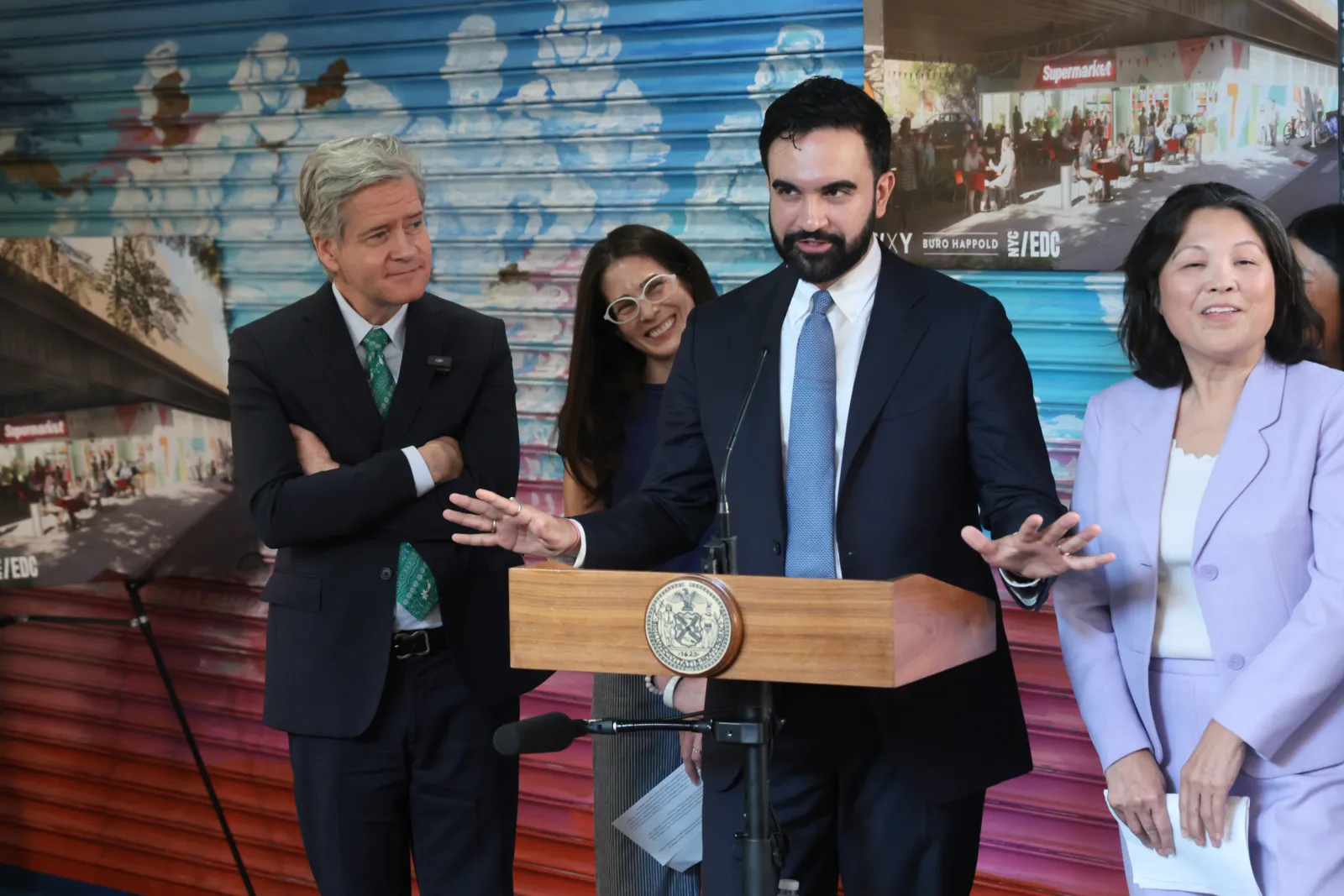
The first of five city-owned grocery stores planned by the Mamdani administration, which will sell essential products to residents for a discounted price, is expected to open in the Bronx next year. Another one is expected to open in East Harlem by 2029. The city still has to confirm where the stores in Brooklyn, Queens, and Staten Island will be located.
Read More on News
...
The initiative has been praised by groups working to fight hunger in the city, like the West Side Campaign Against Hunger, and two City Council members, Elsie Encarnacion and Yusef Salaam of East Harlem.
But it has also found fierce opponents in local business owners and economists worried about the impact that competition from the city-run groceries could have on private stores. Frank Garcia, chairman of the Multicultural Business Coalition, argued that the city’s discounts would "put our businesses out of business," as reported by The New York Times.
Last year, Nallely De Jesus, the vice president of a company that runs a Super Fresh and four other markets in the South Bronx, told the New York Post that creating city-run grocery stores was "a socialist move that goes against the American Dream."
But La Marqueta—the first site for Mamdani’s municipal grocery store program—was actually first opened as Park Avenue Retail Market in 1936 by La Guardia, a Republican mayor that led the city from 1934 to 1946.
A Nearly Century-Old Legacy: NYC-Run Food Markets
Back when La Guardia, the son of Italian immigrants, was mayor, East Harlem was home to a large community of Jewish and Italian immigrants.
Park Avenue Retail Market was established to replace East Harlem’s chaotic system of open-air pushcarts and transform vendors—predominantly Jewish and Italians—into merchants, offering them a retail space, as La Guardia wanted to "professionalize" peddlers. At the same time, the markets wanted to give local residents access to fresh food in a cleaner, more sanitary environment.

...
Between 1936 and 1941, La Guardia built a network of 10 city-run indoor food markets designed to make groceries more affordable and clean up the city’s streets. Six of these markets still survive today, owned and managed by the city’s Economic Development Corporation; others faded as private supermarkets took over.
Unable to compete with the rise of mega-supermarkets in the city, refrigeration, and suburban distribution networks, many of the La Guardia-era food markets were closed or consolidated.
The legacy of La Guardia’s initiative is still alive in Arthur Avenue Market, in the Bronx, La Marqueta in East Harlem, and Certo Market in Brooklyn. Among the six public markets still operating as such these days are Jamaica Farmers Market. Moore Street Market, and Essex Market. La Marqueta has since then become a central hub for the Latinx and Caribbean communities.
Now, Mamdani is promising to revive this legacy—instead of introducing a new "socialist" initiative, the 32-year-old mayor is returning to the city’s early food policies.
Newsweek contacted Mamdani’s office for comment by email on Tuesday morning and is awaiting a reply.
How Will Mamdani’s City-Run Grocery Stores Work?
The Mamdani administration has announced five planned city-owned grocery stores, one for each of the city’s boroughs, which the mayor said on Monday will sell vegetables, meat, bread, milk, and other essentials at a 30 percent discount. The city will build the stores and waive rent and property taxes, but it is moving to select private operators who will run them.
Once running, the stores would set prices for staples—including produce, meat, seafood, pasta, bread, yogurt, butter, nuts, rice, and beans—once a month based on market-rate average prices across the city.

...
"No weekly fluctuations, nor sticker shock at the checkout line," Mamdani said during a press conference on Monday. "Not for our seniors living on fixed incomes, nor for the parents who rely on a regular supply of apple slices to keep toddler tantrums at bay."
Other products will be sold at regular market prices. The city-run stores will not sell hot food to not compete with the local bodegas.
The city-run grocery stores should allow Mamdani to keep his campaign promise of making New York more affordable for its residents bogged down by the high cost of living in the city, and enable them to purchase fresh, healthy food in their neighborhoods.
According to an analysis by the city’s Economic Development Corporation, the discount on the "core basket" of goods will allow shoppers to save an average of about $90 per month or roughly $1,000 per year.
Contact Newsweek editors on this story: Ben Kelly and James Debens
window.addEventListener('message',function(e){ var f=document.getElementById('dtd-promo'); if(f&&e.data&&e.data.dtdPromoHeight&&f.contentWindow===e.source)f.style.height=e.data.dtdPromoHeight+'px'; });

View 0 Comments
Submit Correction
View Editorial & AI Guidelines