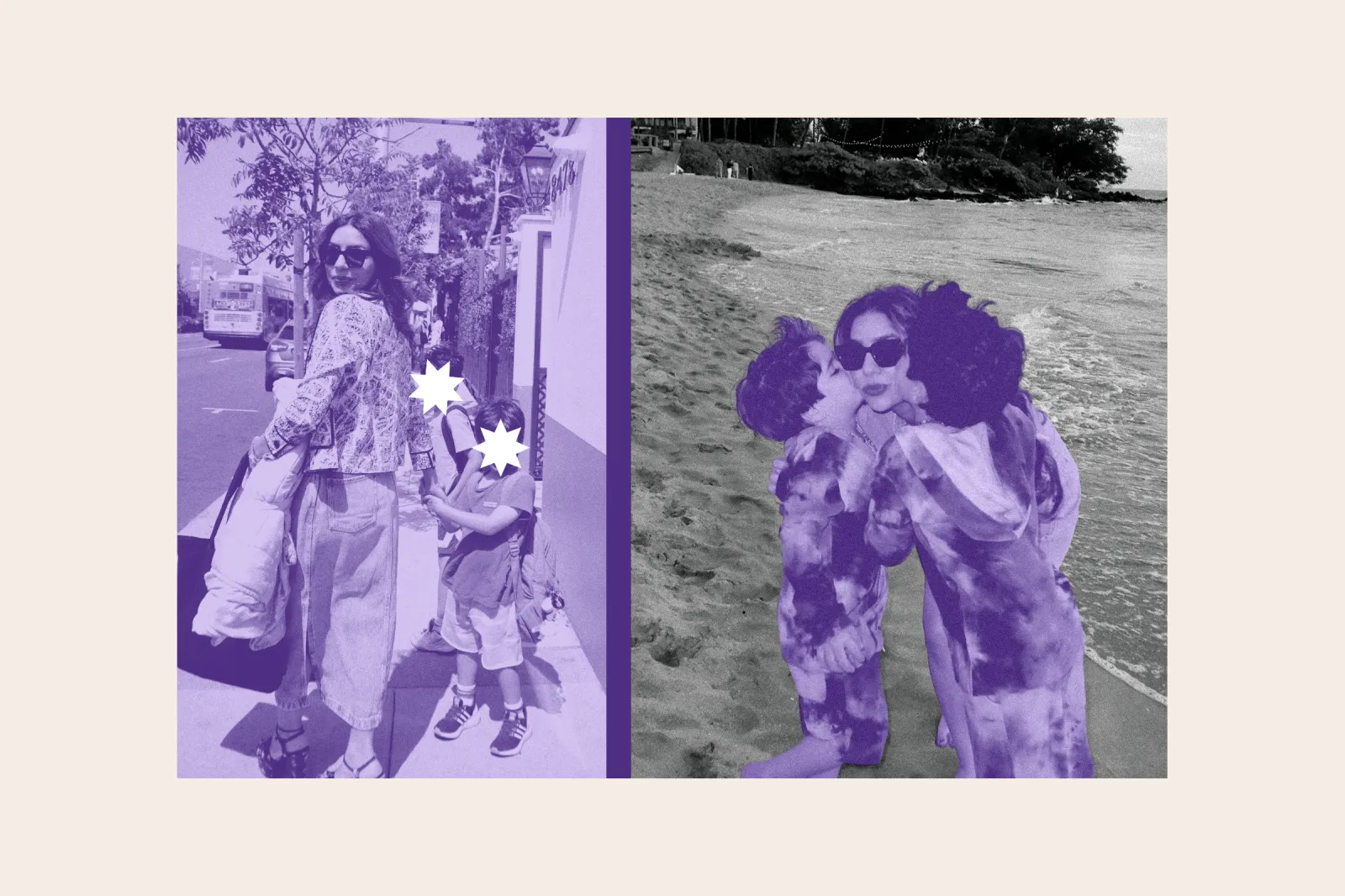
Photo-illustration by Newsweek/Courtesy of Deepika Chopra

By Deepika Chopra
0
Share
Newsweek is a Trust Project member
See more of our trusted coverage when you search.Prefer Newsweek on Googleto see more of our trusted coverage when you search.
My 2-year-old son was lying on an operating table while I stood outside the room staring at a red light that read “Surgery in Progress.” Only days earlier he had been wrestling with his older brother on our living room floor, shrieking with laughter and demanding snacks every 15 minutes. Now a team of surgeons was working inside his small body while my husband and I were outside the room, suspended in the particular kind of time that exists only in hospitals—the kind that stretches and folds in on itself, where every passing nurse makes your heart jolt.
The doctors had prepared us as carefully as they could. They told us his condition was extraordinarily rare. Fewer than two children in a million receive this diagnosis each year. They walked us through the procedure step by step.

...
Read More on My Turn
My Neck Hurt After a Massage. 10 Days Later Terrifying Truth Was Revealed7 min read

I Gave My Nephews a Bow and Arrow for the Holidays—With One Condition. I Didn’t Expect Their Reaction7 min read

I Love My Husband. I’m Also Angry At His Epilepsy for What It’s Done to Our Family7 min read

What they could not give us was a future we could relax into. They couldn’t tell us whether the illness would return, the treatment would work, and they certainly couldn’t map out what came next.
As a parent, you grow accustomed to small risks. You accept scraped knees, playground tumbles and fevers in the middle of the night. You memorize the number of your pediatrician and stock your cabinet with children's pain relievers. You assume that most crises will resolve with time and reassurance.
I also felt like I should have been more equipped to handle this situation. I’m a behavioral scientist and health psychologist, widely known as the Optimism Doctor. My work has centered on helping people tolerate uncertainty and build resilience in the face of it. In that hallway, none of my tools worked.
Within days, our home had transformed into something unrecognizable. Medical terminology replaced bedtime stories. Insurance phone calls replaced casual dinners. I found myself Googling phrases I had never imagined needing to understand. I held my son’s stuffed animal against my face because it still smelled like his shampoo—proof that a version of our life existed beyond the sterile doors in front of us.
The months that followed were defined by treatment. Every morning, we gave him a chalky steroid so bitter he gagged before it reached the back of his throat. We mixed it into yogurt, syrup and even ice cream. He detected it every time. My husband and I developed a silent choreography, one of us bracing his flailing arms while the other delivered the dose. When it was over, we would sit on the kitchen floor holding him until his sobs slowed.

...
But it was the Tuesdays that broke me. For more than a year, every Tuesday morning we drove to the hospital while most people were still finishing their first cup of coffee. Every Tuesday, a nurse accessed the port in my toddler’s small chest to deliver the medication that was keeping him safe.
We created our own rituals. My son wore his “magic shoes”—paint-splattered Vans sent to him by a woman I had never met in person, an online friend who wanted him to have something to wear to the hospital that made him feel brave. The movie Cars became his comfort film. Before all of this, we had been careful about screens, but on Tuesdays, none of that mattered. Cars played on a continuous loop while nurses prepared syringes and saline and sterile drapes. That movie created a small, glowing pocket of childhood in a room that had none. I’m grateful to Lightning McQueen in ways I cannot explain.
There was another moment we learned to anticipate: the nurse preparing to access the port. My husband and I would go quiet without discussing it, our bodies holding a single shared breath, silently praying they would get it on the first try.
But the days when it took multiple attempts—when they had to reposition the needle, when his face shifted from confusion to panic and his eyes searched mine for an explanation—those were the days that broke me.
Some mornings he cried and twisted away. Other mornings he insisted on pushing the syringe himself, his tiny hand steady with a determination no 2-year-old should have to possess. Talk about a jolt of perspective.
By Monday afternoon, my nervous system was already bracing for Tuesday. And every Tuesday night, after the house finally went quiet, I made the bathtub my place.
All day I held it together—through the drive home, through unpacking the hospital bag, through answering “How did it go?” in a voice that sounded almost normal. The bath was where my body told the truth. I turned on the water and cried until it went cold. My son had his comfort movie; I had the sound of the water filling the tub. Two rituals. Two nervous systems trying to survive the same day of the week.
During this time, I was also writing a book about optimism. When uncertainty entered my own family, I did what many high-functioning people do: I tried to outwork it. I journaled more, repeated more affirmations, searched for more recovery stories, curated what I allowed myself to read. On the surface I appeared composed. Inside, my body remained on constant alert.
I realized that what I wanted was not optimism, it was certainty. But unfortunately, no amount of positive thinking can produce certainty. The shift came late one night when I heard a line in a forgettable movie: “The end is none of your business.”

...
I realized I had been sacrificing the only time I actually had in an attempt to control an outcome that did not belong to me. From then on, I began to embrace real optimism.
Real optimism is not the belief that everything will be OK. Grounded in evidence, it’s the decision to remain fully engaged with your life even when you cannot guarantee the outcome.
We had survived hospital corridors, medication battles and days that once seemed impossible to imagine. We had survived Tuesdays. That was more important than any affirmation.
Today my son is healthy, although we don’t know what the future holds. He runs across the same living-room floor where this story began. He wrestles with his brother and leaves sticky fingerprints on every surface in our house.
For a long time, the arrival of Tuesday still triggered a phantom surge of adrenaline, as if my body had not yet received the message that we no longer had to go. Healing, I learned, is not only about the body that was treated. It is also about the nervous system that learned to live in vigilance.
Slowly, almost imperceptibly, Tuesdays finally changed. Once again, they became school drop-offs and work meetings and ordinary dinners—the kind of mundane, forgettable hours that once felt completely out of reach. Now, when Tuesday comes, I pause with a quiet recognition: We are here, and we are safe today.
Not because the future is guaranteed, but because we learned how to live inside the uncertainty and still show up for our lives. What I carry from that year is not the illusion that nothing hard will happen again. It is the lived, cellular knowledge that when it does, I will meet it. I can do hard things.
That is what real optimism is. Rather than a personality trait or a mood, it’s a practice. It’s a willingness to stay alongside uncertainty. That has made all the difference.
Psychologist Deepika Chopra, known as the Optimism Doctor, is the author of The Power of Real Optimism*, out March 10, 2026.*
Do you have a personal essay you want to share with Newsweek? Send your story to MyTurn@newsweek.com.
View 0 Comments
Submit Correction
View Editorial & AI Guidelines