

By Hannah Parry and Robert Birsel
0
Share
Newsweek is a Trust Project member
See more of our trusted coverage when you search.Prefer Newsweek on Googleto see more of our trusted coverage when you search.
The Orionid meteor shower peaked on Tuesday night, between midnight and dawn.
Named after the constellation of Orion, where the meteors appear to originate from, they are actually debris left behind by the Halley’s Comet as it orbits the sun. While the comet itself is currently far away and not visible to us, Earth's passage through the trail of dust it leaves behind creates a light show in our skies every October.
Tuesday evening is expected to offer excellent views of the shower in most areas because the new moon will ensure dark, clear skies, according to the American Meteor Society.
What To Know
- The best place to view tonight's shower is in a dark location, away from city light pollution, and preferably without any cloud cover.
- Viewers can expect to see anywhere between 10 and 20 Orinoids per hour at their peak. They will appear to originate from the three bright stars of Orion's belt but can then be spotted across the night's sky.
- Meteor showers are visible to the naked eye so there is no need for binoculars or a telescope to observe them, though you will need to allow your eyes to adjust to the dark.
- This year the Orionid meteor shower is active from October 2 to November 7, peaking in the early hours of October 22 between midnight and dawn
- Halley's Comet last passed the Earth in 1986 and is due to return in July 2061. It was first discovered by English Astronomer Edmund Halley, who was also the first to calculate its orbit and predicted its return (which takes place approximately every 76 years.)
This live blog is closed.

...
Oct 22, 2025 at 05:36 AM EDT
Meteors Spotted Over the United Kingdom
But some stargazers reported seeing fewer Orionids than they had expected.
@HollyJGreen Hi Holly. Last night was very uneventful re the Orionids. Here's one under a plane and I think on the horizon there's a couple of planets emerging but I'm not sure which they could be. Shot at Reculver Nr Herne Bay facing N/E.#Orionids #hernebay pic.twitter.com/kFyqRV6tYz
— Paul 'Donk' Darby (@DarbsUK) October 22, 2025
Oct 22, 2025 at 05:27 AM EDT
Meteors over Brazil
Meteors recorded over Brazil on October 16.
A chuva de meteoros Oriônidas está ativa desde 2 de outubro até 7 de novembro, com pico esperado para esta semana. No vídeo, um registro feito quinta-feira (16), em Taquara (RS). Crédito: Observatório Heller & Jung.#OlharDigital #ChuvadeMeteoros #MeteorShower pic.twitter.com/YDrVTLN0G6
— Olhar Digital (@olhardigital) October 20, 2025
Oct 22, 2025 at 03:16 AM EDT
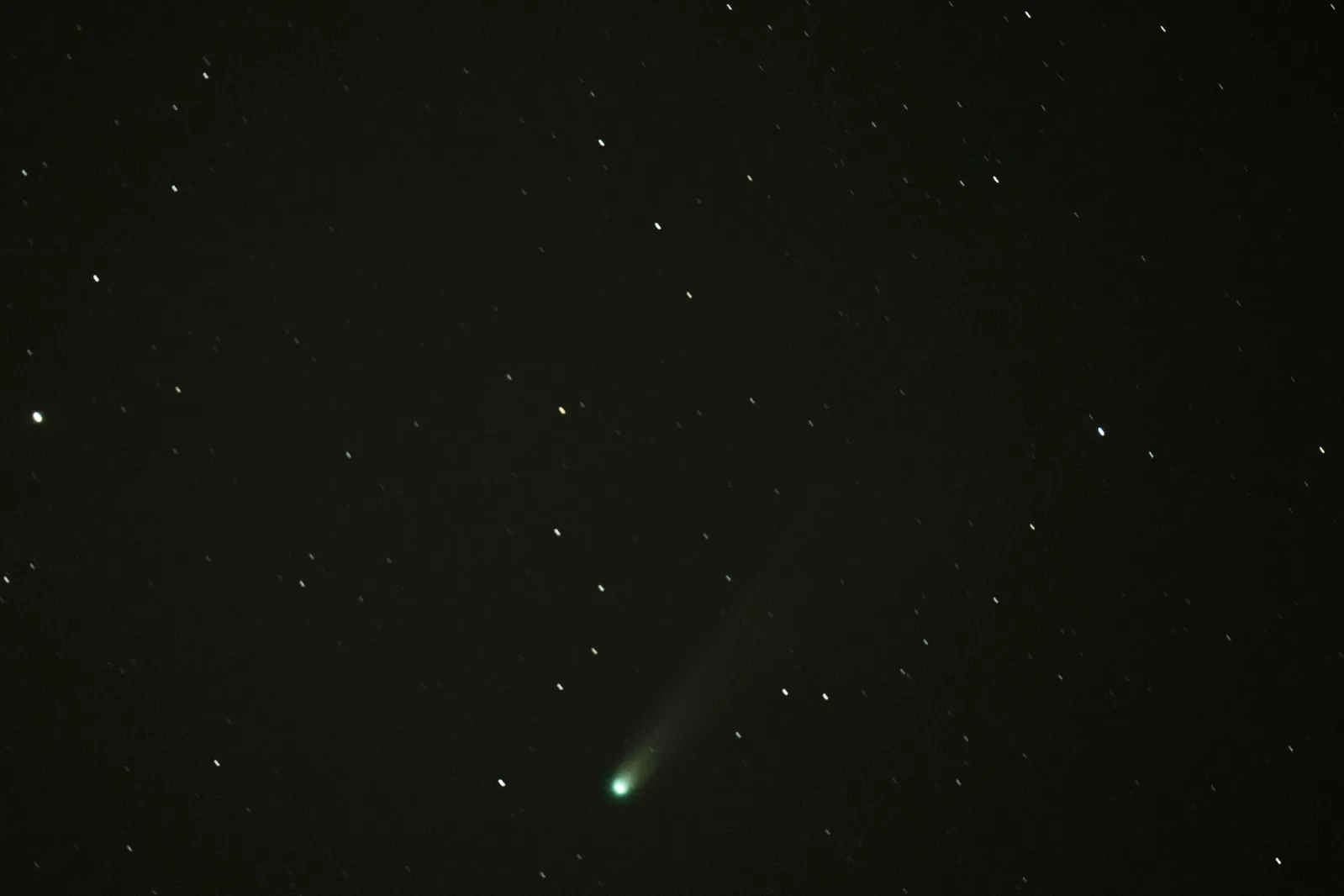
Comet Lemmon Streaks Across the Night Sky
Comet Lemmon was only discovered in January and is now making its closest approach to Earth. If you miss it, it won’t be back for more than 1,000 years.
...
Oct 22, 2025 at 02:42 AM EDT
Ireland Expecting the Orionid Meteor Shower
Photo shows clear night sky over Ireland.
Orionid Meteor Shower, live from Termonfeckin
What a night for it
(30sec exposure) pic.twitter.com/28qixI5pFm
— Conor Nolan (@ConorN11) October 21, 2025
Oct 22, 2025 at 01:37 AM EDT
The Meteor Shower Will Also Be Visible in the Southern Hemisphere
Astrophysicist Sara Webb said Australians and others in the southern hemisphere will get their chance to see the meteors.
"With the Orionids peaking this week, it's a perfect opportunity to head outside, away from city light and soak up the universe for an hour or so," Webb told Australia’s 9News network.
"Look in the direction of the Orion constellation, a very easy one to spot with your naked eye, or via the help of a night sky app."
Oct 22, 2025 at 12:12 AM EDT
Clouds likely to obscure some views of the night sky
Rain clouds over parts of the east coast are likely to obscure views of the sky on Tuesday night and clouds were also reported to be increasing over central California.
But skies are clear in many other parts of the U.S., weather maps showed.
Oct 21, 2025 at 09:33 PM EDT
The Other Halley’s Comet Meteor Shower
Debris left by Halley’s Comet leads to two major meteor showers every year, the Orionids and the Eta Aquarids.
The next peak for the Eta Aquarids, which are called that because they appear to emerge from the constellation Aquarius, will be early on May 5, 2026.
Oct 21, 2025 at 08:39 PM EDT
When is the New Moon in October 2025?
The new moon is today, October 21, at 8.25 a.m. ET, when the moon is directly between the Earth and the Sun, which is why the dark skies are ideal for spotting meteors.
The next new moon will be on November 20 at 1.47 a.m. ET.
Oct 21, 2025 at 07:56 PM EDT
Could Halley’s Comet collide with Earth?
The chance of Halley’s Comet colliding with Earth is extremely low. Its orbit is well understood and stable, and it follows a predictable path around the Sun every 76 years. When it last passed close to Earth in 1986, it came no closer than about 15 million kilometers (9.3 million miles).
Scientists continuously track Halley’s Comet and other near-Earth objects with great precision. While comets and asteroids do occasionally pose impact risks, Halley’s orbit does not currently intersect Earth’s path in a way that would cause a collision anytime soon. So, while it’s a fascinating and sometimes spectacular visitor to our skies, there’s no real danger of Halley’s Comet hitting Earth in the foreseeable future.
Oct 21, 2025 at 07:51 PM EDT
What is Halley’s Comet? What to Know
Halley’s Comet is the most famous periodic comet, visible from Earth roughly every 76 years.
Named after British astronomer Edmond Halley in 1705, it was the first comet recognized to return in a regular orbit. Its appearances have been documented for over 2,000 years, with its last visible pass in 1986. During that visit, it was studied up close by the European Space Agency’s Giotto probe, marking a milestone in comet exploration. The comet is expected to return in 2061, when it will once again be visible to the naked eye.
Even when it’s not visible, Halley’s Comet makes its presence known through two meteor showers: the Orionids in October and the Eta Aquariids in May.
These showers occur when Earth passes through the dusty trails left behind by the comet, producing streaks of light as debris burns up in the atmosphere. Though Halley’s next appearance is still decades away, it continues to play an active role in our skies every year.
Oct 21, 2025 at 07:33 PM EDT
IN PICTURES: Orionids meteor shower over Serbia

...
Oct 21, 2025 at 07:26 PM EDT
What, when is the next meteor shower?
The next major meteor shower after the Orionids Meteor Shower is the Southern Taurids Meteor Shower, which will peak around November 4‑5.
Southern Taurids is a minor annual meteor shower that produces a relatively low number of meteors per hour—usually around 5 to 10. However, it is known for its bright fireballs, which are large, slow-moving meteors that can outshine the stars.
This shower is caused by debris left behind by Comet 2P/Encke, which orbits the Sun every 3.3 years. As Earth moves through the scattered particles along the comet’s path, some of that debris enters our atmosphere and burns up, creating visible meteors. The shower appears to radiate from the constellation Taurus, which is why it's called the Taurids.
The best time to observe them is after midnight, when Taurus is higher in the sky and Earth is facing directly into the stream of debris.
Following that, the Leonids Meteor Shower will peak on November 16‑17, and then the much stronger Geminids Meteor Shower is set for December 13‑14.
Oct 21, 2025 at 07:20 PM EDT
How might tonight’s moon impact viewing of the Orionids meteor shower?
Tonight offers near-perfect conditions for viewing the Orionids meteor shower, thanks to the absence of moonlight due to the new moon.
The new moon phase provides less than 1 percent illumination, meaning it won’t brighten the sky or interfere with visibility.
This creates an ideal backdrop for spotting even the faintest meteors as Earth passes through the debris trail left by Halley’s Comet. The Orionids typically peak after midnight, and with no moonlight to compete with the stars, viewers can expect a clearer, darker sky for optimal meteor watching.
Oct 21, 2025 at 07:07 PM EDT
What is the new moon phase?
A new moon is the phase of the Moon when it is positioned between the Earth and the Sun, with its sunlit side facing away from us. As a result, the Moon appears invisible or nearly invisible from Earth.
During this phase, the Moon rises and sets with the Sun, meaning it is up during the day and not visible at night. Because no direct sunlight is reflecting off the side of the Moon we can see, the sky remains darker at night—making it the best time for stargazing and watching meteor showers, like the Orionids, since there's no moonlight to interfere with visibility.
Oct 21, 2025 at 07:00 PM EDT
What part of the U.S. will have the clearest gaze of the Orionids meteor shower?
The Orionids meteor shower is not limited to specific regions but should be viewable across the entire United States.
The only two factors that could affect the view of the showers is light pollution and poor weather.
That means that the best part of the U.S. to view the Orionids this year is likely remote or rural locations, especially in the Western and Central U.S., because many parts of the West and Mountain states have lower light pollution, increasing visibility.
Weather reports for tonight show that the best regions to watch the shower will be in the West, South and Midwest. New England and the Rust Belt are expected to have some cloud cover which could affect the views of the sky.
Oct 21, 2025 at 06:36 PM EDT
WATCH: How to watch the Orionids meteor shower
Oct 21, 2025 at 06:25 PM EDT
Five essentials for watching the Orionids meteor shower
The Orionid meteor shower is set to give viewers a spectacular display this evening. But to ensure the best viewing experience, bring these five essentials to keep warm and comfortable.
Blanket or Sleeping Bag
To stay warm and comfortable while lying on the ground or in a chair. October nights (like during the Orionids) can get cold, especially in open areas.
Reclining Chair or Mat
A reclining lawn chair, camping chair, or even a yoga mat lets you lie back and look up at the sky without straining your neck.
Warm Clothes or Layers
Even in warmer seasons, nights can be chilly. Bring layers, gloves, and a hat to stay warm during long periods of sitting still.
Red Flashlight or Headlamp
A red light helps you see in the dark without ruining your night vision—essential for spotting faint meteors. Avoid using bright phone screens.
Snacks and Drinks
Bring water, a thermos of hot chocolate, or your favorite snacks to stay hydrated and keep your energy up—especially if you're out for several hours.
Oct 21, 2025 at 06:14 PM EDT
What is the myth behind the Orion constellation?
Orion's Belt is one of the most famous and easily recognizable constellations in the night sky.
In Greek mythology, Orion was a powerful and talented hunter who incurred the wrath of the gods for being too boastful about his own skills.
There are several versions of the myth, but in one of the most popular, Orion boasted that he could kill all the animals on Earth, which angered the goddess Gaia (Earth).
Gaia sent a giant scorpion to stop Orion, who was stung and died. In honor of both Orion and the scorpion, the gods placed them in the sky as constellations—Orion and Scorpius. They’re positioned so that when one rises in the sky, the other sets, as if they’re still chasing each other.
In another version, Orion, who often hunted with the goddess Artemis, was killed by her after trying to force himself on the virgin goddess.
Oct 21, 2025 at 06:05 PM EDT
What are the best conditions to see a meteor shower?
To see a meteor shower at its best, you need the right conditions in terms of time, location, and environment. Here are the key factors:
Clear, Dark Skies
- Avoid city lights: Light pollution from streetlights, buildings, or cars can wash out faint meteors. Try to find a dark-sky location, like a rural area or a designated dark-sky park.
- Check the weather: Clouds, fog, or haze will block your view. Make sure the sky is clear in your area on the night of the meteor shower.
Little or No Moonlight
- A bright moon can outshine many meteors, especially the dimmer ones.
- The best conditions are during a new moon or when the moon is below the horizon during peak viewing hours.
Peak Time and Date
- Each meteor shower has a peak night when the most meteors can be seen.
- The best time to watch is usually after midnight and before dawn, when your region is facing into the stream of debris.
Give Your Eyes Time to Adjust
- It takes about 20–30 minutes for your eyes to fully adapt to the dark.
- Avoid looking at phones or any bright lights during this time.
Know Where to Look
- Meteors typically appear from a specific point in the sky called the radiant, often located in a constellation, such as Perseus for the Perseids or Orion for the Orionids.
- However, meteors can appear anywhere in the sky, so it's best to lie back and take in as much of the sky as possible.
Oct 21, 2025 at 06:00 PM EDT
Why do we call meteors ‘shooting stars’?
Meteors are often called "shooting stars" because the bright, glowing meteor can look like a star is falling from the sky.
However, while real stars are massive, glowing balls of gas located light-years away from Earth, meteors are usually just tiny bits of rock or dust—often no bigger than a grain of sand—that come from comets or asteroids. When they burn up in our atmosphere, they briefly glow like stars,
Oct 21, 2025 at 05:46 PM EDT
What causes meteor showers?
Meteor showers occur when Earth passes through streams of debris left behind by comets. As a comet orbits the Sun, it heats up and begins to shed particles of dust and rock. These particles remain in the comet’s orbital path, forming a trail of debris in space. Over time, this trail can spread out along the orbit, creating a dense cloud of material.
When Earth’s orbit intersects with one of these debris trails, the particles enter our atmosphere at extremely high speeds—often tens of thousands of miles per hour. As they streak through the atmosphere, they burn up due to friction with the air. This process produces bright flashes of light in the sky, which we see as meteors. When many of these meteors appear in a short time and from the same general area of the sky, it is known as a meteor shower.
Each meteor shower is associated with a particular comet and occurs at roughly the same time every year, as Earth returns to the same point in its orbit. Meteor showers are typically named after the constellation from which the meteors seem to radiate. For example, the Perseid meteor shower is named after the constellation Perseus and is caused by debris from Comet Swift-Tuttle.
Oct 21, 2025 at 05:43 PM EDT
Which direction should I look for the Orionids meteor shower?
Viewers can expect to see anywhere between 10 and 20 Orinoids per hour at their peak. They will appear to originate from the three bright stars of Orion's belt, which will rise from the eastern horizon and appear roughly 45° above the southern horizon by approximately 4 a.m.
However, the meteor showers will be viewable across the entire night's sky.
Meteor showers are visible to the naked eye so there is no need for binoculars or a telescope to observe them, though you will need to allow your eyes to adjust to the dark.
Oct 21, 2025 at 05:30 PM EDT
What time does the Orionids meteor shower start tonight?
The dazzling Orionid meteor shower is set to peak tonight between midnight and dawn local time.
This year's meteor shower is active from October 2 to November 7, but the best views are expected this evening when a new moon offers dark skies and undisrupted views of the shower.
Oct 21, 2025 at 05:27 PM EDT
When is Halley’s Comet next passing by Earth?
The Orionids, named after the constellation of Orion where the meteors appear to originate from, are actually debris left behind by the Halley’s Comet as it orbits the sun. While the comet itself is currently far away and not visible to us, Earth's passage through the trail of dust it leaves behind creates a light show in our skies every October.
The Halley's Comet last passed the Earth in 1986 and is due to return in July 2061.
It was first discovered by English Astronomer Edmund Halley, who was also the first to calculate its orbit and predicted its return (which takes place approximately every 76 years.)
Oct 21, 2025 at 05:23 PM EDT
Expert reveals top tips for spotting Orionids meteors
Seth McGowan—president at Adirondack Sky Center and Observatory based in New York, and a NASA Solar System Ambassador—told Newsweek that looking for Orionids is relatively simple since most can easily find the three bright stars of Orion’s Belt
“The Orion Constellation will rise from the eastern horizon at roughly 10:00 PM (depending on where you are in the US.) It will appear roughly 45° above the southern horizon by approximately 4:00 AM.
“But that is not to say that will be the only place the showers can be seen. Quite the opposite. They meteors will appear all across the sky. However, the lines they follow will generally all point toward the Orion Constellation regardless of where you catch them.”
Dark, wide-open spaces located away from streetlights and other sources of light pollution are ideal locations for meteors watching. Higher elevations are also preferred since the can offer a wider and uninterrupted view of the horizon.
“But, regardless of where you choose, please monitor weather. Cloudy conditions can make a trip disappointing, and cold temperatures can make it very uncomfortable. No less amazing though.” McGowan added.
View 0 Comments
Submit Correction
View Editorial & AI Guidelines