...

By Lucy Notarantonio
Senior Reporter
0
Share
Newsweek is a Trust Project member
See more of our trusted coverage when you search.Prefer Newsweek on Googleto see more of our trusted coverage when you search.
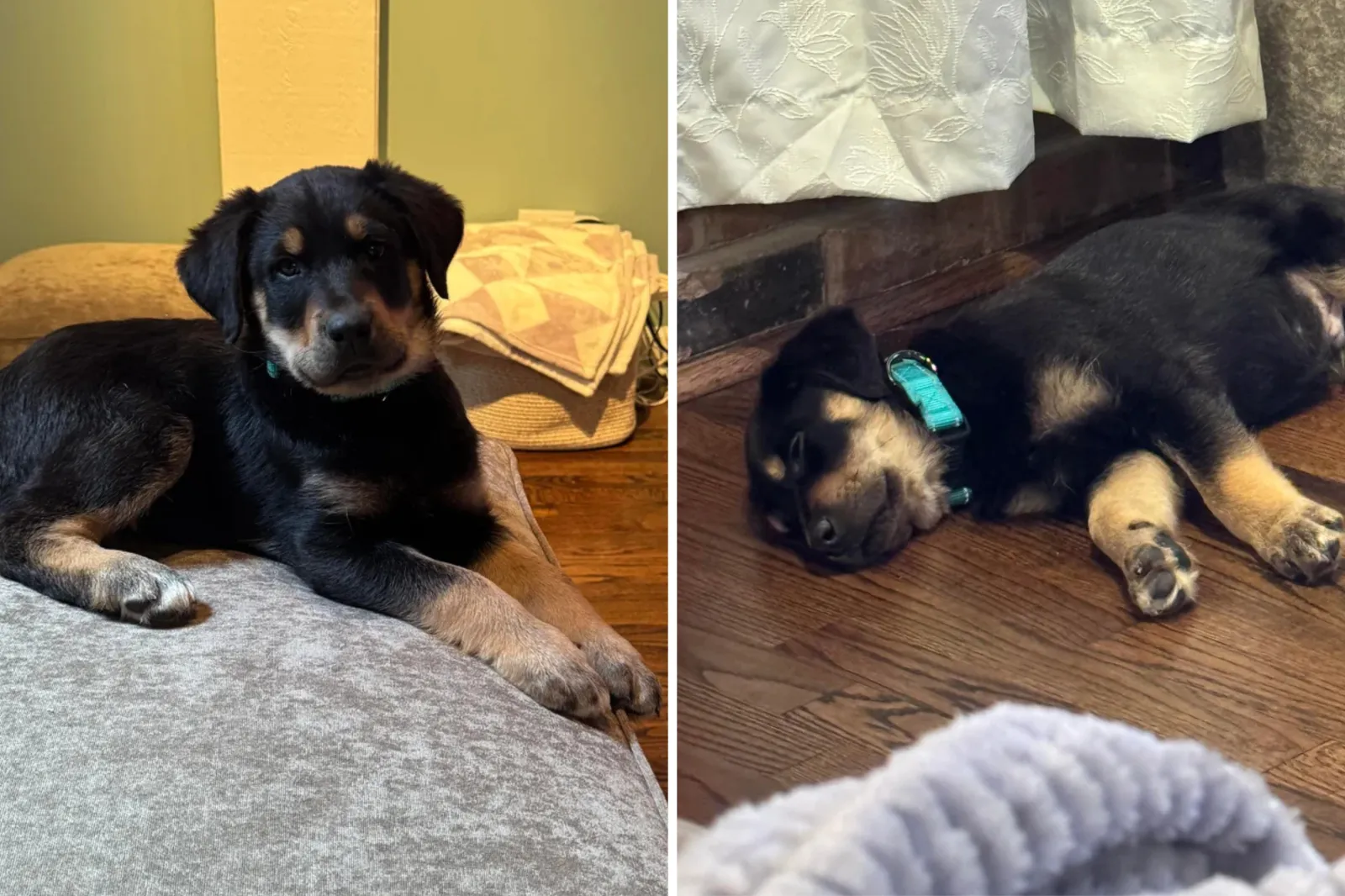
At first glance, many viewers thought this puppy was a Rottweiler mix—including her owners. But a DNA test revealed she was something very different.
A slideshow of images shared on Reddit shows the puppy with a black coat and rust‑to‑mahogany markings over her eyes, cheeks, sides of the muzzle, throat, chest and legs—a coloring commonly associated with Rottweilers. The Reddit user u/zwevo wrote in the caption that their "best guess" was a German shepherd, Rottweiler and Labrador mix.
The results told a different story. According to the DNA test, the pup is mostly golden retriever (31.3 percent), followed by poodle (23.5 percent), Labrador retriever (23.2 percent), Siberian husky (19 percent) and German shepherd dog (3 percent).
Read More on Pets
"We were pretty surprised by the poodle!!" the owner wrote.

...
Why Looks Can Be Misleading
The surprise highlights how unreliable visual breed identification can be—something researchers have found repeatedly in genetic studies of canines.
In a 2018 study, researchers genetically tested 919 shelter dogs at two U.S. shelters in Arizona and California to compare visual breed labels with actual breed heritage. The DNA results revealed highly mixed backgrounds, identifying 125 different breeds, with only about 5 percent of the canines found to be purebred.
The most-common breed backgrounds—American Staffordshire terrier, Chihuahua and poodle—made up about 42 percent of all breed identifications at the great‑grandparent level. The study also found that dogs with pit bull‑type ancestry waited longer to be adopted than other pups.
When shelter staff’s visual breed guesses were compared with DNA results, staff correctly identified at least one breed about two‑thirds of the time. Accuracy dropped sharply when multiple breeds were involved.
Because shelter dogs often have complex genetic histories that can’t be reliably identified by appearance alone, researchers concluded that focusing on a canine’s behavior, personality and physical traits—rather than breed labels—may better support adoption efforts.
Reddit Reacts
The result left many viewers stunned, especially as the pup doesn’t have a curl in sight.
"Doodle that comes out looking like a Rottweiler that’s a first. So cute!!!! what’s the temperament like? I’m laughing imagining someone adopting him and expecting him to be a guard dog," one user commented.
Another added: "Wow! No Rottie?!?! I'm absolutely floored! He is the cutest Rottie impostor I have ever seen."
A third commenter pointed out that the coloring isn’t unheard of in one of the pup’s breeds: "My first instinct was actually Goldendoodle haha. Poodles can have this color combo! It’s referred to as ‘phantom’ and, while it isn’t always black and tan, that is a more common phantom coloring."
Newsweek reached out to u/zwevo for comment. We could not verify the details of the case.
Reference
Gunter, Lisa M., et al. "A Canine Identity Crisis: Genetic Breed Heritage Testing of Shelter Dogs." PLOS One, vol. 13, no. 8, Aug. 2018, p. e0202633. PubMed Central, https://doi.org/10.1371/journal.pone.0202633.
View 0 Comments
Submit Correction
View Editorial & AI Guidelines