...

By Hollie Silverman
News Editor
0
Share
Newsweek is a Trust Project member
See more of our trusted coverage when you search.Prefer Newsweek on Googleto see more of our trusted coverage when you search.
President Donald Trump's unprecedented move to threaten punitive tariffs on eight European allies over their opposition to American control of Greenland has sparked backlash both overseas and at home.
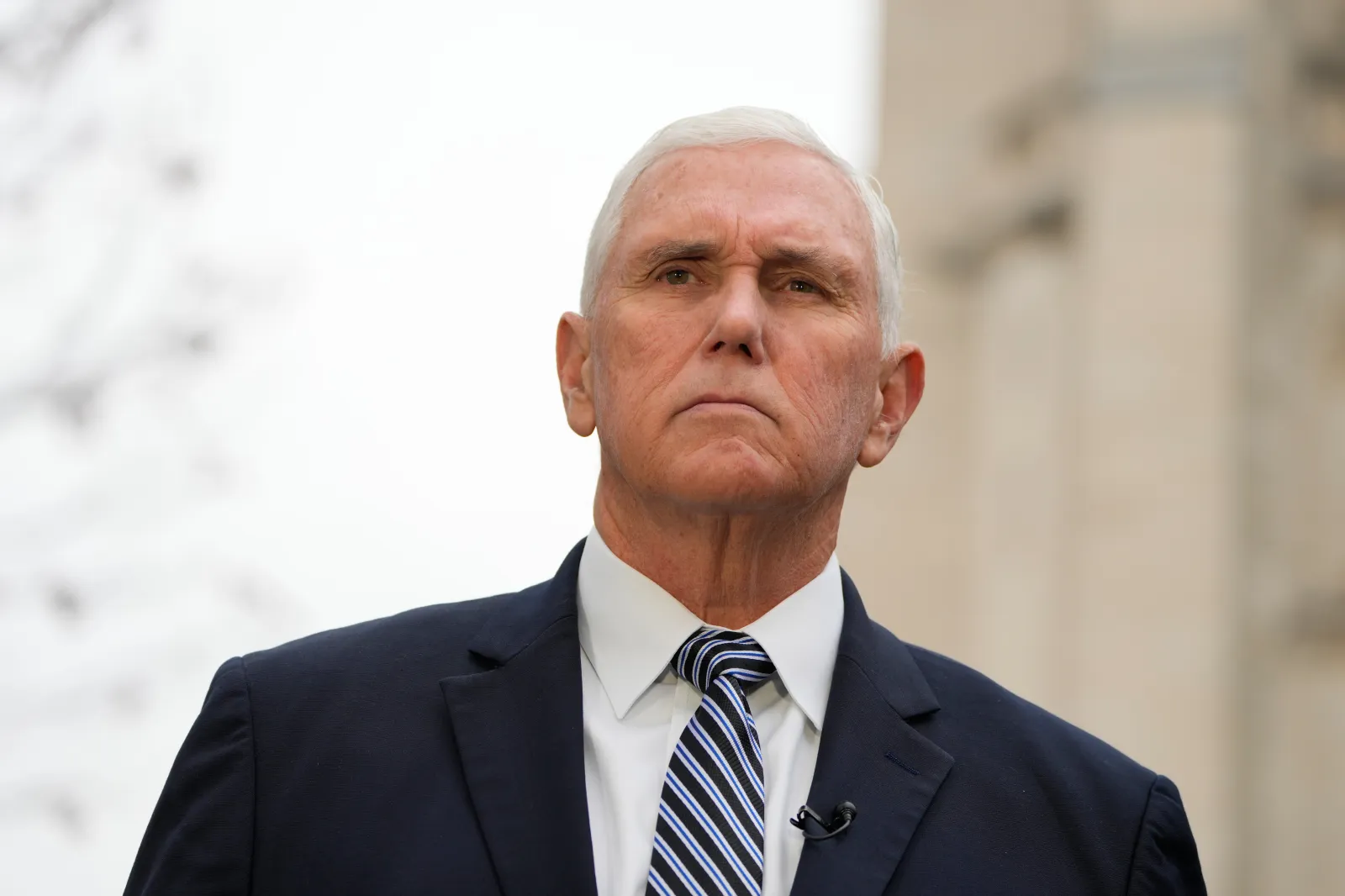
Former Vice President Mike Pence questioned Trump's authority to impose the proposed 10 percent tariffs during an interview appearance with Jake Tapper on CNN's State of the Union, saying, "I think it's a question right now, Jake, not of what the president's trying to accomplish, but how?"
He added: "And I have concerns about using what I think is a questionable constitutional authority, imposing unilateral tariffs on NATO allies, to achieve this objective as much as I had concerns about the threat of a military invasion, which apparently is no longer being talked about."
Read More on News
Pence, who was Trump's vice president during his first term where the two later had a falling out following the January 6, 2021, U.S. Capitol riot, did say he supports the president's plan to annex Greenland and agreed it was a matter of national and international security.
Newsweek reached out to the White House by email Sunday for comment.
Why It Matters
Trump has stressed the need for the U.S. to acquire Greenland, whether monetarily or through military force, as part of a broader effort to shore up Arctic security in the face of Russian and Chinese ambition. However, European leaders have defended Greenland's right as a self-governing territory within the Kingdom of Denmark to determine its future.
Therefore, European leaders deployed troops to Greenland, which is the world's largest island, in support of its autonomy.
Trump in turn threatened to impose and adjust tariffs on nations who do not support the U.S. effort to acquire Greenland, saying that it will be for the benefit of NATO as a whole.
...
What To Know
Pence raised the question of the president's ability to impose tariffs on European nations that had deployed forces to Greenland, adding that while he supports what Trump is trying to do, he is not sure of how he is doing it, calling the newly proposed tariffs "questionable."
"So what the president's trying to do here, I think, is absolutely in the interest of the United States of America," the former vice president said. "I would just rather see the president use his persuasive powers, and U.S. investment in Greenland, to lay a foundation for ultimately achieving that goal."
Trump announced on social media Saturday that the U.S. would impose a 10 percent import tax starting February 1 on goods from Denmark, Norway, Sweden, France, Germany, the United Kingdom, the Netherlands, and Finland. The tariffs would then increase to 25 percent on June 1 unless, as Trump wrote, there was a "Complete and Total purchase of Greenland" by the U.S.
It remains unclear what legal authority Trump would invoke to implement the tariffs, given that the European Union functions as a single economic bloc and that Congress has previously signaled discomfort with tariff actions taken without legislative approval.
Trump has cited the International Emergency Economic Powers Act for similar actions in the past—a statute now under review by the U.S. Supreme Court. Congressional members, including Republicans, have discussed reclaiming tariff authority to limit executive latitude for unilateral trade moves, the Financial Post reported.
The targeted European countries have condemned the tariffs, with French President Emmanuel Macron equating the threats to acts of coercion seen elsewhere, and promising a "united and coordinated" European response.
Denmark’s foreign minister described the White House move as a "surprise" following a week of talks in Washington that had established a working group on the Greenland dispute but failed to resolve "fundamental disagreements."
European troops have participated in military exercises in Greenland alongside Danish and NATO forces, signaling continental commitment to Greenlandic and Danish interests.
A bipartisan congressional delegation visited Copenhagen and reaffirmed support for Denmark and Greenland, distancing themselves from the administration's tactics, the Associated Press reported.
Senators Lisa Murkowski, an Alaska Republican, and Jeanne Shaheen, a New Hampshire Democrat, recently introduced a bill to bar the use of U.S. funds to annex Greenland or any NATO territory without consent.
Public protests this weekend in Nuuk, Greenland's capital, and Copenhagen, along with statements from Greenlandic politicians and Inuit leaders, also denounced the pressure campaign and reaffirmed Greenland's commitment to Denmark and NATO.
What People Are Saying
President Donald Trump said on Truth Social Saturday in part: “Starting on February 1st, 2026, all of the above mentioned Countries (Denmark, Norway, Sweden, France, Germany, The United Kingdom, The Netherlands, and Finland), will be charged a 10% Tariff on any and all goods sent to the United States of America. On June 1st, 2026, the Tariff will be increased to 25%. This Tariff will be due and payable until such time as a Deal is reached for the Complete and Total purchase of Greenland."
Senator Lisa Murkowski, an Alaska Republican, said after meetings in Copenhagen, as reported by AP: “Greenland needs to be viewed as our ally, not as an asset, and I think that’s what you’re hearing with this delegation.”
Danish Foreign Minister Lars Lokke Rasmussen wrote in a post on X Saturday: "The President’s statement comes as a surprise. Earlier this week, we had a constructive meeting with Vice President Vance and Secretary Rubio. The purpose of the increased military presence in Greenland, to which the President refers, is to enhance security in the Arctic. We agree with the US that we need to do more since the Arctic is no longer a low tension area. That’s exactly why we and NATO partners are stepping up in full transparency with our American allies."
What Happens Next
Congress is likely to pursue legislation reasserting tariff authority, while several lawsuits and a pending Supreme Court ruling could block or complicate the president's plans.
European countries are expected to coordinate a collective response and may pursue measures under the EU's anti-coercion tools. Further high-level diplomatic meetings are scheduled, and Trump is expected to address the controversy at the upcoming World Economic Forum in Davos.
View 0 Comments
Submit Correction
View Editorial & AI Guidelines