10
Loading video...

By Ellie Cook
Senior Defense Reporter
Share
Newsweek is a Trust Project member
See more of our trusted coverage when you search.Prefer Newsweek on Googleto see more of our trusted coverage when you search.
U.S. defense giant Raytheon has pledged to "dramatically accelerate" its production of long-range Tomahawk cruise missiles under a new Pentagon contract, after concerns emerged that stockpiles have been run down by the United States' war with Iran.
Raytheon said on Monday that it had reached an "unprecedented" contract with the U.S. Department of Defense (DOD) worth nearly $23 billion over a seven-year period.
The Pentagon has pushed defense manufacturers to churn out equipment more quickly under sweeping changes to how the DOD dishes out its contracts as demand for high-end weapons surges around the world.
Read More on World
European countries and Canada, under pressure from President Donald Trump, are scrambling to buy more military items, but hard-to-replace stockpiles of missiles with long lead times have been drained by the U.S. conflict with Tehran and Russia's war with Ukraine.
...
The White House has denied that the U.S. is suffering from any munitions shortages despite the periods of high-intensity strikes across Iran.
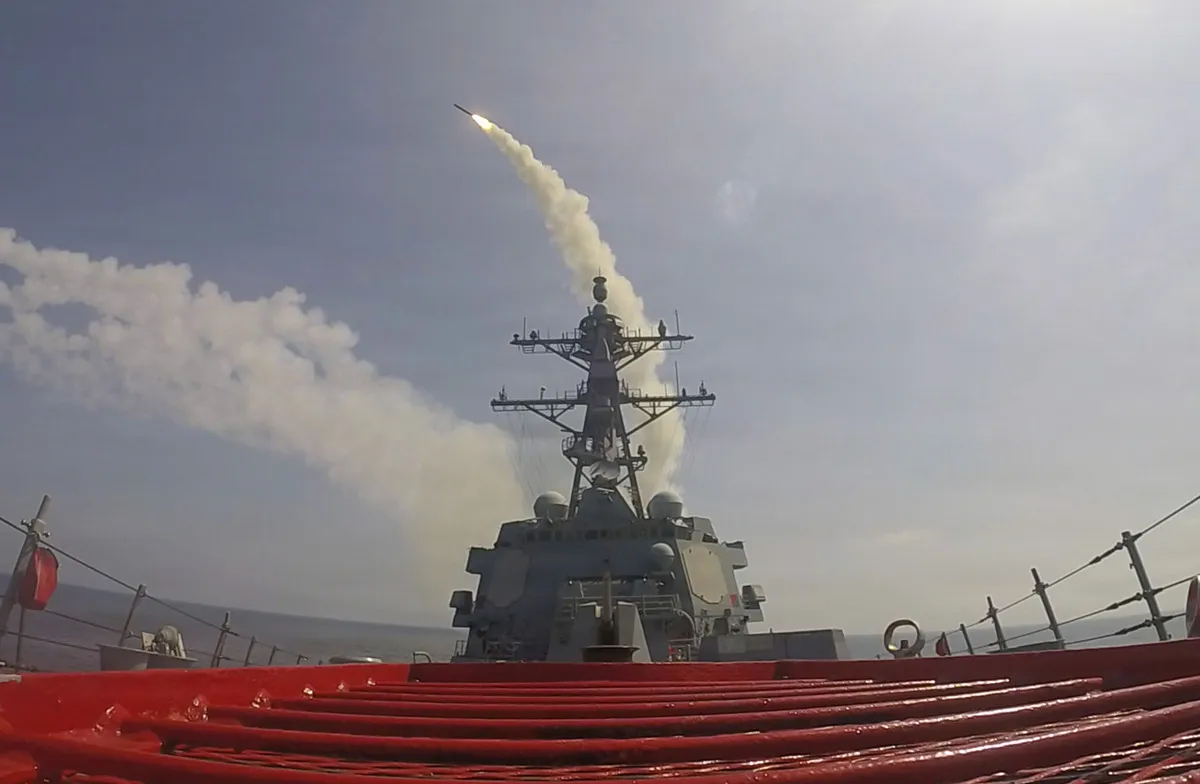
Tomahawks are land-attack cruise missiles typically launched from ships, like the U.S. Navy destroyers deployed in the Middle East.
The U.S. has used Tomahawks since the 1980s, and they are a staple of U.S. Navy operations reaching targets 1,000 miles away, according to the manufacturer. The latest versions are touted as able to switch targets mid-flight and loiter over a target area for hours after being launched.
The U.S. has used up just under half of its stockpile of Tomahawk missiles since February, the Reuters news agency reported at the start of August.
Related Video

01:25
Trump Orders Korea Exercise Cuts, Hayden Panettiere Death, American Killed On Italian Volcano: The Bulletin, August 17
The U.S. fired more than 1,000 Tomahawks between the start of the Iran war on February 28 and late April, according to a separate report in The Wall Street Journal. More than 850 of these were in the first month.
Raytheon said in February it would raise its annual Tomahawk production to more than 1,000 missiles, a roughly five-fold increase from recent years, according to military experts.
RTX, Raytheon's parent company, said on Monday that it had made three times more Tomahawks in the first half of 2026 than in the first six months of 2025.
But it will take roughly four years for the U.S. to backfill its arsenal of Tomahawks to pre-war levels, the Center for Strategic and International Studies, a Washington, D.C.-based think tank, assessed in late May.
"Tomahawk is the Navy's most important strike weapon, able to target hostile forces hundreds of miles away without ever risking the lives of our sailors," Raytheon President Phil Jasper said on Monday.
The Pentagon "challenged industry to answer the call to expand munitions production and capacity," said Michael Duffey, the department's under secretary for acquisition and sustainment.
Several U.S. allies use Tomahawks or have bought the long-range cruise missiles, but the delivery times are now in doubt as the U.S. balances restocking its munition cupboards with lucrative foreign sales.
Japan purchased 400 Tomahawks in 2024, but Defense Secretary Pete Hegseth told his Japanese counterpart in May that delivery would be delayed, the Financial Times reported.
Australia announced it would acquire around 200 Tomahawks in 2023, while the Netherlands is buying Tomahawks for its frigates.
Contact Newsweek editors on this story: Matthew Robinson and Dave Siminoff.
Submit Correction
View Editorial & AI Guidelines