...


By Amanda Greenwood and Anna Skinner
0
Share
Newsweek is a Trust Project member
See more of our trusted coverage when you search.Prefer Newsweek on Googleto see more of our trusted coverage when you search.
A fast-moving outbreak of severe storms unleashed multiple tornadoes across central and western Mississippi late Wednesday, leaving behind a trail of destruction, scattered power outages, and reports of residents trapped inside damaged homes as emergency crews scrambled to respond.
Mississippi Governor Tate Reeves said the state was “in contact with local emergency managers and first responders,” as meteorologists confirmed that the storms prompted a “tornado emergency,” one of the most serious warnings issued, as violent storms moved across several counties overnight.
Early reports, photos, and videos indicate that homes have been destroyed, trees uprooted, and communities cut off by debris, though the full scale of injuries and damage is still being assessed.
Read More on News
Mississippi Tornadoes Injure At Least 17 People, No Deaths Reported
On Thursday morning, Reeves provided an update about the damage from the tornadoes, saying at least 17 injuries have been reported so far.
"No fatalities have been reported," Reeves said in a follow-up post.
Homes Destroyed and Residents Trapped
Hundreds of homes were damaged or destroyed by the twisters, Reeves said in the update.
The post said: "275 homes and 50 apartment units are damaged or inaccessible in Lamar County. 30 roads are closed due to debris.
"More than 200 homes were damaged in Lincoln County. The Cajun Navy is deploying a 50-person shelter pod, 30KW generator, and 10 pallets of supplies. 12 homes were damaged in Lawrence County. Multiple roads are closed due to downed trees and power lines."
More than 15,600 people remain without power as of 10:50 a.m. ET.
Mississippi Tornadoes: How Many Twisters?
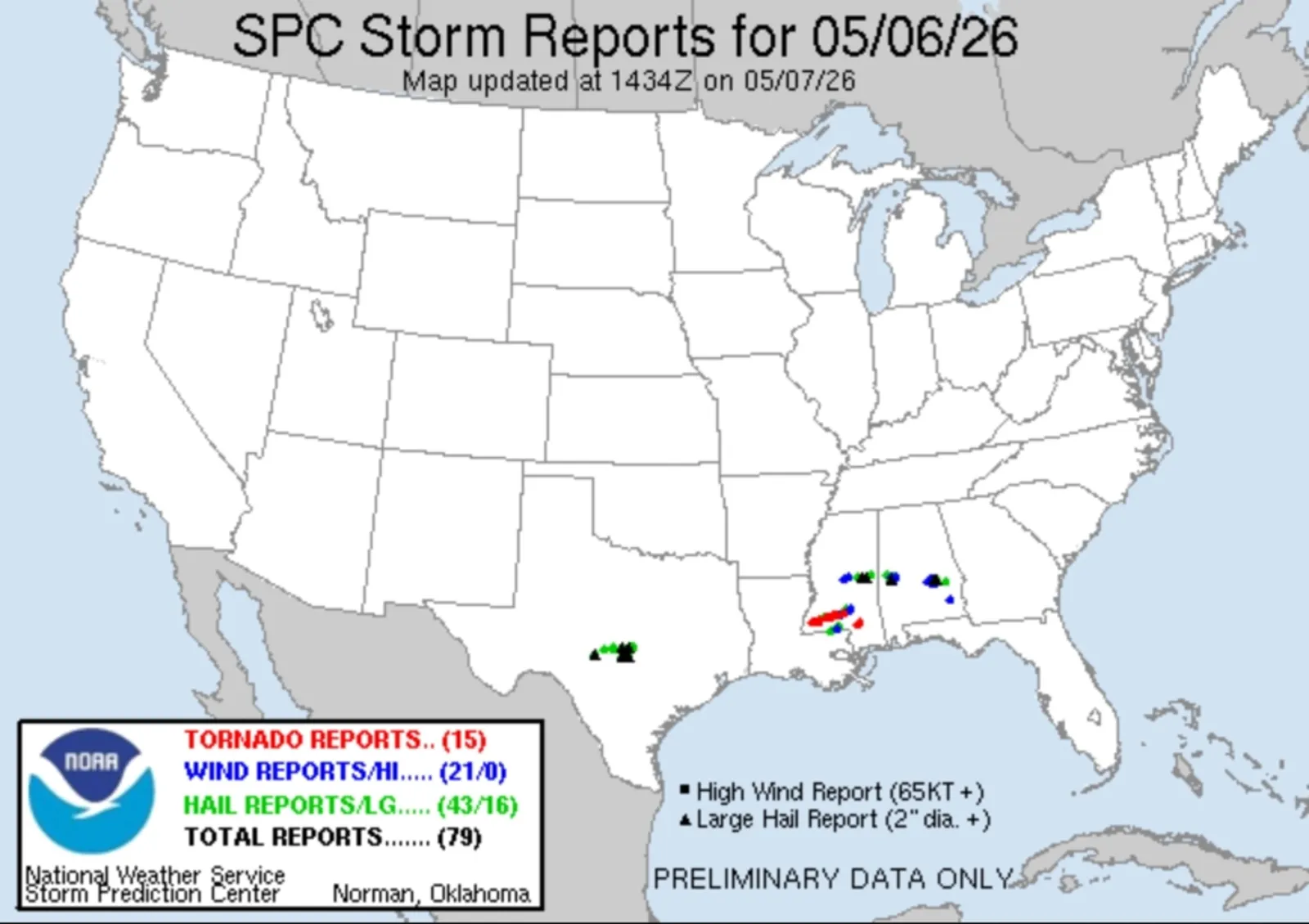
The NWS Storm Prediction Center storm report map reveals that 15 tornadoes were reported on Wednesday, all in Mississippi, according to preliminary data. This includes four reports in Franklin County, one report in Adams County, two in Lamar County, one in Forrest County, five in Lincoln County, one in Lawrence County and one in Jefferson Davis County.
...
Local news outlets reported that some of the most severe damage was reported in Franklin County near Garden City, where local emergency officials said a powerful tornado tore through neighborhoods, flattening structures and leaving people trapped inside collapsed homes.
Authorities warned that ongoing hazardous conditions—including heavy rain, debris, and downed power lines—slowed search and rescue efforts, forcing some responders to temporarily shelter rather than immediately reach survivors.
In nearby Lincoln County, a mobile home park was devastated, with witnesses describing entire rows of trailers destroyed or overturned. Residents said structures were ripped apart within seconds, leaving only scattered debris where homes once stood.
While early reports suggested some injuries—including cuts, broken bones, and concussions—the extent of casualties remained unclear as officials continued to conduct overnight damage assessments.
Statewide Response Underway
Emergency crews worked through the night to clear roads, reach isolated communities, and account for residents, while the Mississippi Emergency Management Agency led the statewide response effort.
Mattie Powell, Director of the Wilkinson County Emergency Management Agency, confirmed that people were trapped in the Garden City and Perrytown area, according to WLBT News, confirming that she had “informed the Fifth District supervisor” who “will work his way to them as soon as he can.”
Authorities also warned that conditions remained dangerous in many areas, with flooding, fallen trees, and blocked roadways continuing to pose risks even after the tornado threat began to ease.
Multiple Tornado Watches Still in Effect
Compounding the crisis, the storm system extended well beyond Mississippi, prompting multiple active tornado watches across several Southern states overnight.
According to the National Weather Service (NWS), tornado watches will remain in effect until Thursday morning, covering wide parts of the region:
- Alabama: Includes multiple counties across the south and southeast, including Mobile, Baldwin, Pike, Barbour, Coffee, Dale, Geneva, Henry, and Houston
- Mississippi: Hancock, Harrison, Jackson, George, Greene, Perry, and Stone counties
- Florida: Includes Escambia, Okaloosa, and Santa Rosa, along with a broader stretch of Panhandle counties such as Bay, Leon, Walton, and Jackson
- Georgia: 17 counties in southwest Georgia, including Baker, Calhoun, Clay, Colquitt, and Decatur
- Adjacent coastal waters: Mobile Bay, Perdido Bay, Pensacola Bay, and Choctawhatchee Bay
The NWS warned that the watch area faced the potential for tornadoes, damaging winds, and large hail, urging residents to remain prepared to take shelter at short notice.
What Is A Tornado Warning?
According to the NWS, tornado watches and warnings are two types of alerts that signal very different levels of risk and urgency.
Tornado Watch — “Be Prepared”
A tornado watch is issued when weather conditions are favorable for tornadoes to develop in and near a specific area.
- Watches typically cover large geographic areas, sometimes spanning multiple counties or states.
- They are usually in effect for several hours and serve as an early alert to monitor conditions closely.
The NWS advises that during a tornado watch, people should review emergency plans, check supplies, and be ready to act quickly if conditions worsen or a warning is issued.
Tornado Warning — “Take Action”
A tornado warning is a much more urgent alert. It is issued when a tornado has been sighted by observers or indicated by weather radar, meaning there is an immediate threat to life and property.
- Warnings are usually issued by local NWS forecast offices and typically cover smaller, more specific areas, such as a city or part of a county.
- These alerts indicate that danger is imminent or already occurring.
The NWS stresses that when a tornado warning is issued, individuals should seek shelter immediately—preferably in a basement or an interior room on the lowest floor of a sturdy building, away from windows.
What Should You Do During a Tornado Warning?
A broad swath of the Gulf South remains under tornado watches as forecasters warn the threat may not yet be over.
As daylight breaks, officials are expected to provide more detailed updates on damage totals, injuries, and the scope of recovery efforts.
For now, residents in Mississippi and neighboring states are being urged to:
- Stay off roads to allow emergency vehicles access
- Monitor local alerts for new warnings
- Avoid downed power lines and floodwaters
- Seek shelter immediately if new warnings are issued
Mississippi's Most Destructive Tornadoes
Mississippi sits in “Dixie Alley,” a region of the southeastern United States particularly vulnerable to violent, long-track tornadoes. The state has recorded thousands of tornadoes since 1950, with hundreds of deaths and injuries, according to NWS data.
According to the NWS, two of the most destructive include:
The 1971 Mississippi Delta Outbreak
The deadliest tornadoes in modern Mississippi history occurred during the February 21, 1971 outbreak, when multiple violent storms struck the Delta region: An F4 tornado from Issaquena to Grenada counties killed 58 people and injured 795 others, while a second F4 tornado from Issaquena to Sunflower counties killed 46 people and injured 496.
These storms remain the deadliest on record in Mississippi since 1950, according to NWS data.
The Jackson Area Tornado (1966)
Another of the state’s most destructive tornadoes—an F5—struck central Mississippi on March 3, 1966, tracking from Hinds County (including Jackson) into Kemper County.
The storm killed 58 people and injured 518, tying it for the highest death toll of any tornado in Mississippi’s modern record.
It caused widespread devastation across both urban and rural areas, including severe damage in and around the Jackson metro.
View 0 Comments
Submit Correction
View Editorial & AI Guidelines