...

By Soo Kim
Reporter
0
Share
Newsweek is a Trust Project member
See more of our trusted coverage when you search.Prefer Newsweek on Googleto see more of our trusted coverage when you search.
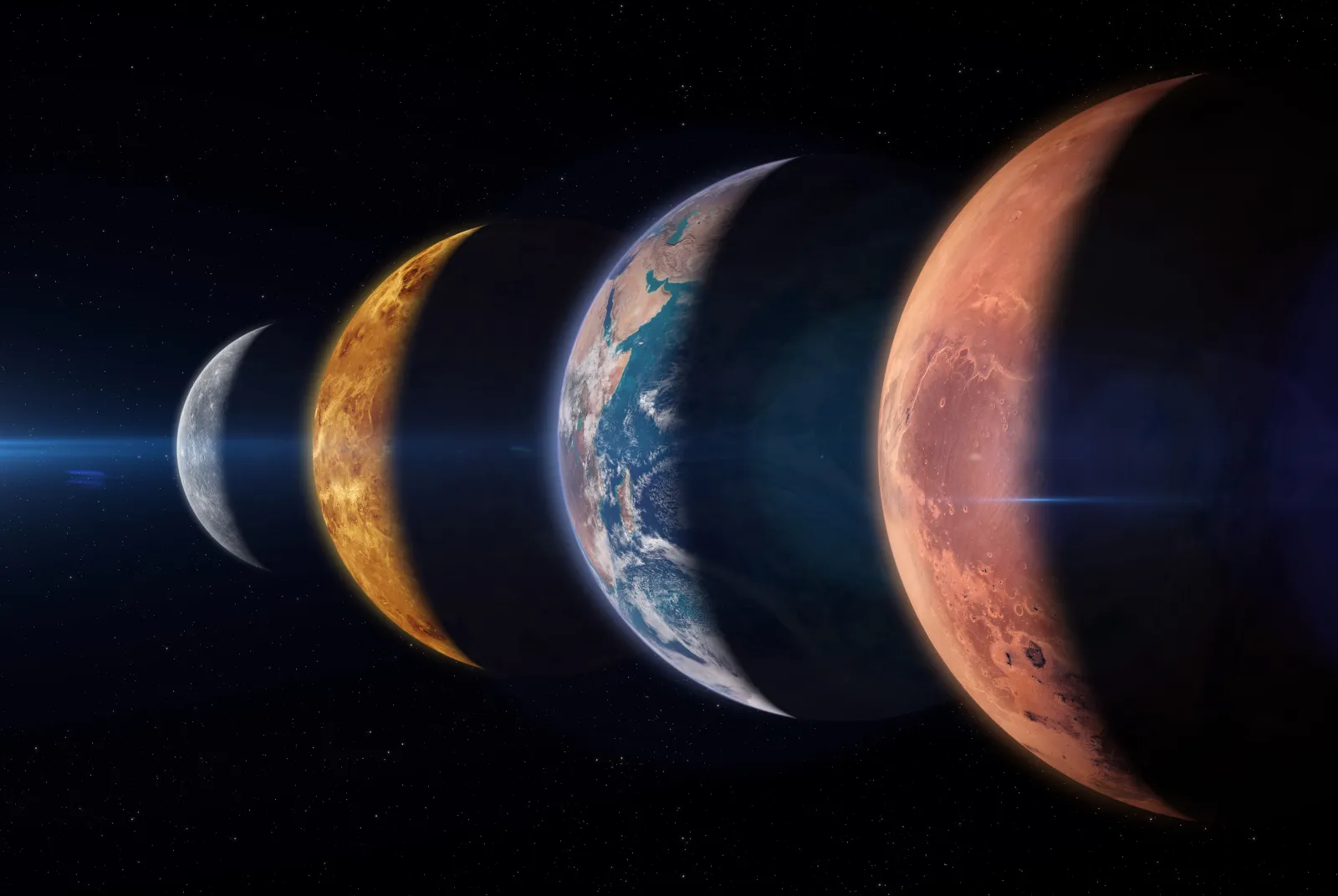
Stargazers this month will get to see not just two or three, but six planets in alignment across the night sky.
This “planetary parade” consisting of Mercury, Venus, Neptune, Saturn, Uranus, and Jupiter will appear shortly after sunset on February 28, according to NASA.
The planets are “visible soon after sunset throughout the month of February, but they’ll be lined up best toward the end of the month,” the space agency says.
Read More on Science
Weather permitting, only four of these planets will be visible to the naked eye. Only observers using optical aides will be able to spot Uranus and Neptune, while Mercury can be harder to see at times as well.
...
For most people to see a planet with the naked eye, the planet needs to be at least a few degrees above the horizon, and 10 degrees or higher is best.
“This is crucial because Earth's atmosphere near the ground dims celestial objects as they rise or set,” NASA explains. “Even bright planets become difficult or impossible to spot when they're too low, as their light gets scattered and absorbed on its path to your eye.” Buildings, trees, and other forms of obstruction can also block the view near the horizon.
“This visibility challenge is particularly notable after sunset or before sunrise, where the sky is still glowing. If a planet appears very low within the sunset glow, it is very difficult to observe.”
To have any chance at all of catching the upcoming planetary alignment, viewers will need an unobstructed view due west, clear skies, around half an hour after sunset on February 28, as well as binoculars or a telescope, according to Space.com.
Four of the six planets are already close to the sun and will be visible only for a short time, if at all, in bright twilight. Venus and Mercury will be closest to the horizon at twilight, followed by Saturn and Neptune, while Uranus and Jupiter will be much higher in the sky. Therefore, it will likely be a challenge to observe more than three planets.
Depending on the weather, on most nights, you can see at least one bright planet in the night sky. Two or three planets are also typically visible around sunset, while occasionally four or five bright planets can be spotted simultaneously with the unaided eye, says NASA. "Lineups of four or five planet naked-eye planets with optimal visibility typically occur every few years."
Mars, Jupiter, and Saturn are frequently spotted in the night sky, but the addition of Venus and Mercury makes four- and five-planetary lineups a noteworthy event. Both of them orbit closer to the sun than Earth, with smaller, faster orbits than the other planets.
Venus is visible for a couple of months at a time during its greatest separation from the sun, appearing just after sunset or before sunrise. Completing its orbit in just 88 days, Mercury can only be seen for two weeks, or even a few days, at a time just after sunset or just before sunrise.
Other planetary alignments in the pipeline include one in late October 2028, when five planets will be visible at once before sunrise. There will be another alignment in late February 2034, where five planets will be visible at once after sunset, with Venus and Mercury being a challenge to see, according to NASA.
Do you have a tip on a science story that Newsweek should be covering? Do you have a question about space? Let us know via science@newsweek.com.
View 0 Comments
Submit Correction
View Editorial & AI Guidelines