...

By James Bickerton
News Reporter
0
Share
Newsweek is a Trust Project member
See more of our trusted coverage when you search.Prefer Newsweek on Googleto see more of our trusted coverage when you search.
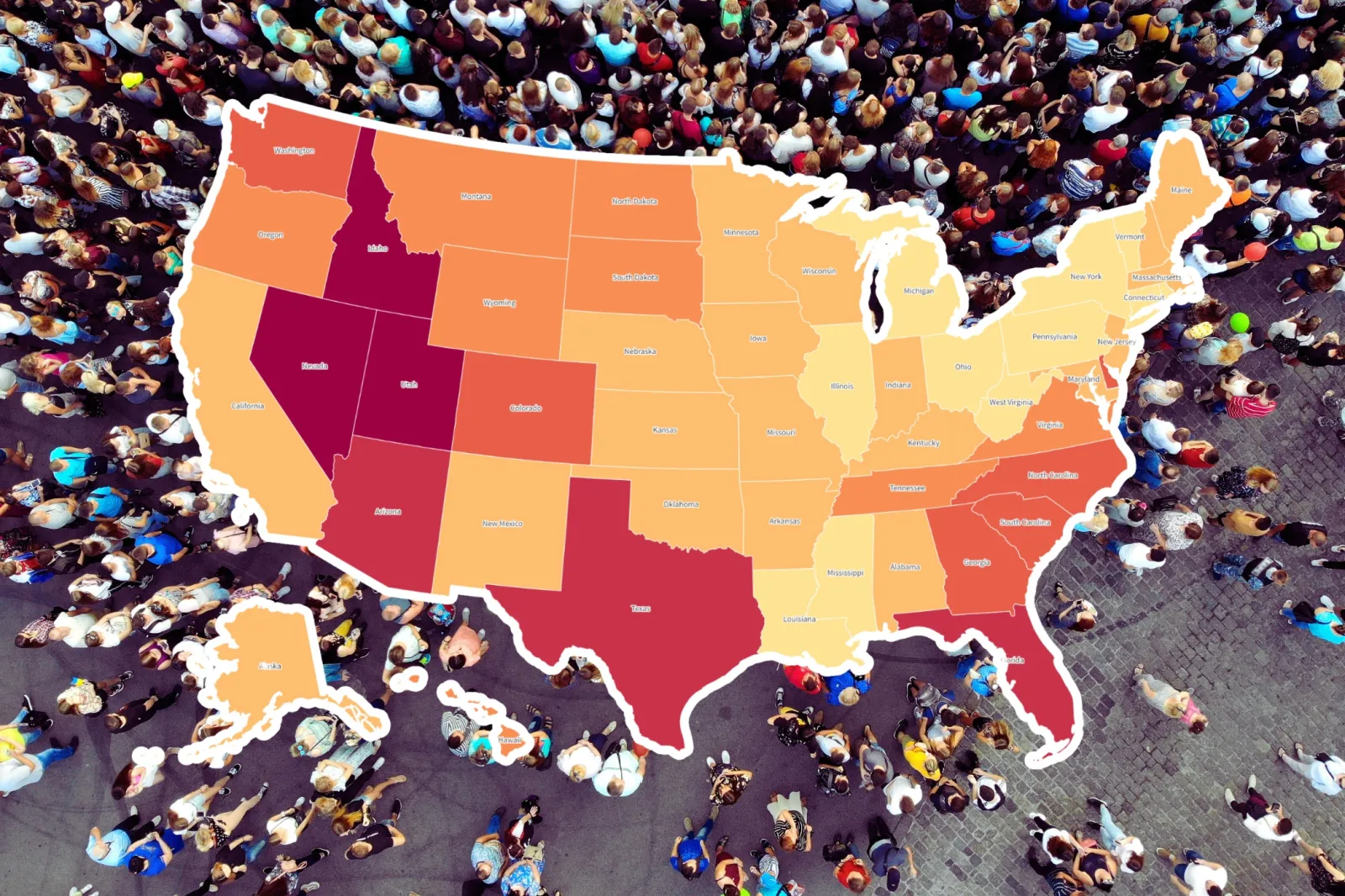
Nevada, Utah, Idaho, Texas, and Arizona saw the fastest population growth in percentage terms of any American state between 1 July, 2000, and 1 July, 2023, according to U.S. Census Bureau data.
The figures showed all U.S. states bar West Virginia recorded population growth over this period, with the Mountain State seeing a population decline of two percent. Speaking to Newsweek, Professor Kenneth M. Johnson, a senior demographer at the University of New Hampshire, said the key factors in population change for each state are natural growth, when births exceed deaths, internal migration from within the United States, and immigration from other countries.
Read more: Find the Lowest Rates From Top Mortgage Lenders
Read More on U.S.
Between 2000 and 2023, the U.S. population grew from around 281 million to about 333 million, according to Census Bureau figures. American population growth remains healthy, unlike in some other advanced economies, such as Japan and South Korea, where significant falls are expected due to a combination of below replacement level fertility rates and low migration.
However, the rate of immigration, some of it illegal, into the U.S. has become highly controversial. According to the House Committee on Homeland Security, there were over 3.2 million migrant encounters between suspected irregular migrants and law enforcement in 2023 alone.
According to the Census Bureau data, the population of Nevada increased by 58.2 percent between 1 July 2000 and 1 July 2023, from 2,018,741 to 3,194,176.
The neighboring states of Utah and Idaho saw population growth of 52.3 percent and 51.2 percent over the period, from 2,244,502 to 3,417,734 and 1,299,430 to 1,964,726. Arizona recorded growth of 44 percent from 5,160,586 to 7,431,344.
"Utah generally has the highest population growth rate in the country. Its population gain is fueled by far above-average levels of natural increase due to high birth rates. It also receives significant domestic migration, but it is natural increase that is the big driver of its population gain," Johnson said.
Read more: First-Time Homebuyer Guide
Substantial population growth was also recorded in a number of states along the southern east coast. The population of Florida increased by 40.9 percent, North Carolina and Georgia by 34.1 percent and South Carolina by 33.5 percent. Texas also recorded an impressive growth of 45.6 percent, from 20,944,499 to 30,503,301.
Johnson commented: "Domestic migration also has fueled most of North and South Carolina's population gain. Both states also have average levels of natural increase, plus modest increases from immigration.
"Georgia has a similar growth pattern to North Carolina and South Carolina. It has above average levels of natural increase as well as significant migration gains fueled mostly by migration from other parts of the U.S."
The increase in Florida was also attributed primarily to internal migration, with a particular emphasis on retirees.
"Florida has had relatively modest levels of natural increase, in part because its population is older. Florida's substantial population gain was fueled primarily by migration—most of it domestic migration, though Florida also receives significant [outside] immigration," Johnson said.
...
"Many domestic migrants to Florida come from the Northeast and the Midwest. In fact, in many years, the biggest domestic migration stream is from New York to Florida."
At the other end of the scale, the population of West Virginia declined by two percent over the period, from 1,807,021 to 1,770,07.
The smallest population rises were recorded by Michigan and Illinois at 0.9 percent, Louisiana at 2.3 percent and New York at three percent.
Johnson said: "Between 2000-2023, 66,000 more people died than were born in West Virginia...[the state] has had a very modest gain from domestic migration recently and during the '00-'10 decade, otherwise, its population loss would have been even greater."
California was the 29th fastest-growing state in the period in percentage terms, with its population increasing by 14.6 percent from 33,987,977 to 38,965,193.
According to Johnson, the Great Recession, which in the U.S. lasted from December 2007 to June 2009, according to Natural Bureau of Economic Research figures, had a substantial impact on American demographics.
He said: "The Great Recession had a significant impact on U.S. demographic change during the period from roughly 2008-2015. Economists might say that the Great Recession ended in 2010, but demographers would say that its impact continued well into the 2010s. In fact, the fertility declines that began in 2008 continue to this day."
View 0 Comments
Submit Correction
View Editorial & AI Guidelines