10
Loading video...

By Melissa Fleur Afshar
Reporter
0
Share
Newsweek is a Trust Project member
See more of our trusted coverage when you search.Prefer Newsweek on Googleto see more of our trusted coverage when you search.
A posture coach's hack that promises a quick fix for "tech neck" has gone viral on social media.
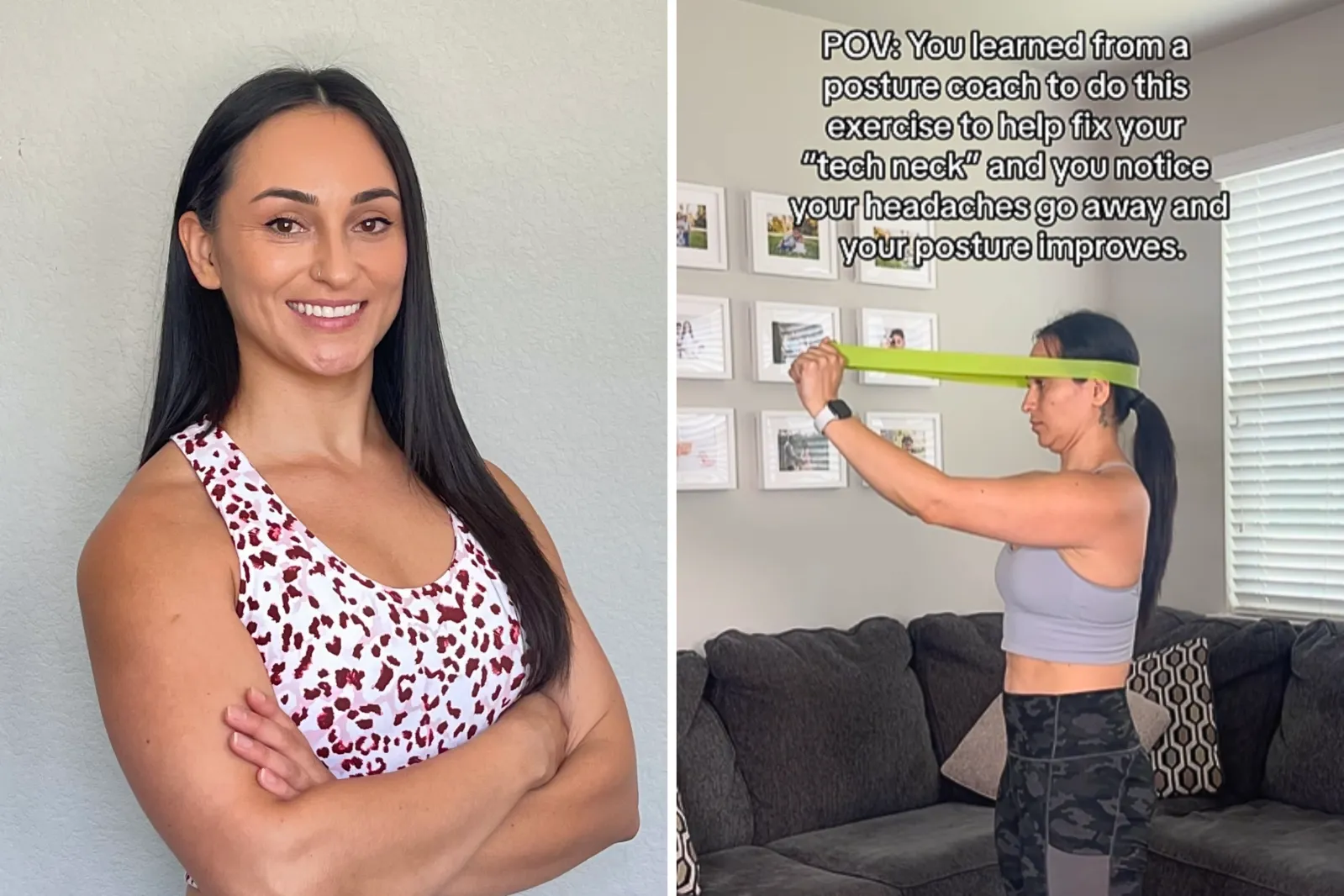
Jenn Lashley, a certified ergonomist with specialist expertise in posture correction, demonstrated her simple yet effective technique in a video shared to Instagram on May 22. The Austin, Texas-based coach captured the interest of viewers online with her "chin tuck exercise" that is aimed at alleviating "tech neck"—a common issue stemming from prolonged device use or endless screentime.
"The exercise strengthens the deep neck flexors located at the front of the neck and simultaneously stretches the muscles in the back and side of the neck," Lashley told Newsweek. "These muscles often become tight and overworked due to constantly looking down at our phones or working on computers, leading to headaches, pain, and poor posture."
Read More on Wellness & Fitness
Viewers were able to see Lashley standing sideways with a neon resistance band looped around the back of her head, the other end held taut in her hands. She then performs a series of neck movements, gently pushing her head forward and backward against the band's resistance.
...
An overlaid text on the video read: "You learned from a posture coach to do this exercise to help fix your 'tech neck', and you notice your headache goes away and your posture improves."
The short clip has garnered over 20,000 likes on Instagram, and nearly 1 million views across other social-media platforms, including Facebook.
The viral status of Lashley's hack reflects a growing awareness of the impact of modern technology on our physical health. "Tech neck," characterized by neck pain and stiffness from prolonged device use, is becoming increasingly prevalent. Multiple studies have determined that smartphone and computer use can lead to the uncomfortable phenomenon. The Texan coach wants more people to talk about how to combat it.
"Strengthening the neck muscles isn't something many people discuss," Lashley said. "In this age of technology, it's a must, as forward head posture has been linked to headaches, pain, breathing difficulties, and other health issues."
The Chin Tuck Exercise
To start the short exercise, Lashley recommends practicing without any equipment to focus on building strength in the neck muscles.
"Begin by simply holding the tucked position and activating the muscles in the front of your neck for five to 10 seconds, repeating 10 times. As the neck muscles get stronger, you can incorporate resistance bands or use a wall for added support," Lashley said.
Alternative Exercises
While most viewers have offered positive responses to Lashley's workout, some have raised that her exercise may not be suited to people with specific health conditions or concerns.
"This is not recommended for people with [temporomandibular joint dysfunction]," one user, @taylorgriffin, wrote.
Another, known as Sinead Doyle on the platform, added: "I'm too nervous to try this. Neck health anxiety."
Healthline recommends a number of well-known yoga poses to aid in combating tech neck and improving posture, ranging from the downward dog pose to the cat-cow pose.
Lashley's "chin tuck" exercise is included in its list of recommended neck health movements, but without the resistance band.
"As with any form of exercise, it's always best to consult with their physician or chiropractor before starting," the posture coach said. "For anyone, any age concerned with having forward head posture I recommend to start without the band for 2 to 3 sets of 10 with five- to 10-second holds. This can be done 2 to 3 times a week for 2 to 4 weeks before progressing to using the band."
"I wouldn't recommend the chin tuck exercise to those who have cervical kyphosis, otherwise known as military neck, since the neck is already too far back and this exercise can make it worse," she added.
Lashley, known online as @jennlashley_, has a background steeped in fitness and posture correction. She began her career in fitness in 2014 after a stint as a track and field athlete in college, but her expertise in posture correction isn't just theoretical—it comes from personal experience.
"My career began through my passion for fitness," Lashley said. "I was always injured and saw several doctors, but it wasn't until I noticed my poor posture in a photo that I realized this was the root of my problems."
Despite her efforts, traditional medical treatments failed to effectively address her injuries. She decided to take on the challenge herself.
"Throughout my years as a collegiate athlete, I was always injured and saw several doctors, chiropractors, and physical therapists. None of these treatments addressed the root cause of my issues," Lashley said. "This led me on a journey to correct my own imbalances and inspired my passion for posture correction," she added.
The coach emphasized that posture correction is not just about physical adjustments but also involves our mental health, too.
"Our postural habits can determine the way our bodies move and adapt, and breathing patterns are often compromised when the body is in bad posture," she said.
With screens dominating many people's daily lives, Lashley hopes that her simple exercise can offer a practical and effective solution to a widespread problem.
Is there a health issue that's worrying you? Let us know via health@newsweek.com. We can ask experts for advice, and your story could be featured on Newsweek.
View 0 Comments
Submit Correction
View Editorial & AI Guidelines