...


By Tom Howarth and Aila Slisco
0
Share
Newsweek is a Trust Project member
See more of our trusted coverage when you search.Prefer Newsweek on Googleto see more of our trusted coverage when you search.
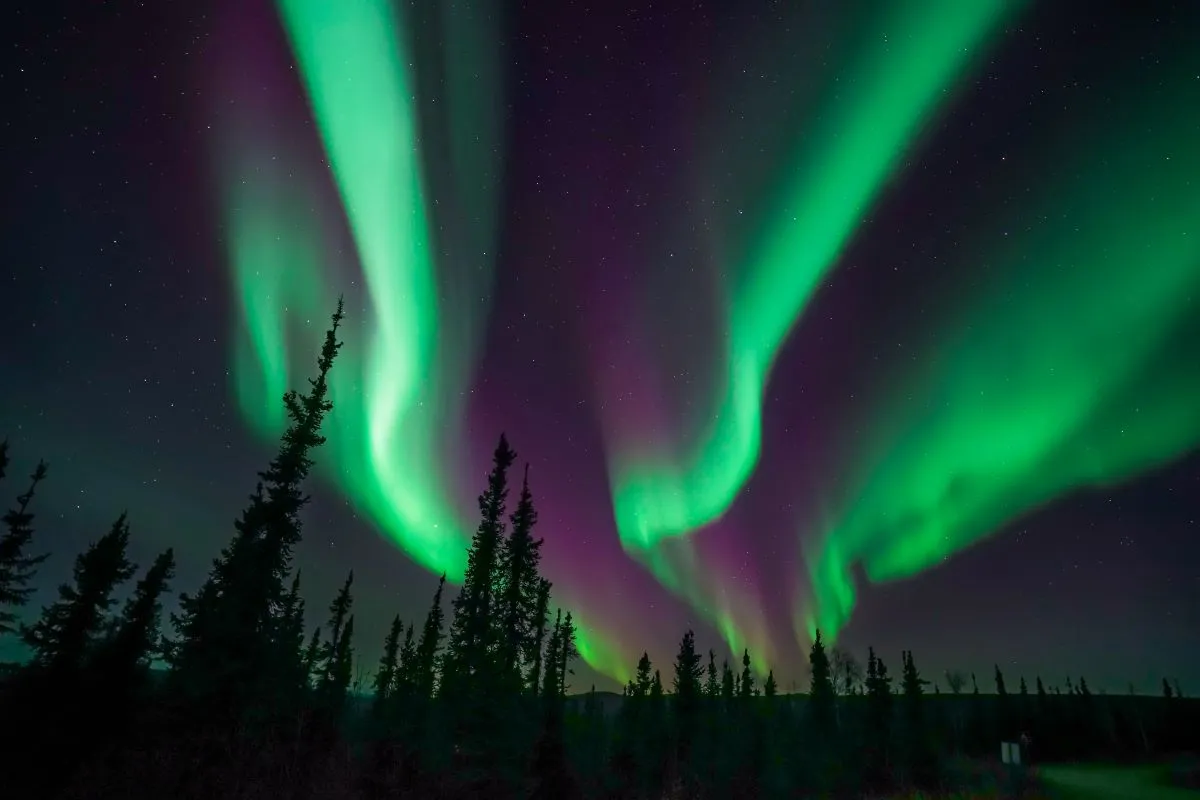
As 2024 draws to a close, the skies over parts of the United States may offer a dazzling display of nature's fireworks in the form of the aurora borealis, or northern lights, thanks to heightened solar activity.
Several eruptions occurred on the sun's surface over the weekend, with two sending material hurtling toward Earth. When this material, called a coronal mass ejection (CME), arrives at Earth on New Year's Eve, it will interact with Earth's atmosphere to form auroras.
"There have been multiple M-Class and X-Class solar flares in recent days that are forecast to make at least a glancing blow to the Earth's magnetosphere sometime over the next 48-72 hours between Monday night and Wednesday night," Brandon Buckingham, a meteorologist at AccuWeather, told Newsweek.
Read More on Science
"Because of the multiple solar flares and the degree of uncertainty of the speed at which they will travel towards the Earth, the forecast time frame for a potential impact from a CME is rather wide—even though the onset of the event is expected to be soon."
...
When Will Northern Lights Be Visible on New Year's Eve?
The exact time at which the geomagnetic storm will hit is difficult to predict. Auroras are typically best viewed during the darkest part of the night, around midnight and the early hours of the morning.
According to the National Oceanic and Atmospheric Administration's (NOAA) Space Weather Prediction Center, "We will not know the true potential of geomagnetic disturbance levels of response until the CME(s) arrive 1 million miles from Earth (when they will be about 30-60 minutes from reaching our planet) and their structure and intensity can be measured by our solar wind observatories."
Where Can I See the Northern Lights?
NOAA is predicting that the northern lights could be viewable on New Year's Eve over a smaller part of the U.S. than the sightings earlier this year, though it may be seen by residents of states that border Canada.
Forecast maps shared by the Space Weather Prediction Center show parts of more than a dozen northern states highlighted with a low-to-medium likelihood of being in the "aurora viewline" from December 30 to New Year's Day.
While it is not certain that the northern lights will be viewable in any of the lower 48 states over New Year's, they might be seen in parts of the following states: Washington, Idaho, Montana, Wyoming, North Dakota, South Dakota, Wisconsin, Minnesota, Iowa, Illinois, Michigan, New York, Vermont, New Hampshire and Maine.

...
How Can I Increase My Chances of Seeing the Northern Lights?
For your best chances of seeing the northern lights tonight, head out to a dark location far from city lights and look northward. Let your eyes fully adjust to the darkness for about 20 minutes.
"One factor aiding in the potential to see the lights is that we are currently in a New Moon phase, allowing the night sky to be very dark," Buckingham said.
"Unfortunately, over the next few days, clear skies will be tough to come by across the northern tier of the United States, likely making it very difficult for widespread viewing ability."
Buckingham pointed to the northern Plains (Dakotas, eastern Montana) as the best place to catch a glimpse of the auroras on Tuesday evening.
What Is a Geomagnetic Storm?
A geomagnetic storm is a disturbance in Earth's magnetosphere caused by solar wind and charged particles ejected from the sun, such as during a solar flare or coronal mass ejection.
These storms can disrupt satellite communications, power grids and navigation systems while also creating spectacular auroras.
Solar flares occur when the sun's intense magnetic fields twist and reconnect, releasing vast amounts of energy.
These flares are typically linked to active regions on the sun, which are often visible as sunspots—areas where the magnetic fields are most concentrated and dynamic.
Flares are classified by their intensity, starting with the smallest, B-class, and progressing through C, M and, the most powerful, X-class.
Much like the Richter scale for earthquakes, this classification system is logarithmic, with each step representing a tenfold increase in energy. An X-class flare is therefore 10 times stronger than an M-class flare and 100 times more intense than a C-class flare.
"A flurry of activity occurred the weekend of 28–29 December," the NOAA's geomagnetic storm watch said on Monday. This "litany" of flares sent out a number of CMEs, with two expected to arrive at Earth over New Year's Eve and New Year's Day.
CMEs can interact with Earth's magnetic field to create geomagnetic storms. These storms, if strong enough, produce spectacular auroras visible at lower latitudes.
Auroras occur when charged solar particles interact with Earth's magnetic field, traveling down its lines toward the poles. Upon entering the atmosphere, these particles collide with gases such as oxygen and nitrogen, releasing energy as vibrant colors of light.
The predominant green hues often seen in auroras are characteristic of oxygen, while nitrogen can produce purples, blues and pinks.
Rare scarlet-red auroras occur during particularly energetic events.
Can You Take Pictures of the Northern Lights With a Phone?
Cameras are much better at picking up auroras than our eyes, so even if you can't see the northern lights yourself, you might be able to catch a spectacular New Year's Eve picture.
If your camera has a longer exposure "Night Mode," this will help increase your odds. For crystal-clear shots, try using a tripod or something to support your phone.
Do you have a tip on a science story that Newsweek should be covering? Do you have a question about solar flares and the Northern Lights? Let us know via science@newsweek.com.
Update 12/31/24, 6:52 a.m. ET: The article was updated to reflect that the geomagnetic storm is forecast for tonight.
View 0 Comments
Submit Correction
View Editorial & AI Guidelines