
...


By Gabe Whisnant and Hollie Silverman
0
Share
Newsweek is a Trust Project member
See more of our trusted coverage when you search.Prefer Newsweek on Googleto see more of our trusted coverage when you search.
A U.S. military refueling aircraft declared an in‑flight emergency while flying near Qatar on Tuesday, according to Iranian state media and flight‑tracking data.
The incident comes as the United States and Iran test a fragile ceasefire amid renewed attacks and efforts to reopen the Strait of Hormuz, a critical global energy corridor. Heightened military activity in the region has put U.S. forces, commercial shipping and regional allies on alert, raising concerns about whether tensions could escalate further.
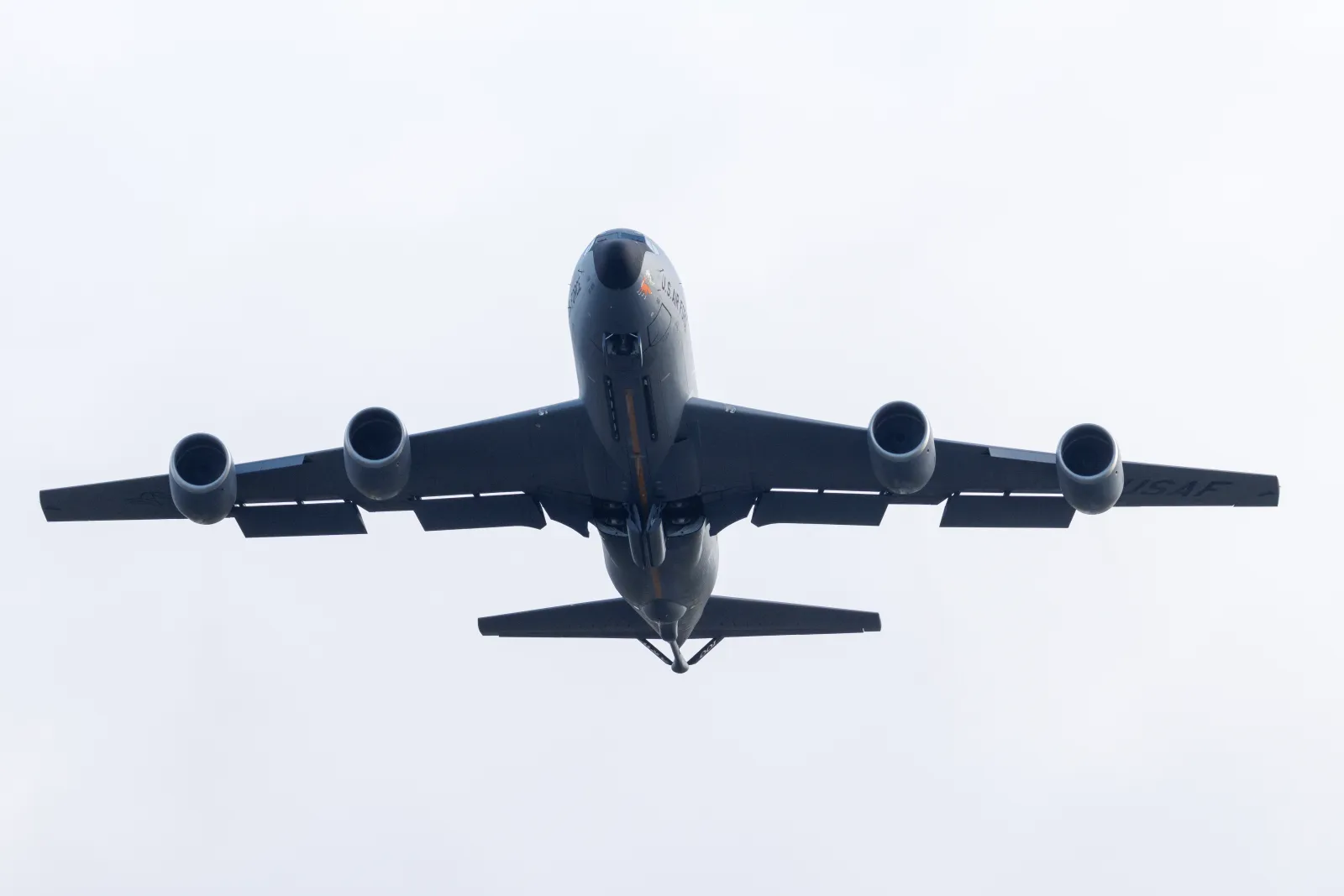
Flight-tracking data cited by Iran’s semi‑official Fars news agency showed a U.S. Air Force KC‑135 Stratotanker transmitting a “7700” general distress signal over the Persian Gulf before disappearing from tracking screens over Qatar. The aircraft, often described as a “flying gas station,” had reportedly taken off from Al Dhafra Air Base in the United Arab Emirates.
Read More on World
Its ultimate destination was not publicly identified, and the U.S. military has not said whether the tanker was en route to a specific base or conducting a refueling mission at the time.
The aircraft landed safely, a U.S. defense official told Newsweek, without providing any additional details.
Newsweek reached out to the U.S. Air Force via email for comment.
Ceasefire Holds as US Pushes to Reopen Strait of Hormuz
The incident comes as U.S. military leaders said Tuesday that a ceasefire with Iran remains in effect, a day after Washington blamed Tehran for new attacks in the Strait of Hormuz and against targets in the United Arab Emirates.
“No, the ceasefire is not over,” Secretary of Defense Pete Hegseth said at a Pentagon press conference, reaffirming Joint Chiefs General Dan Caine’s earlier statements.
The fragile truce, reached nearly a month ago, appeared to be holding as U.S. forces continued efforts to reopen the strategic waterway, a critical route for global energy shipments. On Monday, the U.S. military said it sank six small Iranian boats after they threatened commercial vessels.
President Donald Trump was asked Tuesday what actions by Iran would constitute a violation of the ceasefire, given repeated instances of Iranian fire toward U.S. ships. Trump declined to specify, saying, “You’ll find out, because I’ll let you know. They know what to do, and they know what not to do.”
So far, only two merchant ships have transited a newly established U.S.-protected corridor, while hundreds remain stalled in the Persian Gulf. It remains unclear whether continued U.S. military action will reassure shipping companies without reigniting the conflict sparked by U.S. and Israeli strikes on Iran on February 28.
Meanwhile, Secretary of State Marco Rubio on Tuesday unveiled a joint U.S.-backed United Nations resolution threatening Iran with sanctions if it does not halt attacks on shipping in the Strait of Hormuz. The draft, co-sponsored by Gulf allies, could come up for a vote in the Security Council in the coming days and may trigger penalties or further action if Iran fails to comply.
...
What Is a KC-135 Stratotanker?
The KC‑135 Stratotanker is a U.S. Air Force aerial refueling aircraft that has served as the backbone of America’s tanker fleet since the Cold War. Developed by Boeing in the 1950s and derived from the company’s 367‑80 prototype, the jet entered service in 1957 and was designed to extend the range of U.S. bombers and fighter aircraft by refueling them mid‑air. More than 730 KC‑135s were built, and the aircraft has supported U.S. military operations from the Vietnam War through conflicts in the Middle East and Eastern Europe.
Today’s KC‑135 fleet is operated primarily by the U.S. Air Force, with aircraft based across the continental United States and forward‑deployed overseas. The tankers are flown by active‑duty units, the Air National Guard and the Air Force Reserve and are stationed at major air bases, including those in Kansas, Washington, California and Ohio. KC‑135s fly with a crew of three or three plus a navigator. Upgraded variants, including the KC‑135R and KC‑135T, remain in service while the Air Force gradually replaces part of the fleet with the newer KC‑46 Pegasus.
The KC‑135 Stratotanker has also been involved in one of the deadliest incidents for U.S. air crews during the war with Iran. In March, a U.S. Air Force KC‑135 crashed in western Iraq while supporting combat operations against Iran, killing all six service members aboard, U.S. Central Command said at the time. The aircraft was operating in friendly airspace during Operation Epic Fury and was not brought down by hostile or friendly fire, U.S. military officials said, adding that the cause of the crash remained under investigation.
The incident marked the first Air Force fatalities of the conflict and underscored the risks faced by refueling crews operating over the region.
View 0 Comments
Submit Correction
View Editorial & AI Guidelines