10
Loading video...

By Jordan King
Reporter
0
Share
Newsweek is a Trust Project member
See more of our trusted coverage when you search.Prefer Newsweek on Googleto see more of our trusted coverage when you search.
The proportion of non-religious people in America is growing in every U.S. state except South Dakota, new research suggests.
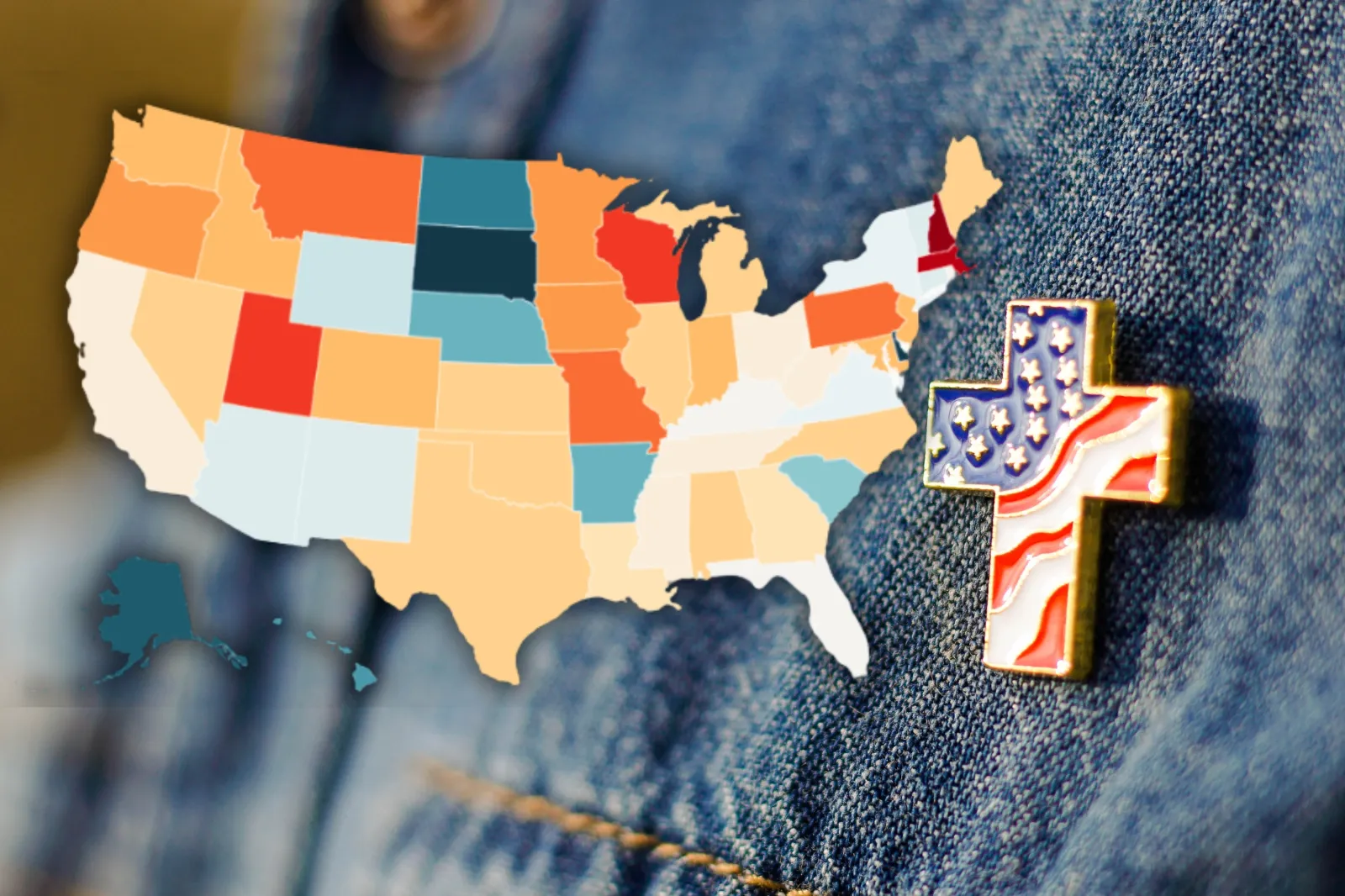
Newsweek's map, below, shows where the change is happening, comparing the oldest available data—from 2007 or in some cases 2014—from Pew's Religious Landscape Study and its most recent, from 2023-24, which surveyed more than 35,000 Americans in all 50 states.
These identifying as "religiously unaffiliated"—atheists, agnostics or as "nothing in particular"—accounted for 29 percent of the national population in 2024's survey. That represents a 13 percent increase from 2007.
Read More on News
Why It Matters
There has been a "long period of sustained growth" in religiously unaffiliated adults, the center's researchers said.
The U.S. is a historically Christian country in which the majority of people (62 percent) call themselves Christians—down from 78 percent in 2007, but researchers said the national decline shows signs of slowing; however "we can't know for sure whether these short-term signs of stabilization will prove to be a lasting change in the country's religious trajectory," co-author Gregory Smith said.
Pew found a huge age gap, with young adults overwhelmingly less religious than their elders—some 46 percent of the youngest Americans identify as Christian, compared to 80 percent of the oldest adults.
"These kinds of generational differences are a big part of what's driven the long-term declines in American religion," Smith said. "As older cohorts of highly religious, older people have passed away, they have been replaced by new cohorts of young adults who are less religious than their parents and grandparents."
What To Know
Pew's 2024 survey suggested New Hampshire, Massachusetts, Utah, Wisconsin, Missouri, Montana and Pennsylvania had the largest growth in the proportion of people who identified as "religiously unaffiliated" since the 2007 study.
In the most recent study, 48 percent of New Hampshire respondents said they were not affiliated with organized religion—up from 27 percent in 2007.
Massachusetts rose from 17 percent in 2007 to 37 percent in 2024—a 20 percent jump— while Utah and Wisconsin increased from 16 percent to 34 percent—an 18 percent rise.
There was a 17 percent rise in Missouri (16 percent to 33) Montana (from 22 percent to 39) and Pennsylvania (from 13 percent to 30).
There is no data from 2007 for Alaska, Delaware, Hawaii, North Dakota, Rhode Island, South Dakota, Vermont and Wyoming because the sample sizes from that year were not significant enough, a Pew Research Center spokesperson said. For these states Newsweek's map compares the 2024 results to 2014, the latest available.
Using only data for 2007-2024 comparison, the following places had the smallest proportional increase in religiously unaffiliated people: Nebraska and Arkansas (5 percent), South Carolina (6 percent), and New Mexico and Connecticut (9 percent).
The overall study disclaims a margin of sampling error of 0.8 percentage points in general and 1.4 percentage points for religiously unaffiliated people.
Pew Research Center also stressed to Newsweek that these margins of sampling error are "much larger" at state level and have been different for each year, meaning "small differences are not statistically significant." For example, New Hampshire has a margin of error of 8 percentage points in the 2023-2024 study and 7.9 percentage points in 2007.
What People Are Saying
Michele Margolis, a University of Pennsylvania political scientist, who has studied religious changes, told The Associated Press that while young adults often move away from religion, it is "more likely to become important when you get married and have kids."
Co-author Patricia Tevington told Newsweek: "Our data only go back to 2007, but other data sources show that the share of Americans who are not affiliated with a religion has been increasing for several decades and has been well underway since at least the 1990s."
What Happens Next
While the proportion of religiously unaffiliated adults has "plateaued in recent years after a long period of sustained growth," Smith said, "something would need to change" to stop the long-term decline of religion in America.
Update 3/11/2025, 11:33 a.m. ET: This article was updated to include comment from Patricia Tevington and more information about the differing margins of error.
...
View 0 Comments
Submit Correction
View Editorial & AI Guidelines