10
Loading video...

By Dan Gooding
Associate News Editor
0
Share
Newsweek is a Trust Project member
See more of our trusted coverage when you search.Prefer Newsweek on Googleto see more of our trusted coverage when you search.
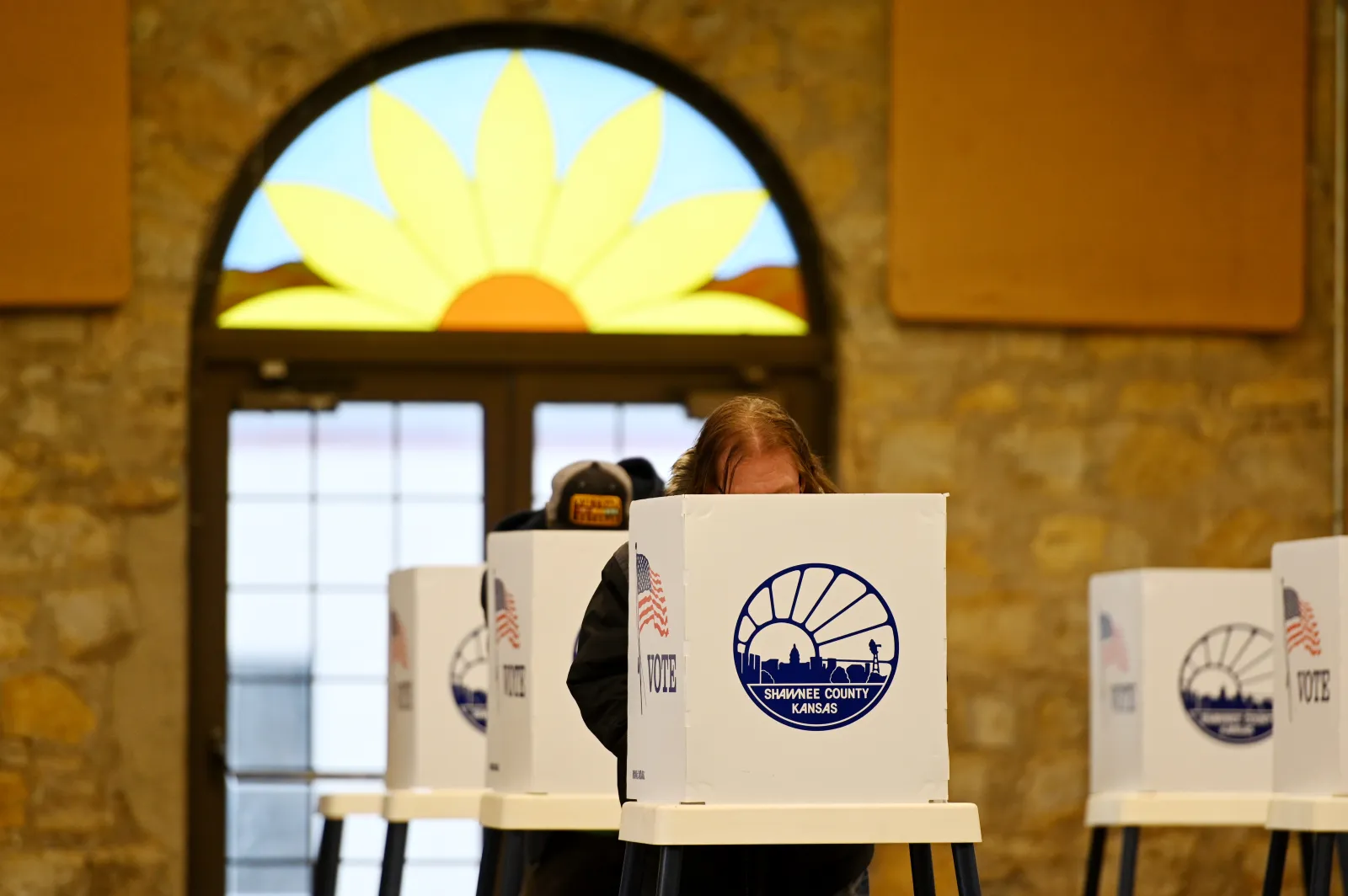
A Republican attorney general who has spent years raising concerns about voter fraud is now pursuing four criminal cases in his state.
Kansas Attorney General Kris Kobach claimed 10 months ago there were likely thousands of cases of non-citizen voters in the state, mirroring claims within the GOP that immigrants are voting in large numbers across the United States.
"So the four is really the tip of the iceberg," Kobach told reporters on September 8. "Those are the ones that clearly the individual knew what he or she was doing; we believe we would get a guilty verdict if the case went to trial. But there are many, many cases where indeed a noncitizen did vote, but for one reason or another there are mitigating factors where we didn't bring the case."
Read More on Politics
Kansas previously tried to enact one of the strictest voter ID laws in the past decade, but federal court ultimately struck it down, with the judge finding no credible evidence that large numbers of non-citizens had registered to vote.
Newsweek reached out to Kobach for further comment.
...
Kansas Non-Citizen Voting: What We Know
Cases of voter fraud have been found and prosecuted in the state, with the most notable in recent years being the mayor of Coldwater, Kansas, being accused of voting in elections despite not being a U.S. citizen. Jose Ceballos, who served as mayor from 2021 and was a registered Republican, faced potential deportation as a result.
In December, officials charged Jose Luis Gomez Sr. in Reno County and Edwin Francisco Ramirez-Guerra in Sedgwick County over alleged voter fraud, per The Topeka Capital-Journal, while another case was filed in June 2026 against a Mariana Alexandra Dewey, also in Sedgwick County. She also faces a federal indictment, filed in September.
Some of the cases Kobach and Kansas Secretary of State Scott Schwab have highlighted involve legal permanent residents, or green card holders. Despite their more permanent status, federal law still prevents them from voting.
While the investigations have led to charges, the votes the small group cast would have had little impact on election outcomes.
Related Story

Trump Slams His Supreme Court Appointees Over Mail-In Voting Decision
How Common Is Voter Fraud Nationally?
President Donald Trump and others within his administration have made repeated claims that there have been high numbers of immigrants, both legal and illegal, voting in federal elections, despite a large body of evidence that such cases are rare.
The Brennan Center for Justice, which has studied election fraud claims for years, has previously described noncitizen voting as "vanishingly rare." In 2024, the organization cited research showing election officials overseeing 23.5 million votes in 42 jurisdictions during the 2016 election referred only an estimated 30 suspected cases of noncitizen voting for further investigation or prosecution.
The conservative Heritage Foundation, which has close ties to the Trump administration's policies, has compiled databases of election fraud, with just 23 instances of noncitizens voting between 2003 and 2022.
In 2026, a handful of cases have emerged in other states, including an announcement by New Jersey's Democratic Governor Mikie Sherrill in July that thousands of noncitizens were able to register to vote due to a software error. Roughly 400 non-citizens went on to vote in elections.
Calls for Tighter Election Security
Trump and other senior Republicans have argued these figures do not give the true scale of the problem and have sought to bring about tougher election measures.
The White House has sought to introduce national voter ID measures, including requiring proof of citizenship when voting. The plans have faced multiple legal challenges, largely because the U.S. Constitution gives states responsibility for administering elections, not the federal government.
Some states have introduced voter ID measures, while others do not require proof of citizenship at registration or at the voting booth. Instead, they use federal databases, including the Social Security Administration and the Department of Homeland Security's SAVE system, to verify identities.
"Since April 2025, more than 24,000 cases have been identified by SAVE as potential non-U.S. citizens who were on voter rolls, and those cases have been referred to ICE's Homeland Security Investigations for further investigation," a DHS spokesperson told Newsweek on August 31. "Over the past year, U.S. Citizenship and Immigration Services has overhauled the SAVE program, making it fully operational and providing states with an easy-to-use tool that has resulted in over 60 million voter verification queries processed since April 2025.
"USCIS is committed to helping eliminate voter fraud and restore trust in America's elections by ensuring only U.S. citizens vote. USCIS continues to strengthen the SAVE program and encourages all states to utilize it."
Overall, voters have supported introducing voter ID. Polls in 2024 from Gallup and Pew Research Center showed over 80 percent of those surveyed supported requiring ID at the polls, with the Gallup survey showing 83 percent support for proof of citizenship.
Heading into the midterms, it is likely more Republicans will cite concerns around non-citizens being able to vote, with Trump administration officials promising to watch states closely as votes are cast and counted.
Contact Newsweek editors on this story: Jason Lemon and Sam Wilson.
View 0 Comments
Submit Correction
View Editorial & AI Guidelines