...

By Maria Azzurra Volpe
Reporter
0
Share
Newsweek is a Trust Project member
See more of our trusted coverage when you search.Prefer Newsweek on Googleto see more of our trusted coverage when you search.
A remarkable underwater discovery in Switzerland has shed new light on daily life and trade along Rome’s northern frontier, after archaeologists recovered hundreds of Roman-era artifacts from Lake Neuchâtel.
The cargo, which dates back nearly 2,000 years, includes pottery, weapons, tools and parts of a horse-drawn vehicle, offering one of the clearest inland-water snapshots of Roman logistics north of the Alps.
The find was discovered in late 2024 during systematic aerial and underwater surveys of the lake. Using drones and sonar mapping, researchers identified unusual formations on the lake bed that hinted at intact archaeological material.
Read More on Science
Although the vessel carrying the cargo has not yet been identified, the artifacts themselves were well preserved beneath the water’s surface.
...
Once the site was confirmed, the Octopus Foundation, a Swiss foundation dedicated to marine exploration and universal knowledge, worked alongside the Cantonal Archaeology Office of Neuchâtel to protect the area and begin careful excavation.
Recovery dives started in March 2025 and were carried out over several controlled campaigns. In total, archaeologists retrieved around 1,200 items. Many objects were fragile and waterlogged, making immediate stabilization critical to prevent rapid decay once exposed to air.
The assortment of artifacts points to a merchant shipment intended for Roman forces operating in the region.
Among the finds were numerous ceramic plates, bowls and cups produced across the Swiss Plateau, alongside amphorae used to transport olive oil from Spain. These imports show how tightly connected local communities were to Mediterranean trade networks.
Weapons and tools were also part of the cargo. Three swords were recovered, one of them still housed in a leather scabbard, as well as a metal pickaxe.
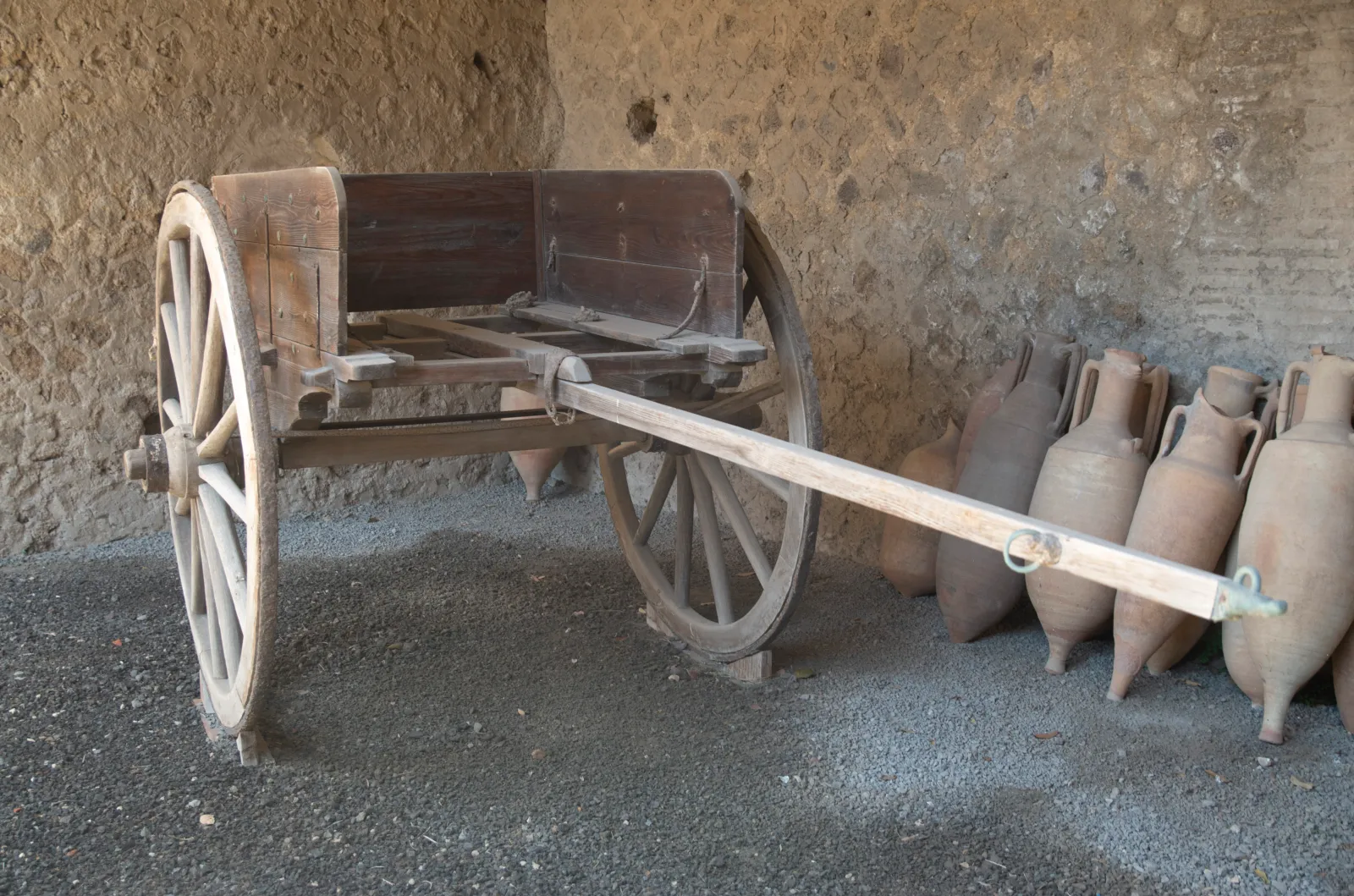
Particularly notable were components of a horse cart or chariot, including wheels, suggesting equipment meant to support overland transport once deliveries reached their destination. A Roman Imperial-era fibula brooch and a waterlogged wooden plank helped researchers narrow down the cargo’s age.
Scientific dating and artifact analysis place the shipment in the early first-century CE, roughly between 16 and 45 CE. Archaeologists believe the goods were likely bound for Vindonissa, a Roman military base along the Aare River that housed the 13th Legion. The garrison played a key role in monitoring and defending the frontier against groups to the north.
The vessel may have departed from the southern shore of Lake Neuchâtel, where the ancient port of Eburodunum—today’s Yverdon-les-Bains—once operated. The presence of Spanish amphorae reinforces the idea that Alpine routes were part of long-distance supply chains serving Rome’s military infrastructure.
Despite the significance of the find, major questions remain. No trace of the ship’s hull has been located, which limits researchers’ ability to reconstruct how the vessel sank. The exact cause of the wreck is also unclear, though the cargo appears to have been lost suddenly.
Cantonal authorities have described the recovery as exceptionally rare for inland waters north of the Alps. Conservation work is now underway, with specialists focusing on stabilizing wood and leather, cleaning ceramics and securing metal objects.
Once treatment is complete, many of the artifacts are expected to go on display at the Museum of Archaeology of Neuchâtel, offering the public a tangible link to Roman-era Switzerland.
View 0 Comments
Submit Correction
View Editorial & AI Guidelines