...

By Joe Kozlowski
Sports Team Lead
0
Share
Newsweek is a Trust Project member
See more of our trusted coverage when you search.Prefer Newsweek on Googleto see more of our trusted coverage when you search.
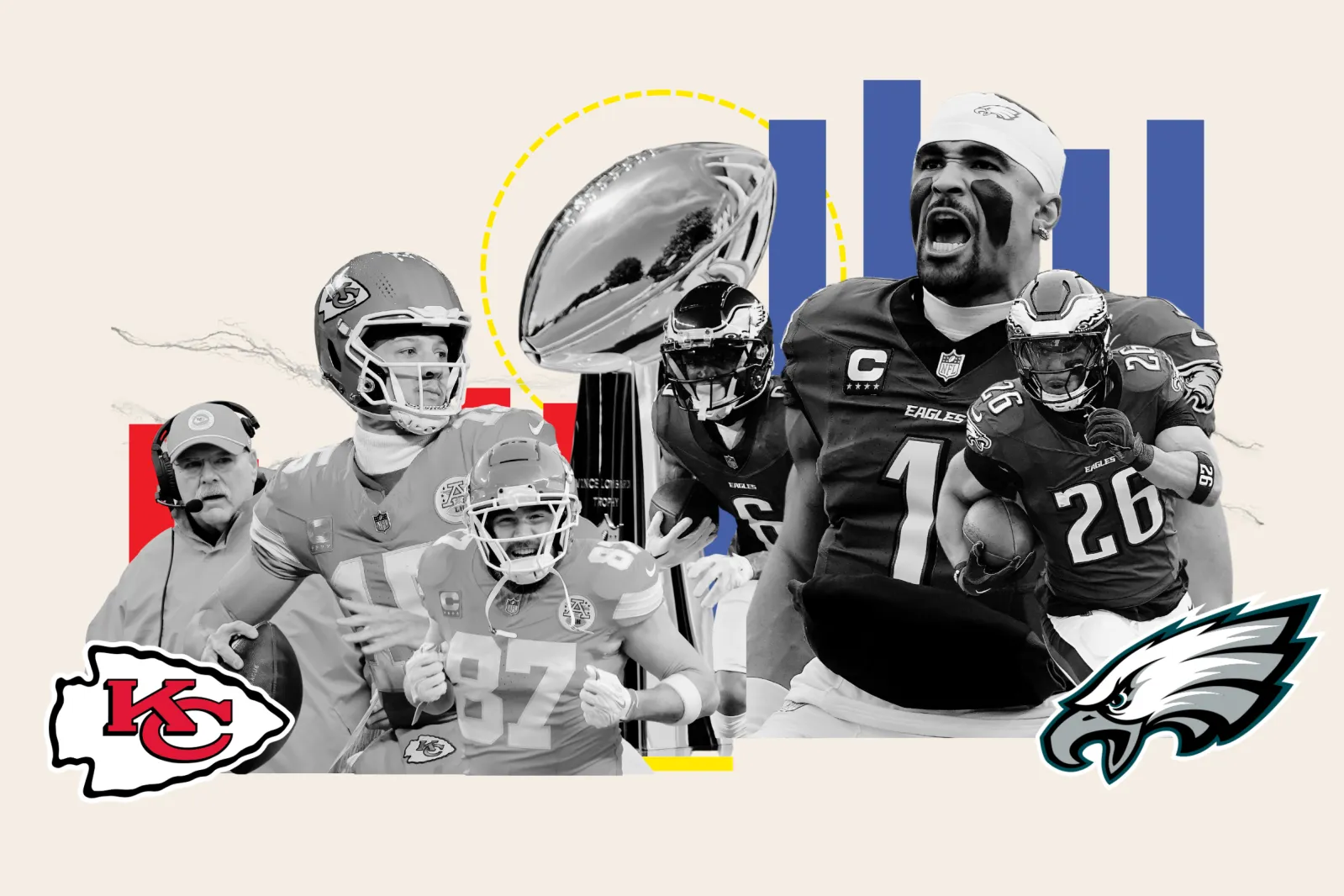
For some fans, there's no question who to cheer for in the Super Bowl. If you're a die-hard Philadelphia Eagles or Kansas City Chiefs fan, there will be plenty of nerves—but no doubts—ahead of the big game. The neutrals, however, face an interesting decision: "Who do I want to win?"
And while there are plenty of memes about "hoping both teams have fun," sports are inherently combative. One team has to come out on top, and it's natural to have a preference.
During the 2024 NFL season, the court of public opinion has ruled against Kansas City. They weren't exactly a fan favorite during the 2023 campaign, as Taylor Swift's burgeoning romance with Travis Kelce and their Super Bowl victory made the team unavoidable. But things ratcheted up as the Chiefs chased a historic three-peat.
Read More on Sports
Consider, for example, the stark difference between national rooting interest ahead of Patrick Mahomes' first Super Bowl and who fans wanted to represent the AFC postseason. The team that seemed like a savior, ready to rescue bored fans from Tom Brady's clutches, now has become its own Goliath.
...
But have you wondered why so many neutrals have generally tended to root against the established power, whether it's the New England Patriots, Kansas City Chiefs or someone else? While there are some situation-specific factors that have colored the past couple of seasons, like Swift's pop-cultural presence and seemingly every commercial break featuring K.C., there's also a general human impulse to support the underdog, even if that may seem counterproductive.
"When I started doing this research, I published my first paper in, like, 2008 on this. It seemed to me kind of like common sense, and an unquestioned assumption," Joe Vandello, a social psychologist and a professor of psychology at the University of South Florida, told Newsweek. "But it actually goes against some classic social psychology....You find that people will often hitch their wagon to successful others. So, people will gain self-esteem through group memberships. We like to take credit in our shared group successes. We call this basking in reflected glory."
So, what is it about rooting for the underdog that causes us to flip the script and cheer for the less-successful choice? While it's tough to nail down a direct cause and effect, there are some common ideas.
"I think it's just some kind of natural sympathy we have for people who are literally underdogs. They're getting overwhelmed by others, they're in trouble, they're in need," George R. Goethals, social psychologist and professor emeritus at the University of Richmond's Jepson School of Leadership, told Newsweek. "I think it's a pretty basic. I know it's a basic tendency to root for underdogs."
Goethals also referenced a study that suggested our sympathies aren't limited to teams or even anthropomorphic characters. We can even root for an underdog shape.
"We did a study that just showed moving geometric shapes," he said. "And they're little circles rolling along a line. There's several variations but there's a big one that moves after the little one that appears to be chasing it....People are just watching geometric shapes, but they think of one as weaker and struggling. If you ask people who they root for, they immediately say the one that looks like it's weaker and struggling.
"And as we said, because we wrote up that study, it's remarkable. Maybe the most remarkable thing is [that] when you ask people 'Which one are you rooting for?' they don't say, 'What the hell are you talking about? What do you mean rooting for one little circle ahead of another?' People get it. They're so tuned into seeing struggling, weak entities, and there's a natural sympathy that goes out for them."
And while that intuitively makes sense—who among us hasn't felt a tiny animal with big eyes tug at our heartstrings?—there could still be a bit more at play.
"People feel that the world is not a fair place," Nadav Goldschmied, a professor of psychological studies at the University of San Diego, told Newsweek. "Financial resources specifically are not distributed equally. Quite the contrary. So, when they are confronting an underdog, they also assume that they are diminished relative to the favorite in terms of financial resources."
If unfairness exists, it can justify standing behind the little guy.
"This is maybe their small way of rectifying the world," Goldschmied added.
On the subject of financial resources, Vandello also noted that salary cap spending can override on-field performance when it comes to evoking underdog sympathies in the sports space.
"People will actually root for the team with the smaller payroll even if they're the favorites," he said.
Think, for example, of how the New York Yankees' and Los Angeles Dodgers' financial might has rubbed many baseball fans the wrong way over the years.
But there may be more at play than just a (potentially) unequal allotment of resources. It's also easier to root for the underdog because of the balance of risk versus reward.
"There's another theory that, because the chances are set as such, if you go with the underdog, you stand only to benefit," Goldschmied said. "In the likely event that it loses, then people expect it to do so.....If you went with the favorite, you don't tend to gain anything in the likely case they prevail. With the underdog, if they lose as they usually do, nothing bad happens. But, again, in the unlikely event that they do prevail, you get the huge emotional uplift."
Beyond that, there's also what an association with one team over another says about you: Would you rather be the big man on campus who's expected to win without breaking a sweat or the plucky underdog who's going to give it 110 percent and fight against the odds? There's a reason that CEOs, presidents and even sports champions tend to highlight their humble origins and hours of behind-the-scenes effort when telling an origin story.
"I think [that] embedded in the underdog concept is working hard," Goldschmied said. "In the competition between talent and trying our best, there's always a preference for trying your best....Working your best, everybody can do it."
Vandello also spoke about the "moral weight" of siding with the underdog.
"Whether it's in sports, whether it's in business, politics, we tried testing these things out in a lot of different domains," he said. "This all stems from the basic idea that there's a lot of research showing that people care deeply about justice, about fairness. We are just wired to care about fairness. And most people at least have some aversion to inequalities. So that seems to apply even to sports, something that seems kind of trivial."
And, in this specific Super Bowl matchup, that morality can also help explain why many neutrals are rooting for Kansas City to fall at the final hurdle.
"With the specific example of the Chiefs, I don't think it's...because they're outspending everyone," Vandello said. "Two things: Part of it is that success becomes boring and predictable, and people want to kind of break from the predictability. We don't want to watch a movie if we already know how it's going to end.
"But I think that part of it is that the Chiefs' success itself starts to feel unfair. Like in a just world, if we believe the world should be a just place, success should be spread around. And I think that other people might think that other fanbases deserve some love. So, it's not just about the excitement of the match, but the 'deservingness' at its core."
That can also help explain why the narrative of things being "rigged" in Kansas City's favor has taken on a life of its own. If we want to root against a team, feeling like they're getting unfair advantages on the way to undeserved wins is an easy way to justify that preference.
"It's probably a post-hoc kind of rationalization to explain people's own 'Why do I hate this team so much?'" Vandello added.
Add some confirmation bias—the Chiefs are frequently playing in important, nationally televised games, making it easier to see and remember bad calls—and you've got a talking point.
But it's not just about supporting the underdog. There's also something to be said for tearing down the established favorite.
Goethals, for example, mentioned tall poppy syndrome (when tall poppies are cut down to be the same height as the other flowers) as a potential touchstone.
"You want to cut them down," he said. "You don't want people to be too big for their britches or, I think, too much better than you. You want to kind of level the playing field and bring down the top dogs or the favorites."
He also noted, though, that in a sporting context, greatness can be acceptable if it's within the context of a one-off, historical event.
"One interesting example is Secretariat," he said. "He was definitely the favorite going into the Belmont Stakes after having won the Kentucky Derby and the Preakness [in 1973], but people wanted him to win because he could do something that hadn't been done 25 years [win horse racing's Triple Crown].
"So, you do like to see people, LeBron James get to 30,000 points or get into his 21st All-Star Game. But you don't want to root for the Yankees after they've won three World Series in a row."
Perhaps the Chiefs have simply landed in an unfortunate sweet spot where their pursuit of a historic three-peat requires a bit too long in the spotlight.
"It can get old very fast," Goethals added. "I think with this Super Bowl, there are a lot of people who don't want to see the three-peat because enough of Patrick Mahomes."
The good (and bad) news, though, is that pro sports success is fleeting. No matter how dominant a team may seem, it's only a matter of time until the script flips. The Chiefs, for example, seemed absolutely cursed before Mahomes arrived, and now it seems that nothing can go wrong. Elsewhere in the NFL, the big, bad New England Patriots slipped from the top of the mountain to the cellar without Tom Brady under center. The target is off their backs.
But until the NFL tide changes again, Kansas City doesn't seem to collectively be bothered by being the "tall poppy" that others are looking to see cut down to size. As Mitch Holthus, the main play-by-play voice of the team's radio network has explained, "You can doubt the Chiefs. You can dislike the Chiefs. You can disrespect the Chiefs. You're gonna have to deal with the Chiefs!"
After decades of falling short, being rooted against is a small price to pay for an era of unprecedented success.
View 0 Comments
Submit Correction
View Editorial & AI Guidelines