
...

By Jesus Mesa
Reporter
0
Share
Newsweek is a Trust Project member
See more of our trusted coverage when you search.Prefer Newsweek on Googleto see more of our trusted coverage when you search.
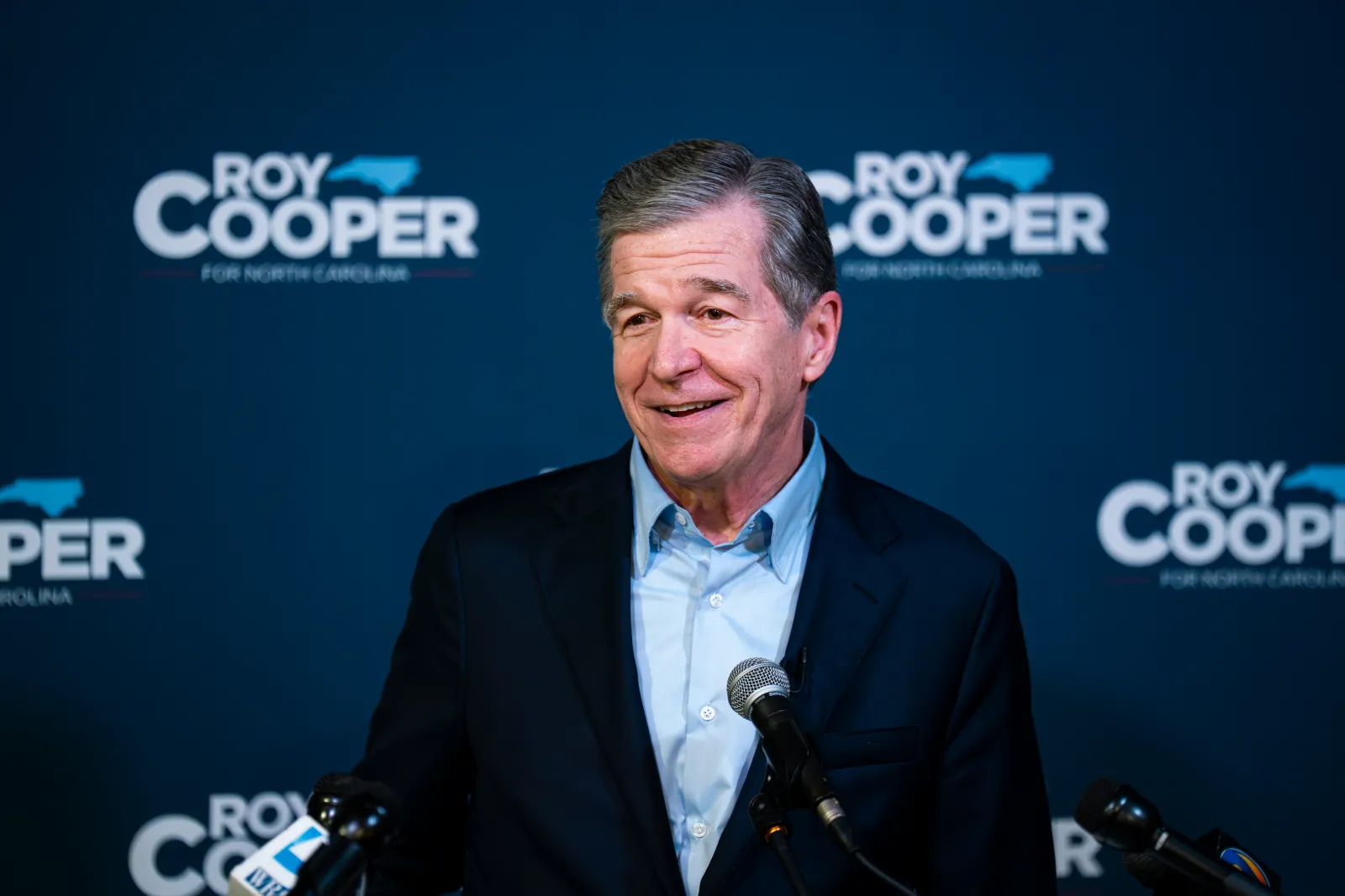
Former Democratic Governor Roy Cooper holds a commanding early lead over Republican Michael Whatley in the race for North Carolina's open U.S. Senate seat, according to a poll commissioned by Healthier United, a health care advocacy group and released March 27.
The survey, conducted March 8–9, shows Cooper ahead 50 percent to 32 percent, with Libertarian Shannon Bray at 4 percent and 14 percent undecided. The margin is considerably wider than two other recent surveys.
Why It Matters
North Carolina's open Senate seat represents one of Democrats' few plausible pickup opportunities in 2026. Democrats need to net four seats to flip the Senate, making any movement in this state's race consequential for chamber control.
Read More on Politics
What To Know
The Healthier United poll, conducted March 8–9 and released March 27, found Cooper at 50 percent to Whatley's 32 percent—an 18-point lead. The Healthier United survey was conducted just days after both candidates clinched their nominations on March 3, when Whatley in particular had yet to establish his profile with general election voters.
Paul Shumaker of Capitol Communications, one of the pollsters, said Whatley's immediate challenge is building name recognition. Cooper is currently drawing 10 percent support from Republican voters, a share Shumaker said is unlikely to hold as the campaign matures. Unaffiliated voters will ultimately be decisive.
“North Carolina is a state that’s a good reflection of the country as a whole,” Shumaker said.
...
Nearly 78 percent of likely voters rated their interest in the Senate election an 8, 9, or 10 on a scale of one to 10. Among those giving a perfect score, Democrats hold a clear engagement advantage: 73 percent of Democrats, compared to 59 percent of Republicans and 60 percent of unaffiliated voters.
A majority of North Carolina voters—58 percent—say the country is headed in the wrong direction, with only 35 percent saying it is on the right track. The pessimism is more pronounced among the most engaged: 62 percent of voters rating their interest a 10 said the country is on the wrong track.
President Trump's favorability in North Carolina stands at 40 percent favorable and 53 percent unfavorable. Governor Josh Stein draws a net positive image—39 percent favorable to 25 percent unfavorable—though 36 percent of voters have either no opinion of him or have never heard of him.
On health care, which Healthier United emphasized, 27 percent of voters said lower costs are what they most need to improve their health. Overall, 58 percent said costs are too high, but they pay anyway, and 17 percent said costs are so high that they have skipped needed care. Only 23 percent said they are satisfied with what they pay.
An earlier Carolina Journal poll conducted March 22–23 showed Cooper ahead 49 percent to 41 percent, an 8-point margin. A Public Policy Polling survey from March 13–14 found the race tighter, with Cooper at 47 percent and Whatley at 44 percent, within the poll's margin of error.
Nexus Strategies and Strategic Partners Solutions conducted the Healthier United survey among 800 registered North Carolina voters. The margin of error is plus or minus 3.46 percentage points at a 95 percent confidence interval.
What People Are Saying
Paul Shumaker of Capitol Communications, one of the pollsters on the Healthier United survey, said: "The bigger challenge for Michael Whatley right now is getting a level of identity established and defining that level of identity as it matters going into the Senate race."
Morgan Jackson of Nexus Strategies, the survey's other lead pollster, said: "The thing that stands out the most to me is that 75 percent of people right now in North Carolina are extremely concerned about health care costs. About one-in-six of those folks have opted out of the system because they can't afford it."
What Happens Next
The general election is scheduled for November 3, 2026. Both campaigns are expected to intensify outreach as Whatley builds name recognition and unaffiliated voters emerge as potential tiebreakers in a state known for late movement.
In a polarized era, the center is dismissed as bland. At Newsweek, ours is different: The Courageous Center—it's not "both sides," it's sharp, challenging and alive with ideas. We follow facts, not factions. If that sounds like the kind of journalism you want to see thrive, we need you.
When you become a Newsweek Member, you support a mission to keep the center strong and vibrant. Members enjoy: Ad-free browsing, exclusive content and editor conversations. Help keep the center courageous. Join today.


View 0 Comments
Submit Correction
View Editorial & AI Guidelines