...

By Hollie Silverman
News Editor
0
Share
Newsweek is a Trust Project member
See more of our trusted coverage when you search.Prefer Newsweek on Googleto see more of our trusted coverage when you search.
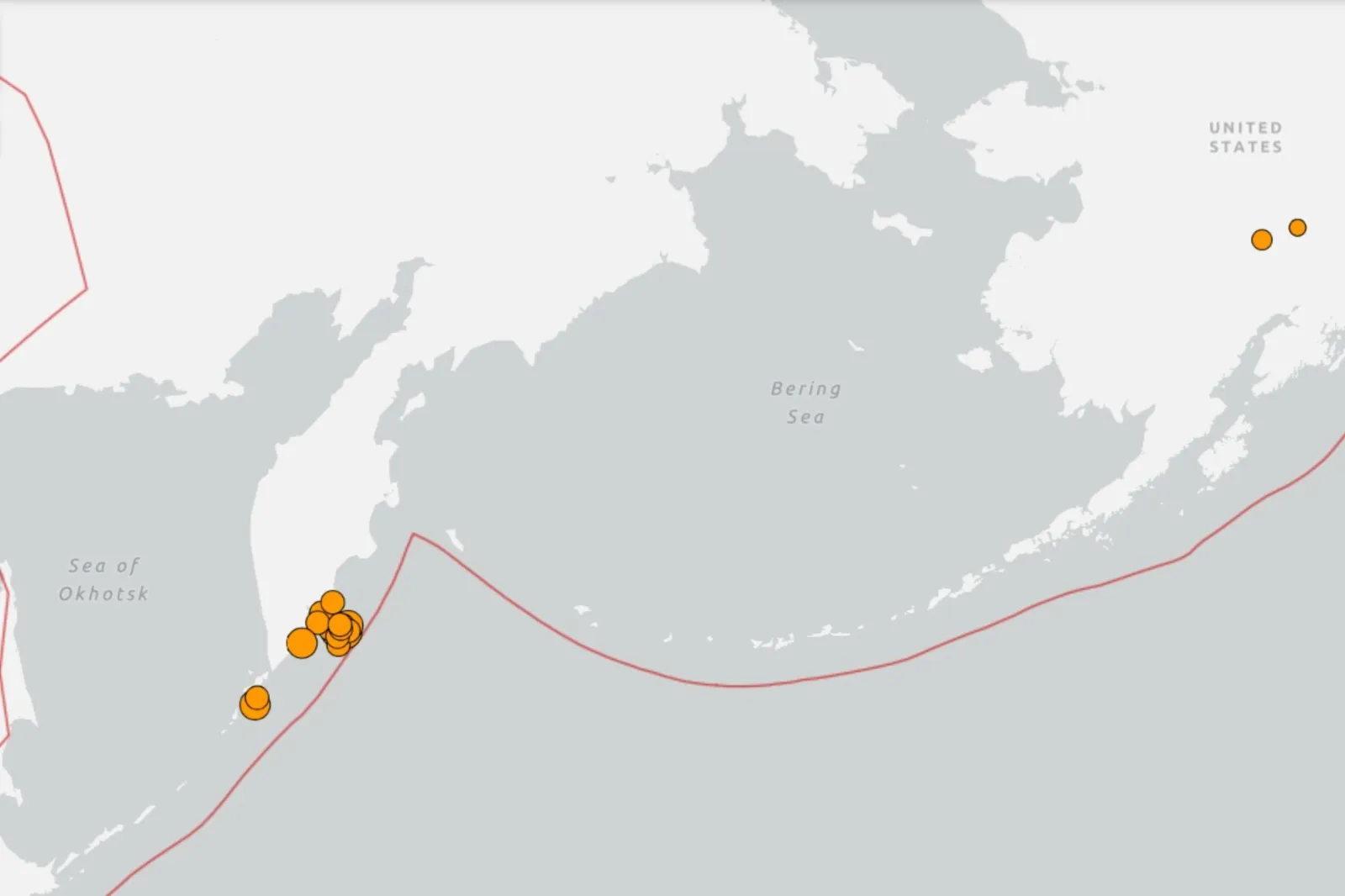
Nearly two dozen earthquakes have struck off the coast of Russia, near the Kamchatka Peninsula, in the last 24 hours, according to the U.S. Geological Survey (USGS).
The temblors were measured from 4.3 to 6.1 magnitude, the latter considered a strong earthquake that could inflict damage on populated areas.
No injuries, deaths or destruction were immediately reported, and no tsunami warning was issued following Monday's series of quakes.
Read More on News
The region has seen frequent seismic activity over the last few months, with a potent 8.8 magnitude earthquake striking on July 29 and prompting tsunami warnings up and down the U.S. West Coast.
Why It Matters
The Kamchatka Peninsula is among the world’s most seismically active areas, sitting at the tectonic boundary where the Pacific Plate subducts beneath the Okhotsk Sea Plate along the Kuril-Kamchatka Trench.
The latest series of earthquakes came on the heels of the late July powerhouse, which tied for the sixth-strongest quake ever recorded by modern instrumentation.
This succession of aftershocks and seismic events highlights the ongoing geophysical risks facing Kamchatka and underscores the importance of international scientific oversight and hazard preparedness, particularly for surrounding Pacific nations and U.S. interests on the West Coast, Hawaii and Alaska.
What To Know
The USGS registered 22 separate earthquakes around the Kamchatka Peninsula on November 2 and November 3. The magnitude of these quakes varied, with some strong enough to be felt locally and potentially exacerbate landslide and tsunami risks.
At 7:25 p.m. EDT July 29, a magnitude 8.8 temblor struck off the shores of Kamchatka. The rupture zone measured about 300 miles by 100 miles, with the fault slipping by as much as 30 feet.
Occurring at a depth of about 12 miles, the earthquake displaced the seafloor vertically, triggering tsunami warnings and evacuations across the Pacific, with warnings affecting communities in Russia, Japan, Canada, Hawaii and the U.S. West Coast.
...
That massive quake prompted tsunami warnings across the Pacific and set off a rare cluster of simultaneous volcanic eruptions in the region, while tying the 2010 Chile and 1906 Ecuador-Colombia shakes as the sixth-strongest earthquake ever measured.
It triggered seven volcanoes in Kamchatka for the first time in nearly three centuries, including the Klyuchevskoy and Krasheninnikov. Researchers from the Russian Academy of Sciences attributed the volcanic surge directly to the sequence of seismic shocks. The southern peninsula reportedly shifted up to 6 1/2 feet to the southeast during the quake.
USGS scientists, in a forecast issued days after July 29, anticipated a high likelihood of ongoing aftershocks—including a 24 percent chance of further magnitude 7 or stronger earthquakes and more than a 99 percent chance of magnitude 5 or greater ones in the weeks and months ahead.
What People Are Saying
William Yeck, USGS seismologist, in a forecast after the July 29 earthquake: “Rapidly understanding the size, location, and mechanism of the earthquake is crucial for agencies, like the National Oceanic and Atmospheric Administration, to issue accurate tsunami warnings and for the USGS to estimate the earthquake's shaking-related impacts."
What Happens Next
Seismic monitoring in Kamchatka will continue as scientists expect more aftershocks in the foreseeable future, with the USGS and Russian scientific agencies providing ongoing updates.
Governments and emergency services remain on alert for additional seismic or volcanic hazards.
The evolving nature of aftershocks and renewed volcanic activity highlight continued risks for local populations and international coastal regions linked by the Pacific Rim.
View 0 Comments
Submit Correction
View Editorial & AI Guidelines