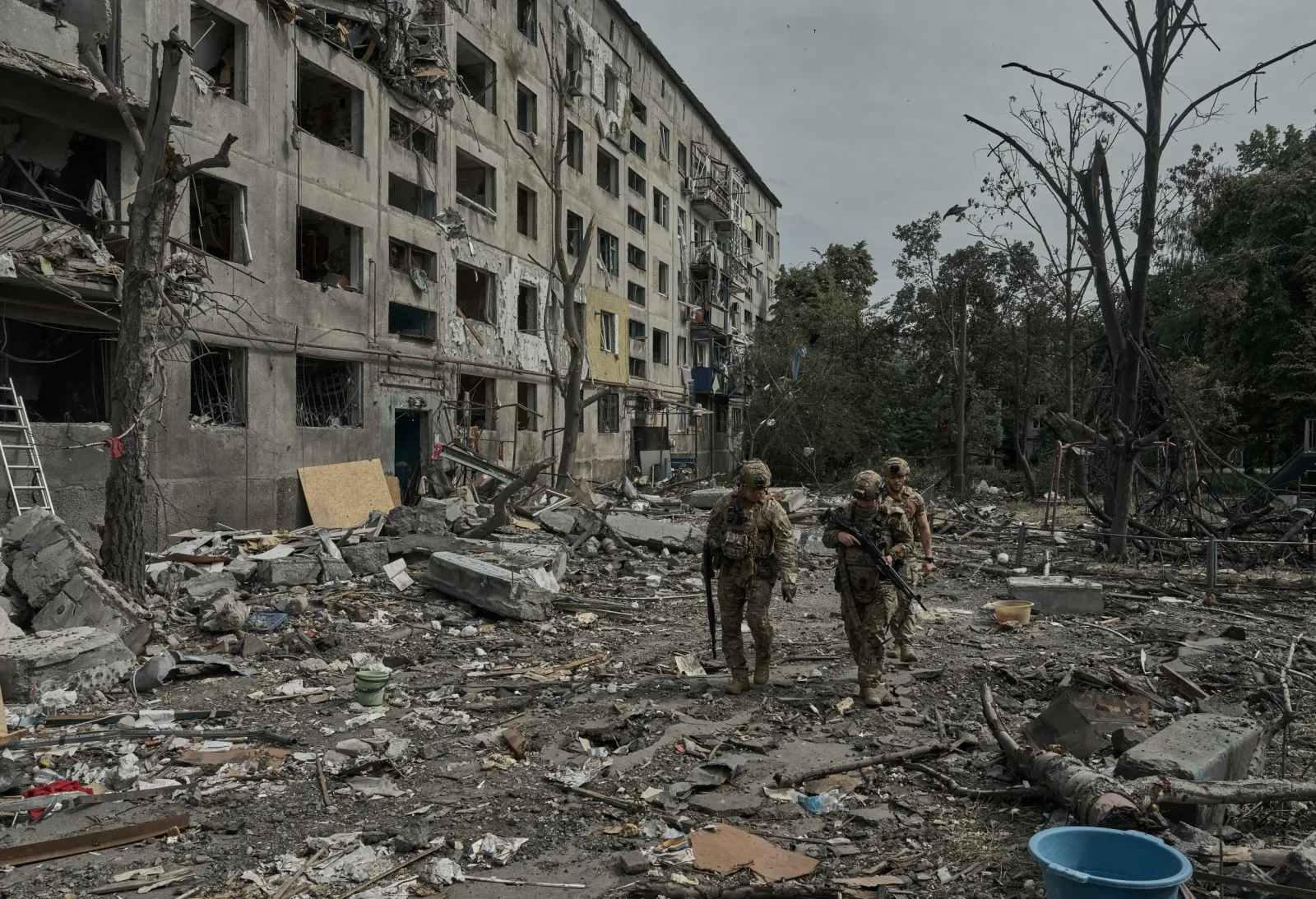
...


By John Feng and Brendan Cole
0
Share
Newsweek is a Trust Project member
See more of our trusted coverage when you search.Prefer Newsweek on Googleto see more of our trusted coverage when you search.
Russian forces are pushing hard in Ukraine's Donetsk region in the hope a breakthrough that can provide leverage in the summit between President Donald Trump and Kremlin Leader Vladimir Putin, the Institute for the Study of War (ISW) has said.
Ukrainian sources reported sabotage and reconnaissance groups were infiltrating near Dobropillia which is northwest of Pokrovsk, the Donetsk hub that is key to Moscow capturing the whole of the region.
The ISW said that Moscow is likely focusing on advances to coincide with Friday's U.S.-Russia summit in Alaska as a Newsweek map shows the front line's state of play.
Read More on World
Newsweek has contacted the Russian Defense Ministry for comment.
...
Why It Matters
Anticipation is building ahead of Friday's summit and whether Putin will try to pressure his U.S. counterpart into accepting Moscow's control over partially occupied areas in exchange for a ceasefire, as has been reported.
The ISW analysis suggests that Putin wants to leverage tactical pushes to seek U.S. concessions as he tries to frame the full capture of Ukraine's regions of Luhansk, Donetsk, Zaporizhzhia, and Kherson oblasts as inevitable.
What To Know
The ISW assessed that Russian forces had likely recently seized settlements southeast and east of Dobropillia, as the think tank noted a claim by the Russian Ministry of Defense that Moscow's forces had seized Fedorivka, which is northeast of Pokrovsk.
The think tank said it was premature to call the Russian advances an operational-level breakthrough, but Moscow would like to see it develop into one in the coming days.
Russian forces used a similar tactical penetration in April 2024, and the coming days in the Pokrovsk area will be critical for Ukraine's ability to prevent accelerated Moscow gains north and northwest of the city, the ISW said.
Finnish geopolitical analyst Joni Askola told Newsweek Tuesday that Russia's breach near Dobropillia isn't as dramatic as some portray it—but it's still a serious issue that must be addressed.
Russia has a large concentration of troops in the area and continues probing for weak spots and their tactic is gradual infiltration—sending small groups without heavy equipment to test defenses, Askola said.
The groups that breached Ukrainian lines this time can still be eliminated, but the danger grows if Russia manages to expand the flanks and bring in more troops and equipment before that happens, Askola added.
This breach is still small compared to past breakthroughs, but Ukraine has sent units, including from the 1st Azov Corps, to contain it.
The First Corps Azov of the National Guard of Ukraine said on Facebook that it had taken up defensive positions on the Pokrovsk front a few days ago as Russian troops advanced in small groups toward Dobropillia, bypassing the first line of Ukrainian positions.
What People Are Saying
The Institute for the Study of War said on Monday: "It is premature to call the Russian advances in the Dobropillia area an operational-level breakthrough, though Russian forces very likely seek to mature their tactical advances into an operational-level breakthrough in the coming days."
Ukraine's First Corps Azov posted on social media: "The situation remains difficult and dynamic. The enemy, trying to advance on this front, is suffering significant losses in personnel and equipment."
Finnish geopolitical analyst Joni Askola told Newsweek: "This is not a breakthrough, nor is it close to a collapse of the front—at least not yet. Similar situations have occurred before, including during Russia's Kharkiv offensive in 2024...but it's still a serious issue that must be addressed.
What Happens Next
A statement by European leaders on Tuesday said borders cannot be changed by force, showing backing for Kyiv by its allies that any land swap for a ceasefire cannot be considered in Friday's summit, as has been previously reported.
However the statement, which was notably not signed by Hungary's Prime Minister Viktor Orban, expressed support for Trump's efforts to end the war, but insisted "meaningful negotiations" could only begin with a ceasefire or a significant reduction in hostilities, and diplomatic pressure on the U.S. will likely continue in the coming days.
Update 08/12/25, 11:35 a.m. ET: This article has been updated with comment from Joni Askola.
View 0 Comments
Submit Correction
View Editorial & AI Guidelines