...

By Ryan Chan
China News Reporter
0
Share
Newsweek is a Trust Project member
See more of our trusted coverage when you search.Prefer Newsweek on Googleto see more of our trusted coverage when you search.
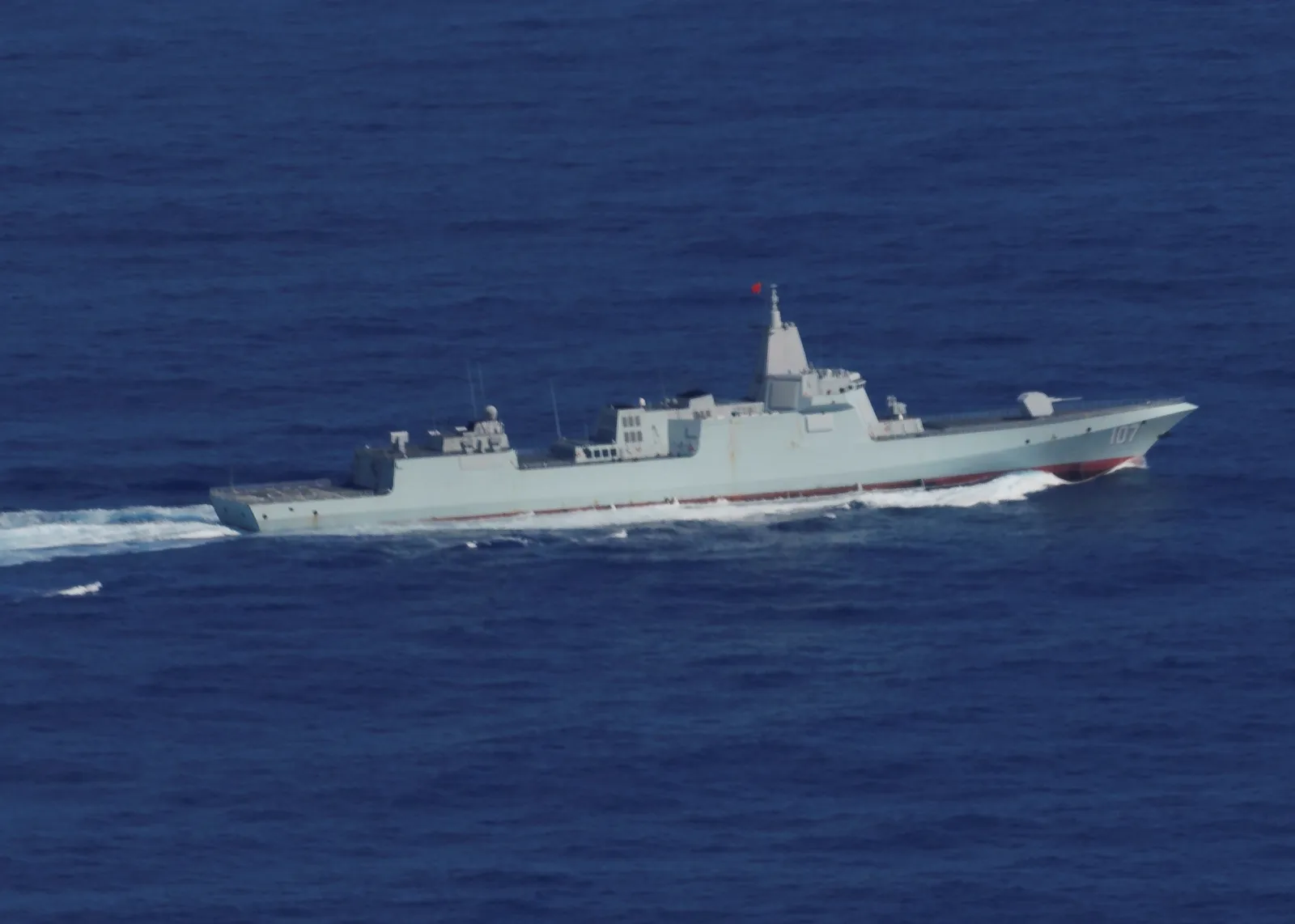
Satellite imagery shows a Chinese naval fleet in the western Pacific, which Australia—a key United States ally—is monitoring amid its possible approach to the country.
On Monday, Australian Defense Minister Richard Marles confirmed the presence of the Chinese warships but refused to provide details, saying the military would continue to track their movements "until we know that task groups are not coming to Australia."
Lin Jian, a spokesperson for the Chinese Foreign Ministry, responded on Monday that the country's naval vessels always operate at sea in accordance with international law.
Read More on World
Why It Matters
China, which operates the world's largest navy by number of warships—with more than 370 ships and submarines, including three aircraft carriers—is steadily expanding its military reach in the Pacific, asserting influence and advancing its national interests.
Between mid-February and early March, the Chinese military dispatched a three-ship task group to circumnavigate Australia, where it staged live-fire drills off the coast. Beijing defended the maneuver, saying it was normal for a major power to demonstrate its sea capabilities.
...
Facing China's increasingly assertive activities in the Pacific, Australia is enhancing its military capabilities with U.S. support, including developing conventionally armed, nuclear-powered submarines and acquiring both manned and unmanned patrol aircraft.
What To Know
Starboard Maritime Intelligence, a New Zealand-based company, said on Tuesday that satellite technology tracked a Chinese naval surface action group in the Philippine Sea, 300 miles east of the Philippines, the Australian Broadcasting Corporation reported.
The company said the Chinese flotilla, which is "definitely going southeast," consists of a Type 075 amphibious assault ship, a Type 052D destroyer, a Type 054A frigate and a Type 903A replenishment vessel, representing a significant projection of naval power.
The Type 075 amphibious warship is designed to project power from sea to shore, a key capability in island-landing missions. The Chinese navy operates four vessels of the class, with the fourth, CNS Hubei, officially confirmed in August to be in service.
"Australians can be assured that we are monitoring our areas of interest and we are monitoring the movements of the Chinese Navy," Marles said at a news conference, referring to Southeast Asia, Northeast Asia, the Northeast Indian Ocean and the Pacific.
While the minister said he would not give "a running commentary" on every movement of the Chinese navy in these four areas, he acknowledged, "We don't know where it's going," as the Chinese ships could have "a whole lot of destinations" across the Philippine Sea.
Meanwhile, the Chinese military on Tuesday released images of the Hubei conducting what it called "high-intensity, multi-subject training" in undisclosed waters. It said the amphibious warship was leading a naval formation to hone its combat capabilities.
Joaquin Camarena, an intelligence analyst on the Chinese military, suggested that the three Chinese naval vessels that transited the Osumi Strait south of Japan on November 11 could be the same ones spotted by Starboard Maritime Intelligence near the Philippines.
The ships, identified by hull numbers as the Type 055 destroyer CNS Anshan, the Type 054A frigate CNS Linyi and the Type 903A replenishment ship CNS Dongpinghu, passed eastward through the waterway from the East China Sea to the Philippine Sea.
What People Are Saying
Richard Marles, Australia's minister for defense, said in a statement: "We maintain constant maritime domain awareness in our geographic areas of interest—that's Southeast Asia, Northeast Asia, the Northeast Indian Ocean, and the Pacific. And in that context, we will routinely monitor the movements of [People's Liberation Army Navy] vessels. And when there are movements such as this, we will monitor them, particularly until we know that they are not coming in the vicinity of Australia."
The Chinese navy wrote on X: "Recently, a task group led by the Chinese [People's Liberation Army Navy ship] Hubei conducted multi-day maritime training. Through multiple drills such as ship-aircraft coordination and live firing, the training fully tested the task group's system-of-systems operational capability and honed its ability to perform diverse tasks under complex conditions."
What Happens Next
It remains to be seen whether the Chinese military will provide additional information regarding its naval activities in the Philippine Sea. If the Chinese warships sail close to Australia, it could serve as a signal amid the U.S.-Australia military partnership.
View 0 Comments
Submit Correction
View Editorial & AI Guidelines