...

By Micah McCartney
Reporter
0
Share
Newsweek is a Trust Project member
See more of our trusted coverage when you search.Prefer Newsweek on Googleto see more of our trusted coverage when you search.
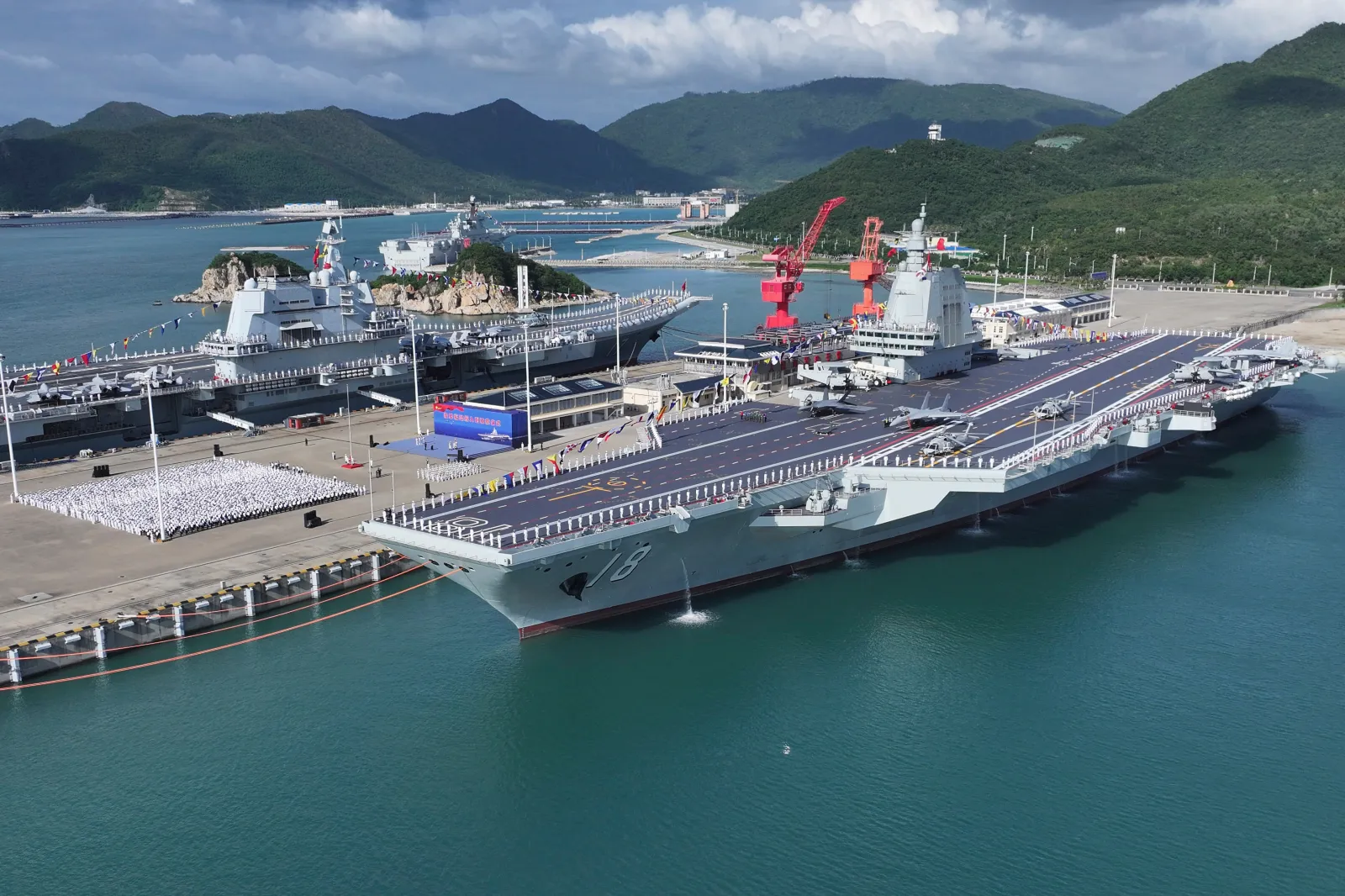
Satellite imagery revealed both of China’s indigenously built aircraft carriers—including the newly commissioned CNS Fujian—docked side by side at their home port in Yulin Naval Base.
Why It Matters
China’s increasingly sophisticated carrier program is the pride of its fleet—the world’s largest by hull count. Home to the PLA Navy’s Southern Theater Command, Yulin boasts a range of specialized facilities to service flattops, submarines, and other vessels.
Read More on World
Situated on southern Hainan’s Yulin Bay, it also serves as a gateway to the South China Sea, where China maintains competing territorial claims with several neighbors. Beijing’s feud with the Philippines has grown more tense in recent years as Chinese maritime forces expand their presence within the U.S. treaty ally’s exclusive economic zone.
Newsweek reached out to the Chinese Defense Ministry via email for comment outside of regular office hours.

...
What To Know
Satellite imagery flagged by open-source analyst MT Anderson and captured by the European Space Agency’s Sentinel-2 satellites shows the CNS Shandong and China’s second and third aircraft carriers, respectively, docked at Yulin.
As of Tuesday, only the Fujian remained at port there.
The Fujian entered service earlier this month in a ceremony overseen by Chinese President Xi Jinping. Last week, satellite images captured the carrier conducting its first training exercises since commissioning.
The Fujian is the first Chinese carrier equipped with catapults, a departure from the “ski ramp” used to launch aircraft from both the Shandong and the Liaoning, a refitted Soviet-era vessel purchased from Ukraine. The Liaoning is home-ported in the northeastern city of Qingdao, on the Yellow Sea.
...
What People Are Saying
Nick Childs and Douglas Barrie, senior fellows with the London-based International Institute for Strategic Studies, wrote in an analysis earlier this month: “It is still unclear how the PLAN [People’s Liberation Army Navy] envisions employing its carriers in the long term. In a potential conflict with Taiwan, they could pose a threat from different directions to complicate the island nation’s defenses, or act as blocking forces against potential intervention by the U.S. and its partners.
“Fundamentally, though, Beijing’s main motivation in investing in this capability is that it sees aircraft carriers as an indispensable element in building a ‘blue-water’ navy that can independently project power and exert influence worldwide as part of China’s long-term ambition to be a global ‘great power.’”
What Happens Next
China has already begun work on its fourth aircraft carrier, currently known as the Type 004. Defense analysts believe that, unlike China’s three conventionally powered carriers, the next will likely use nuclear propulsion—similar to the U.S. Navy’s supercarriers.
Xi aims to complete the country’s military modernization by 2035 and achieve a “world-class” military by 2049, the centennial of the People’s Republic of China. In practice, many analysts believe this means surpassing U.S. dominance in the Pacific.
View 0 Comments
Submit Correction
View Editorial & AI Guidelines