
...

By Sam Stevenson
Associate News Editor
0
Share
Newsweek is a Trust Project member
See more of our trusted coverage when you search.Prefer Newsweek on Googleto see more of our trusted coverage when you search.
Saudi Arabia’s multi-trillion-dollar desert giga-project Neom—once pitched as a revolutionary new model for urban living—appears headed for a dramatic rethink.
Newsweek reached out to Neom via a contact form on its website for comment.
Why It Matters
Any shift in Neom’s scope carries implications for global contractors, technology firms, and potential tenants that have engaged with what was billed as one of the world’s largest construction programs along the Red Sea.
Read More on News
The planned redesign underscores a major recalibration of Saudi Vision 2030’s most high-profile urban initiative, reflecting fiscal pressures, slower progress than advertised, and an effort to align buildout with market demand ahead of costly commitments tied to Expo 2030 in Riyadh and the 2034 FIFA World Cup.
...
What To Know
After years of delays, spiralling costs and increasingly strained public finances, Crown Prince Mohammed bin Salman’s flagship development is now set to be significantly scaled back and redesigned, people familiar with an ongoing internal review told the Financial Times.
It represents a setback for Vision 2030, a national blueprint introduced in 2016 by Saudi Arabia’s leader to broaden the Kingdom’s economic base, cutting its dependence on oil and strengthening key public sectors such as health care, education, infrastructure, tourism, and recreation.
This latest shake-up includes a radical rethink of The Line—Neom’s centerpiece—while officials weighed pivoting parts of the development toward industrial uses such as data centers, according to the FT, citing people briefed on the matter.
According to the FT, the Crown Prince, who chairs Neom, now envisions a project "far smaller" than originally planned, after a review process launched under new CEO Aiman al-Mudaifer assessed scope, phasing, and priorities.
It marks one of the most consequential recalibrations yet of the kingdom’s Vision 2030 agenda, a programme that has long leaned on Neom as its most glamorous symbol of national transformation.
But the original vision—vast, futuristic and spectacularly expensive—has collided with economic reality.
Officials now concede the project must be reshaped into something more practical, more focused and far smaller in scale.
Neom told the FT in a statement that it was "always looking at how to phase and prioritise our initiatives so that they align with national objectives and create long-term value," and added the development was advancing "in line with strategic priorities, market readiness and sustainable economic impact."
Neom’s vast footprint—roughly the size of Belgium—was first unveiled in 2017 with promises of green energy, flying taxis, robot assistants and a built‑from‑scratch society powered by innovation.
At its heart stood The Line, a proposed 105-mile (170‑kilometre) linear city formed by two parallel, 1,640 feet-tall (500 metre) mirror‑clad skyscrapers slicing across desert and mountains.
It was meant to house up to nine million people and operate entirely on renewable energy. But today, that centrepiece has been overtaken by a more sobering reality.
Multiple sources told the FT that The Line will be radically scaled back, with architects already reworking it into a much more modest concept that repurposes existing infrastructure rather than attempting anything close to the original plan.
The megacity is now expected to shift away from utopian urban design and toward industrial uses, particularly large‑scale data‑centre capacity, which Saudi Arabia sees as essential to its ambitions in artificial intelligence.
The pullback stretches beyond The Line. Trojena, Neom’s mountain ski resort originally selected to host the 2029 Asian Winter Games, will be downsized and will no longer host the event.
Saudi authorities announced the change over the weekend, reflecting yet another high‑profile element of the megacity that is being re‑evaluated.
...
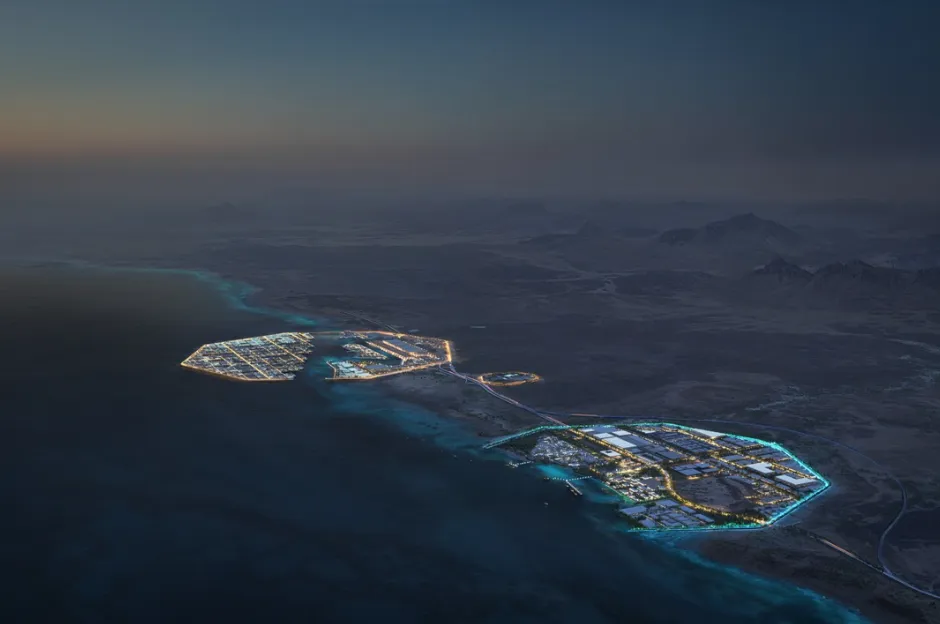
Other components—such as Oxagon, the floating industrial hub—remain in flux, with the precise scope of each subproject still unclear as redesign work continues.
Originally promoted as a $500 billion venture, Neom’s projected cost has since surged dramatically, with recent reporting indicating it could approach $9 trillion, according to The Wall Street Journal, citing an audit revealing "deliberate manipulation of finances."
While a Neom spokeswoman said the WSJ was "incorrectly interpreting" and misrepresenting the figures in its March 2025 report, she declined to provide additional detail, only saying that Neom "champions excellence, professionalism, diversity and ethical conduct," and adding that the project’s "priorities are intact and the project remains on track, demonstrating tangible progress."
What People Are Saying
Neom told the FT in a statement: "As a development that’s meant to span generations, Neom is advancing projects in line with strategic priorities, market readiness and sustainable economic impact."
Saudi Crown Prince Mohammed bin Salman told the Shura Council: "We are determined—by the grace and power of God—to achieve and complete them [his transformation goals]. However, we also affirm that we will not hesitate to cancel or make any radical amendment to any programmes or targets if we find that the public interest so requires."
What Happens Next
The review was expected to conclude by the end of the first quarter or shortly afterward, setting up decisions on phasing, scope, and potential reconfiguration of The Line and other Neom components.
What emerges next may still be significant—a strategically positioned tech‑industrial hub anchored on the Red Sea. But the dream of a multi-trillion-dollar, sci‑fi megacity stretching uninterrupted across the desert is being replaced by something firmly rooted in geopolitical, financial, and physical realities.
View 0 Comments
Submit Correction
View Editorial & AI Guidelines