
By Hannah Osborne
Science Editor
0
Share
Newsweek is a Trust Project member
See more of our trusted coverage when you search.Prefer Newsweek on Googleto see more of our trusted coverage when you search.
Scientists have implanted memories into the brains of birds, helping young zebra finches to learn a song normally taught to them by their fathers. The team say the breakthrough has revealed a crucial pathway to the development of vocal learning, which could one day lead to a better understanding of conditions where speech is disrupted.
Like humans, zebra finches learn how to vocalize by mimicking their parents. By listening to their fathers sing, young birds memorize the notes and replicate them, practicing over and over.
Songbirds provide an excellent model for examining these social memories," Todd Roberts, from the University of Texas Southwestern Medical Center, told Newsweek. "In fact, there are amazing parallels between how songbirds learn their song and the early stages of speech learning."
Read More
Mosquitoes Have Been Killing Us since the Dawn of Humanity—should We Continue Letting Them? | Opinion6 min read

Climate Change Sparks Bloody War Among Birds With Great Tits Killing Flycatchers and Eating Their Brains4 min read

Gorilla Crow: There’s a Video of a Crow That Looks like a Gorilla on Twitter and It’s Everything You Imagine4 min read

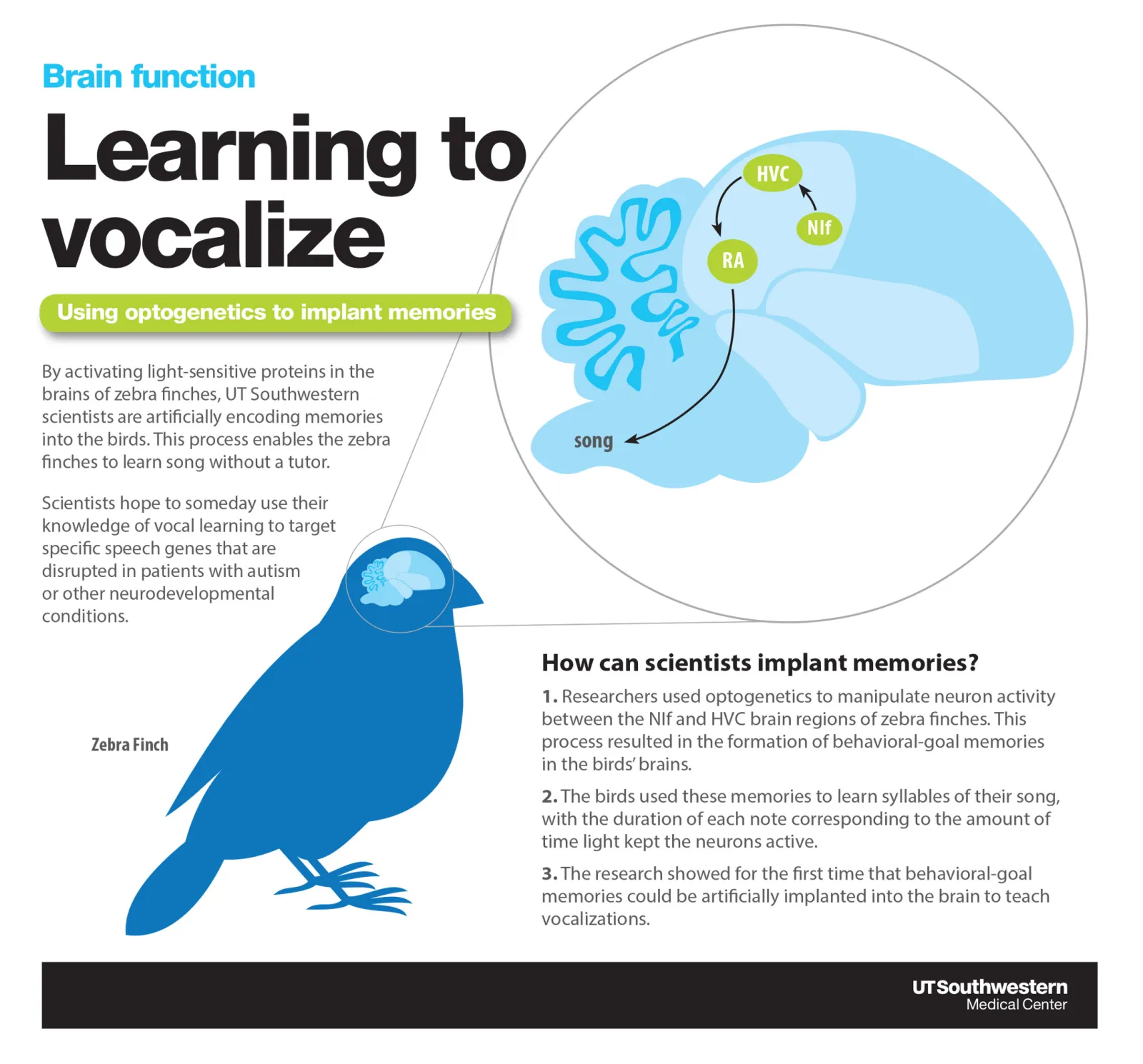
Roberts, together with colleagues Wenchan Zhao, Francisco Garcia-Oscos and Daniel Dinh, used "optogenetic manipulation"—where light is used to monitor and control brain activity—to guide the learning of songs. They controlled the interactions between two regions of the brain in order to create memories of syllables of a song—the length of a note corresponded to the length of light exposure. As a result, they guided the learning of the zebra finch with these implanted memories. Their findings are published in the journal Science.
...
Roberts said they did not implant the song—just the length of the syllables. This is just one pathway involved in vocalizations. If they can uncover the other circuits that control different aspects, such as pitch and order, they could potentially implant the memory of a whole song.
"We learn many behaviors during development by emulating or imitating the behavior of our parents, older siblings or teachers. The brain circuits involved in forming memories of these social experiences are still poorly understood.
"Our research in young songbirds shows that select synapses connecting sensory and motor circuits play a powerful role in laying down these types of memories and that artificial activation of these connections in the brain can help form memories that can guide learning. We were very surprised by the outcome of our experiments," Roberts said.
The team now plans to identify more pathways involved in vocalization learning. Mapping these channels, Roberts said, could eventually lead to them being able to implant fuller song memories—however, "we are likely still a long way from realizing this type of precision."
Roberts said it is unlikely a similar approach could be used in humans to implant memories, and such experiments would carry immense ethical implications. However, he did say that understanding these pathways could help us understand conditions where developmental disorders cause speech problems.
"Disruptions in learning speech, language and social behaviors are common in disorders such as autism. Now we are starting to examine how these brain pathways are affected in genetic models of autism," he said.
...
View 0 Comments
Submit Correction
View Editorial & AI Guidelines