
...

By Ian Randall
Deputy Science Editor
0
Share
Newsweek is a Trust Project member
See more of our trusted coverage when you search.Prefer Newsweek on Googleto see more of our trusted coverage when you search.
Ground scans beneath the medieval fortification of Milan's Sforza Castle have revealed numerous hidden passages.
Some of the tunnels were likely used by the military, while another once linked to a nearby church was used by a grieving duke to privately visit the burial place of his beloved wife, according to Polytechnic University of Milan researchers.
"The aim is to create a digital twin of the Sforza Castle," said Franco Guzzetti, a geomatics professor at the university, in a statement.
Read More on Science
This, he added, will be a model "that not only shows the current appearance of the castle, but also allows us to explore the past by revealing ancient structures that are no longer visible."
...
The present form of Sforza Castle was commissioned in 1450 by the Duke of Milan, Francesco Sforza, on the site of a previous fortification built between 1358 and 1370 but destroyed during the political upheaval in 1447.
In 1494, Francesco's second son Ludovico Sforza, (also known as Ludovico il Moro), took over rulership of Milan and called on various artists to decorate the castle. These included Donato Bramante (the architect whose original plan for St. Peter's Basilica in Vatican City would inspire Michelangelo) and the painter and polymath Leonardo da Vinci, who frescoed several rooms in the castle.
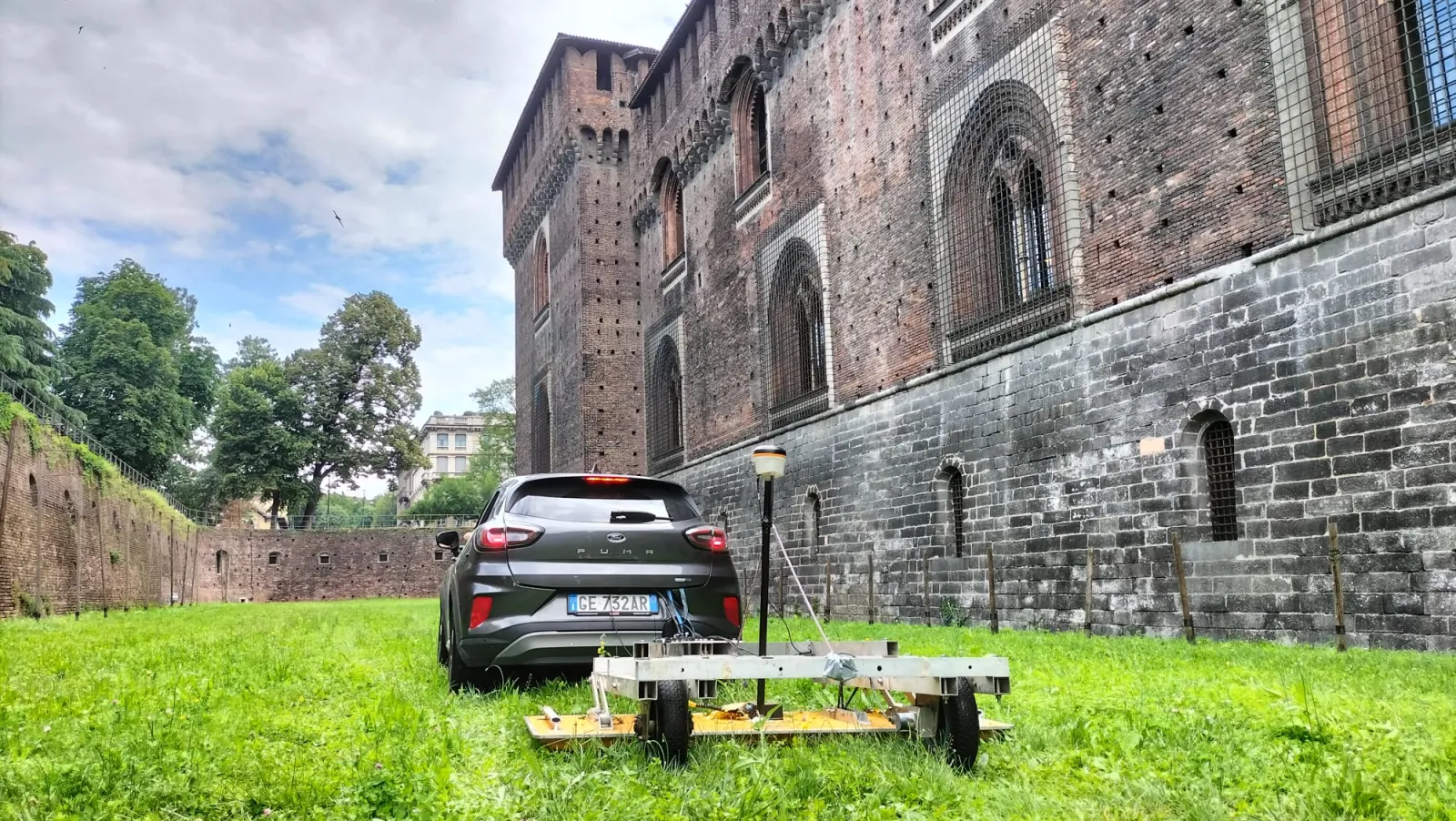
In their study, the researchers used a combination of ground-penetrating radar and laser scanning to build up an accurate map of the subsurface under the castle—and all the underground structures hidden within.
...
In the area of the castle site once surrounded by a ghirlanda, or outer wall, the survey revealed several passageways buried a foot or more under the ground.
Some of these, the researchers say, can be linked to secret military tunnels that can also be seen represented in Leonardo designs.
Also seen in Leonardo's records is the much-storied tunnel built by Ludovico Sforza that connected the castle with the nearby church of Santa Maria delle Grazie, allowing the duke to privately visit his late and much beloved wife, Beatrice d 'Este, who died during childbirth in 1497.
The duke is said to have never fully recovered from the loss—entering, in the words of the historian Luciano Chiappini, "an almost maddening mourning" (involving the deification of his wife, around which he created something of a cult) that is suspected to have contributed to his downfall a few years later.
Besides adding to the castle's historical record, the researchers are hoping to use the radar data to help create an augmented reality experience for visitors to the castle.
"The ground-penetrating radar technology added to our 3D model by providing data about well-known but inaccessible spaces [and] revealing unknown pathways," said architecture researcher Francesca Biolo, who is also with the Polytechnic University of Milan.
The discoveries, she added, are "suggesting ideas for further research into these secret passages."
Do you have a tip on a science story that Newsweek should be covering? Do you have a question about archaeology? Let us know via science@newsweek.com.
View 0 Comments
Submit Correction
View Editorial & AI Guidelines