
By Amanda Castro
Associate News Editor
0
Share
Newsweek is a Trust Project member
See more of our trusted coverage when you search.Prefer Newsweek on Googleto see more of our trusted coverage when you search.
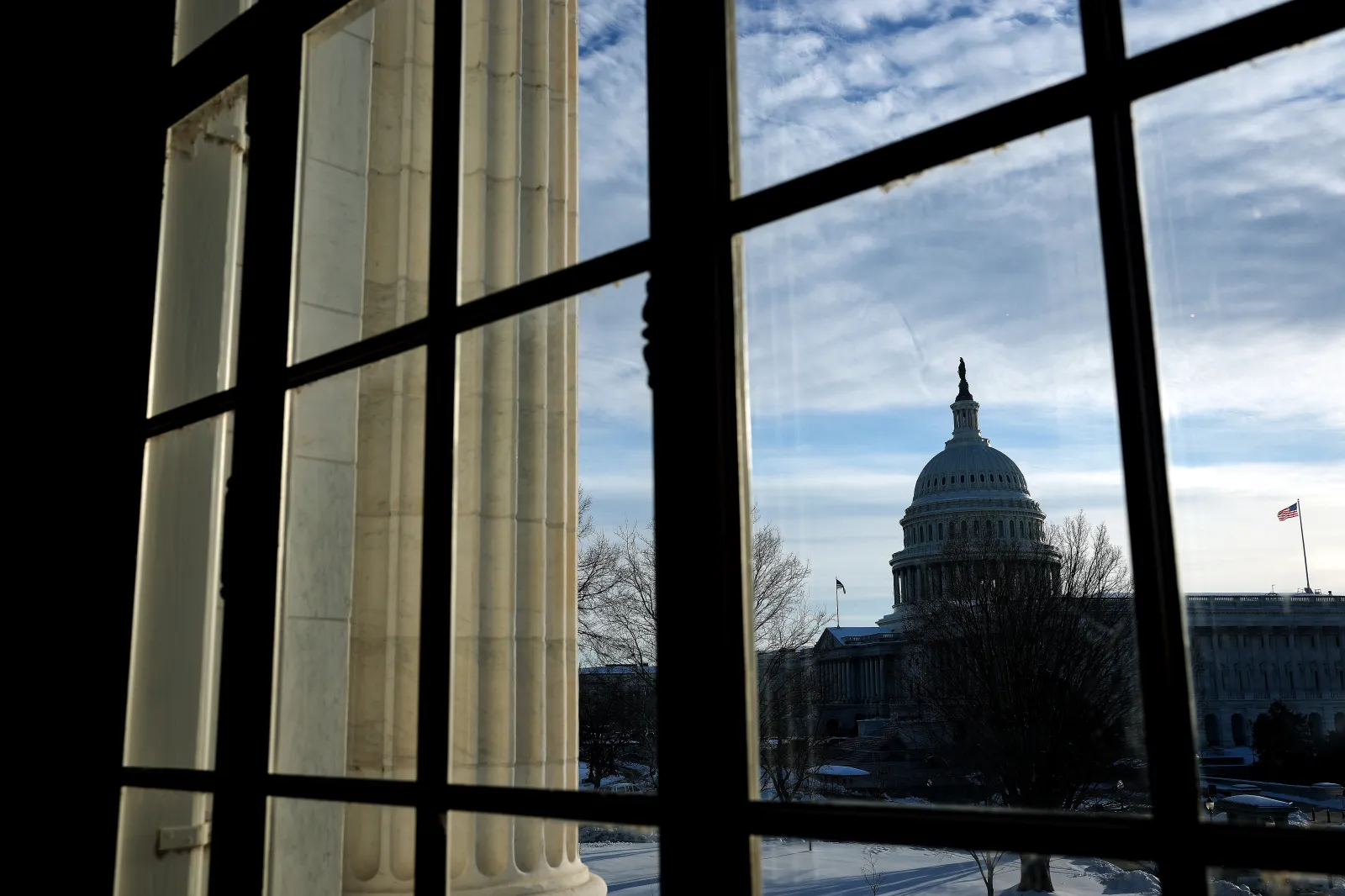
Senate leaders have reached a bipartisan agreement to keep the government funded, but the clock is still ticking toward Friday’s midnight deadline. Meanwhile, Anti‑ICE protests are set to unfold nationwide on Friday, with students in New York City staging a walkout and demonstrators in Minneapolis preparing to rally against federal immigration enforcement.
...
What to Know:
- Negotiators struck a bipartisan deal Thursday, announced by Minority Leader Chuck Schumer.
- The agreement includes a two‑week stopgap extension for DHS funding, requested by Democrats.
- The DHS bill was separated from a larger package funding agencies through September, including Defense, HHS, Labor, Education, Transportation, and HUD.
- Senate talks stalled late Thursday, with rank‑and‑file members unable to move the package swiftly.
- Lawmakers are set to reconvene on Friday, with the aim of sending the bills back to the House for approval.
- The House is currently in recess, meaning final passage could slip to Monday, past the shutdown deadline.
- Speaker Mike Johnson has not committed to a timeline, though swift action could minimize disruption for federal workers.
- The White House has pressed for urgency, mindful of public backlash over ICE’s tactics and the risks of another prolonged funding fight.
This live blog is now closed.
Jan 30, 2026 at 03:50 PM EST
Weekend partial shutdown expected to have limited impact
A brief partial government shutdown is likely to begin at midnight Friday, but its effects are expected to be minimal if the House approves a funding measure early next week.
The closure would temporarily affect agencies covered under five spending bills, along with the Department of Homeland Security. The Office of Budget Management has already alerted agencies to prepare, with guidance expected later Friday and notifications going out to employees exempt from furloughs.
Weekend shutdowns are not unusual and often short-lived. Nearly half of the 21 shutdowns in congressional history have lasted three days or less. By contrast, last October’s 43‑day shutdown — the longest in U.S. history — forced widespread furloughs and slowed economic growth. A Congressional Research Service report estimated that about 670,000 federal workers, or 0.4 percent of the federal workforce, were sidelined during that period.
Jan 30, 2026 at 03:36 PM EST
What’s in the government’s $1.2 trillion minibus package?
The sweeping minibus spending package now moving through Congress covers 96 percent of federal government funding, totaling $1.2 trillion.
The original proposal included appropriations for the Departments of Defense, Labor, Health and Human Services, Education, Transportation, Housing and Urban Development, and Homeland Security. The DHS portion carried an extra $10 billion for Immigration and Customs Enforcement, on top of the $76 billion ICE is already guaranteed over the next four years under the One Big Beautiful Bill Act.
After tense negotiations, Senate leaders agreed Thursday to separate the DHS bill from the rest of the package. Under the deal, Homeland Security will be funded at current levels through February 13 in a stopgap measure, while the other five departments will be considered together.
Jan 30, 2026 at 03:19 PM EST
Why the government faces a temporary shutdown
Congress is bracing for a brief shutdown after Senate Democrats refused to advance a funding package that included money for the Department of Homeland Security. Their opposition followed the fatal shooting of Minnesotan Alex Pretti by federal agents last weekend.
Senate Majority Leader John Thune (R‑S.D.) initially resisted removing DHS funding but shifted after seven Republicans joined Democrats in a vote to split the bill. A procedural hold by Sen. Lindsey Graham (R‑S.C.) delayed action late Thursday, though he has since pledged to lift his objection.
Even with optimism for Senate passage, the House remains in recess until next week. That delay means lawmakers will miss the Friday night deadline, causing funding for most federal agencies to lapse at midnight Saturday.
Jan 30, 2026 at 03:05 PM EST
Schumer condemns Lemon arrest as threat to press freedom
Senate Minority Leader Chuck Schumer, D‑N.Y., denounced the arrest of former CNN anchor Don Lemon, warning that the Trump administration is undermining First Amendment protections.
“The arrest is a dark message to journalists everywhere: If you dare criticize this administration, watch your back,” Schumer said Friday. He added, “That is not democracy. That is a police state, and that is pure authoritarian bile.”
Jan 30, 2026 at 02:50 PM EST
Ellison condemns arrests of journalists at St. Paul protest
Minnesota Attorney General Keith Ellison sharply criticized the arrests of journalists Don Lemon and Georgia Fort, who were taken into custody while covering an anti‑ICE protest at a St. Paul church earlier this month.
In a statement posted on X Friday morning, Ellison called the arrests “deeply troubling and contrary to the rights our Constitution guarantees us.” He stressed that “in Minnesota we do not treat journalists like criminals for doing their jobs,” adding that the First Amendment is “not a luxury in a democracy. It is a necessity.”
Lemon and Fort were live‑streaming on Jan. 18 as dozens of demonstrators entered Cities Church, disrupting a service and sparking tense confrontations with federal immigration agents. Their arrests have fueled concerns about press freedom amid heightened enforcement actions in Minnesota.
Jan 30, 2026 at 02:36 PM EST
DOJ opens civil rights probe into Pretti shooting
The Department of Justice has launched a federal civil rights investigation into the fatal shooting of Alex Pretti in Minneapolis, Deputy Attorney General Todd Blanche announced Friday.
“We’re looking at everything that would shed light on what happened that day and in the days and weeks leading up to what happened,” Blanche said at a press conference. He added that investigators have yet to locate Pretti’s phone or the firearm he was carrying before his death.
Jan 30, 2026 at 02:22 PM EST
Who is Georgia Fort? Minneapolis journalist arrested amid immigration crackdown
Georgia Fort, a Minneapolis freelance journalist, was taken into federal custody Friday in connection with a protest at Cities Church in St. Paul. She was among four people arrested at the direction of Attorney General Pam Bondi, alongside former CNN anchor Don Lemon, activist Trahern Jeen Crews, and Jamael Lydell Lundy.
Fort has built her reputation documenting the Trump administration’s immigration crackdown with reporting and commentary sharply critical of federal tactics. In a recent podcast interview, she argued that journalists must be bold, saying, “We can’t be neutral about the dismantling of our democracy and still expect to be protected by it.”
Her profile rose nationally after the killing of George Floyd in 2020, when she covered the trial and sentencing of former Minneapolis police officer Derek Chauvin. Fort primarily publishes live videos and commentary on social media, where she has more than 137,000 followers on Facebook and about 70,000 on Instagram.
On Friday, Fort posted a video saying agents arrived at her home to take her into custody. She insisted she attended the Jan. 18 protest as a journalist and called the case against her a violation of her Constitutional rights.
Fort has described civil disobedience as essential to confronting injustice, noting in a video after the protest that “history teaches us most protesters got in trouble for taking a stand.” According to her LinkedIn profile, she previously worked as a local news reporter in Columbus, Ohio, and Duluth, Minnesota.
Jan 30, 2026 at 02:08 PM EST
Advocates decry Don Lemon’s arrest as assault on press freedom
Attorney General Pam Bondi announced Friday that journalist Don Lemon was arrested at her direction, despite federal judges previously rejecting Justice Department efforts to secure a warrant. The move has intensified criticism that the Trump administration is targeting reporters who cover grassroots opposition to its policies.
Press freedom advocates point to the arrest as part of a broader campaign to silence journalists. Demand Progress, which recently led a coalition urging Congress to investigate a raid on a Washington Post reporter’s home, condemned the action. Policy Director Emily Peterson‑Cassin said the government is “trying to scare journalists away from covering the events in Minnesota,” calling the arrest “an ongoing, unconstitutional campaign to intimidate a free and fearless press.”
Jan 30, 2026 at 01:53 PM EST
Steube to push expulsion of Cherfilus-McCormick after ethics report
Rep. Greg Steube, R‑Fla., announced Friday he will introduce a resolution next week to expel Rep. Sheila Cherfilus‑McCormick, D‑Fla., following the release of a House Ethics Committee report alleging “extensive misconduct.”
The committee’s findings accuse Cherfilus‑McCormick of using her office for personal gain, including steering community project funds to a for‑profit entity and accepting campaign contributions tied to official actions. In a written response, she denied the allegations and urged that the charges be dismissed.
Steube had previously said he would wait for the committee’s report before pursuing expulsion. The panel has now formed an adjudicatory subcommittee that will hold a hearing on March 5.
Expulsion from the House is rare, requiring a two‑thirds vote. Only six members have ever been removed, most recently former Rep. George Santos in 2023.
Jan 30, 2026 at 01:38 PM EST
What happened with SNAP during the last government shutdown?
By the 20th day of the 2025 government shutdown, the Supplemental Nutrition Assistance Program faced a looming funding crisis. The Department of Agriculture warned that without new appropriations, food aid for roughly 42 million Americans could run out in November.
SNAP requires about $8 billion per month to operate, but only $6 billion in contingency funds remain available, leaving a $2 billion gap. Acting administrator Ronald Ward instructed state agencies on October 16 to pause preparations for November benefits, citing insufficient resources. States including Pennsylvania, Texas, Oregon, West Virginia, Minnesota, Illinois, New York, and Colorado announced they would be unable to issue payments if the shutdown continued past late October.
Jan 30, 2026 at 01:24 PM EST
Hochul moves to end New York’s role in federal immigration enforcement
New York Gov. Kathy Hochul announced Friday that she will pursue legislation banning state participation in 287(g) agreements, which permit local police to collaborate with federal agents on immigration enforcement.
Hochul’s proposal aligns New York with other Democratic‑led states, including Massachusetts and Maryland, where leaders have recently taken steps to limit local involvement in federal immigration crackdowns. Supporters of the ban argue that such agreements erode trust between immigrant communities and local law enforcement, while critics contend they are vital to public safety.
Jan 30, 2026 at 01:10 PM EST
Higher courts bolster Trump’s immigration crackdown
President Donald Trump’s immigration crackdown continues to gain legal backing from higher courts, which have repeatedly overturned trial‑level rulings aimed at curbing federal agents’ actions in major U.S. cities.
A string of decisions from the Supreme Court and federal appeals courts, many dominated by Trump appointees, have reversed early wins for opponents of the administration’s enforcement blitzes in California, Chicago, and Minnesota.
The latest ruling came Monday, when a three‑judge appeals panel indefinitely blocked a Minneapolis judge’s order that sought to impose strict limits on how agents respond to peaceful protesters during Operation Metro Surge. The controversial campaign has drawn fierce opposition in the Twin Cities and led to the fatal shootings of two U.S. citizens.
Trump and his allies argue that lower courts have overstepped in challenging his agenda, insisting the president holds broad authority over immigration enforcement that should not be subject to judicial review.
Jan 30, 2026 at 12:55 PM EST
WATCH: Don Lemon arrested over Minnesota ICE protest
Jan 30, 2026 at 12:40 PM EST
Press freedom groups condemn arrests of journalists in Minnesota
Press freedom advocates are denouncing the arrests of journalists Don Lemon and Georgia Fort, who were taken into custody while covering an anti‑ICE protest inside a Minnesota church on Jan. 17.
Seth Stern of the Freedom of the Press Foundation called the charges “bogus legal theories” and warned they send a chilling message to other reporters. He said the arrests are an attempt to intimidate journalists but vowed that the response must be “an even stronger commitment to journalism, the truth, and the First Amendment.”
Katherine Jacobsen of the Committee to Protect Journalists said Lemon’s arrest “should alarm all Americans,” noting that the treatment of reporters reflects the health of a democracy. Lisa Gilbert of Public Citizen described the arrests as an “authoritarian breach” and “egregious violation of the First Amendment,” stressing that reporters must remain free to document and share information with the public.
Jan 30, 2026 at 12:27 PM EST
Trump labels Pretti an ‘agitator’ amid backlash over Minneapolis shooting
President Donald Trump escalated criticism of Alex Pretti, the Minneapolis nurse fatally shot by federal agents earlier this month, calling him an “agitator” and possibly an “insurrectionist” in a social media post Friday.
The remarks came after videos circulated showing Pretti in a confrontation with immigration agents at a protest 11 days before his death. In the footage, Pretti is seen spitting, shouting, and kicking a vehicle before being forced to the ground. Trump wrote that Pretti’s “stock has gone way down” with the release of the video, repeating his administration’s efforts to portray the victims of recent shootings as aggressors.
Pretti’s family has condemned the characterization, describing him as a dedicated nurse at the Veterans Affairs hospital and rejecting claims that he sought to harm law enforcement. Witness videos from both the earlier protest and the day of his killing contradict federal assertions that he intended to “massacre” officers. While Pretti was carrying a firearm, no evidence has shown that he used it against agents, and Minnesota law permits firearms at protests.
Family attorney Steve Schleicher said the January 13 altercation could not justify Pretti’s death, calling him “violently assaulted” a week before he was shot. The Trump administration has defended agents’ tactics despite mounting criticism, though border czar Tom Homan acknowledged Thursday that the Minnesota operation “needed to be fixed.”
Jan 30, 2026 at 12:13 PM EST
Minneapolis seeks dismissal of federal immigration lawsuit
Lawyers for the city of Minneapolis have asked a federal judge to throw out a Justice Department lawsuit challenging local limits on civil immigration enforcement.
The suit, filed last year, targets Minneapolis’ policies restricting cooperation with federal immigration authorities, as well as broader “sanctuary” measures adopted by the state and other Minnesota municipalities. Federal officials argue such policies obstruct enforcement of immigration law, while city leaders maintain they are necessary to protect community trust and public safety.
Jan 30, 2026 at 11:59 AM EST
Government shutdowns often cost billions, not save money
Despite the perception that halting federal operations might save money, evidence indicates that shutdowns are costly. Agencies must spend resources preparing contingency plans, while user fees and other charges go uncollected. Federal contractors often raise bids to account for payment uncertainty, and furloughed employees are guaranteed back pay, erasing potential savings.
During the 2013 shutdown, the Office of Management and Budget estimated that $2.5 billion was paid to furloughed workers for hours not worked, along with $10 million in penalty interest and lost fees. The economic impact is even greater. The Congressional Budget Office found that the 2018‑2019 shutdown reduced GDP by $11 billion, with $3 billion in permanent losses. Longer shutdowns also stall private investment and hiring, as businesses cannot secure permits, certifications, or federal loans.
A 2019 Senate report concluded that the 2013, 2018, and 2019 shutdowns wasted nearly $4 billion in taxpayer dollars. More recently, the CBO estimated that the six‑week shutdown in 2025 reduced real GDP by $11 billion and deferred $54 billion in federal spending.
Shutdowns, far from saving money, consistently impose high costs on both government operations and the broader economy.
Jan 30, 2026 at 11:45 AM EST
Longest U.S. government shutdown stretched 43 days in 2025
The United States endured its longest government shutdown in history in the fall of 2025, lasting 43 days. The crisis began after a late September White House meeting between President Donald Trump and Senate Democrats failed to produce a deal to keep the government open.
At midnight on October 1, the shutdown took effect when Senate Democrats blocked a continuing resolution passed by the Republican‑controlled House. Democrats opposed the measure because it did not include an extension of Affordable Care Act subsidies that had been temporarily expanded under the American Rescue Plan Act of 2021.
The continuing resolution was rejected 14 times before lawmakers reached a compromise on November 10. The Senate ultimately passed a revised appropriations bill without the subsidy extension, with Republicans promising a separate vote on the issue by mid‑December. The House approved the measure two days later, and President Trump signed it into law on November 12.
Jan 30, 2026 at 11:28 AM EST
What to know about why the shutdown looms
For weeks, lawmakers have been racing toward a January 30 deadline to pass a series of appropriations bills to keep the government open. The House approved the package on January 22, but Senate Democrats have balked at provisions that fund the Department of Homeland Security, citing concerns about immigration enforcement.
Tensions deepened after the recent killing of Alex Pretti, which followed the death of Renée Good earlier this month. The incidents tipped the balance for Democrats, who now refuse to back additional DHS funding, arguing the agency has been central to President Trump’s aggressive immigration tactics.
The timeline was already tight, with a winter storm forcing the Senate to cancel a January 26 vote. Now, with just hours left before the deadline, Congress faces an eleventh‑hour scramble to resolve the dispute and avoid a shutdown.
Jan 30, 2026 at 11:14 AM EST
When would the government shutdown begin?
A partial U.S. government shutdown is set to begin at 12:01 a.m. on Saturday, Jan. 31, if lawmakers fail to pass the necessary appropriations bills before the deadline.
The lapse would halt funding for agencies whose budgets have not been approved, forcing non‑essential operations to pause until Congress acts.
The looming deadline comes just months after the government endured a record‑breaking 43‑day shutdown, triggered by a bitter fight over extending federal health insurance subsidies.
Jan 30, 2026 at 10:58 AM EST
Senate to reconvene Friday as shutdown looms
The Senate is set to return at 11 a.m. ET Friday to resume debate over spending legislation, with Majority Leader John Thune expected to deliver brief remarks before lawmakers continue discussions.
A final vote remains uncertain as senators weigh possible amendments, according to a senior Republican aide. The chamber adjourned Thursday without locking in a deal, leaving the timeline fluid as the government approaches a midnight shutdown deadline.
Even if the Senate reaches an agreement, the measure must still clear the House of Representatives, which is currently out of session. Speaker Mike Johnson said Thursday evening that the earliest the House could act is Monday, February 2, meaning a short shutdown is “inevitable” despite progress in the Senate.
Jan 30, 2026 at 10:43 AM EST
DOJ to hold press conference to update progress on Epstein files
The Department of Justice is holding a news briefing at 11 a.m. ET to give an official update on the progress of the Jeffrey Epstein files.
Jan 30, 2026 at 10:42 AM EST
Social Security benefits safe despite shutdown threat
As Congress struggles to finalize a spending deal, Social Security recipients are being reassured that their monthly payments will continue even if the government shuts down.
Unlike other agencies dependent on annual appropriations, the Social Security Administration’s retirement, disability, survivor, and Supplemental Security Income programs are funded through mandatory sources, primarily payroll taxes. That structure insulates benefits from lapses in congressional funding.
During past shutdowns, checks have gone out on schedule, though agency operations, such as appointment scheduling and customer service, have been delayed. In the current package before the Senate, funds earmarked for the SSA are intended to reduce wait times and improve office services, not to cover benefits themselves.
Finance experts note that the system’s dedicated funding stream ensures uninterrupted payments. In its contingency plan, the SSA pledged to “continue activities critical to ensure accurate and timely payment,” underscoring its commitment to beneficiaries regardless of political gridlock.
Jan 30, 2026 at 10:29 AM EST
Shutdown threat raises concerns over IRS delays
As Congress faces another round of funding negotiations, Clear Start Tax is warning that a government shutdown could disrupt IRS operations, creating headaches for taxpayers.
The firm noted that during past shutdowns, reduced staffing led to backlogs, delayed refunds, and slower responses to inquiries. Refunds requiring manual review, identity checks, or credit validation may be especially vulnerable if agency operations are interrupted. “Even short shutdowns can create long‑lasting ripple effects at the IRS,” a spokesperson said, adding that taxpayers often feel the impact weeks or months later.
While automated collection notices may continue during a shutdown, customer service and resolution timelines typically slow, leaving taxpayers uncertain about deadlines and next steps. Clear Start Tax recommends filing early, monitoring refund status closely, and responding promptly to IRS correspondence to minimize disruption.
Jan 30, 2026 at 10:15 AM EST
Shutdown odds rise as Senate deal hits obstacles
The likelihood of a partial U.S. government shutdown increased Friday after fresh hurdles emerged in the Senate over a bipartisan spending agreement.
The deal, announced by Senate Democrats and President Donald Trump, would keep most federal agencies funded through September while extending Homeland Security’s budget for two weeks to allow debate over immigration enforcement. But late‑night objections stalled progress, with lawmakers set to reconvene Friday morning just hours before the midnight deadline.
Even if the Senate approves the measure, the Republican‑controlled House remains out of session, complicating efforts to secure final passage. Speaker Mike Johnson has said recalling members before the deadline would be difficult.
Democrats, angered by the recent shooting of nurse Alex Pretti by immigration agents in Minneapolis, are pressing for new restrictions on federal officers, including bans on roving patrols and face coverings, and mandatory body cameras. The White House has signaled a willingness to ease operations in Minnesota amid public outrage, but negotiations over DHS reforms remain contentious.
Jan 30, 2026 at 10:01 AM EST
WATCH: Trump says, ‘We don’t want a shutdown’
Jan 30, 2026 at 09:49 AM EST
Journalist Georgia Fort says indictment violates her rights
Independent journalist Georgia Fort said Friday that federal agents arrived at her home to inform her she had been indicted by a grand jury.
In a video posted to Facebook, Fort explained that she attended the Jan. 18 protest at Cities Church in St. Paul to document the event in her capacity as a journalist. She argued the case against her amounts to a violation of her Constitutional rights.
Jan 30, 2026 at 09:47 AM EST
Bondi announces additional arrests to Don Lemon tied to St. Paul Church protest
U.S. Attorney General Pamela Bondi said Friday that federal agents arrested four individuals in connection with last week’s protest at Cities Church in St. Paul, Minnesota.
In a statement posted on social media, Bondi identified those taken into custody as journalist Don Lemon, activist Trahern Jeen Crews, reporter Georgia Fort, and Jamael Lydell Lundy.
Jan 30, 2026 at 09:33 AM EST
California Democrats split over billionaire tax proposal
A plan to raise taxes on California’s wealthiest residents has ignited sharp divisions within the Democratic Party, setting the stage for a broader national debate ahead of the next presidential race.
The proposed “billionaire tax,” which could appear on the ballot this fall, has quickly become a flashpoint in the state’s open governor’s contest and among potential 2028 White House contenders. Gov. Gavin Newsom, viewed as a likely presidential hopeful, has joined several Democratic gubernatorial candidates — including Katie Porter, Antonio Villaraigosa and Xavier Becerra — in opposing the measure. They argue higher taxes would drive investors and tech leaders out of California.
On the other side, Rep. Ro Khanna and billionaire candidate Tom Steyer have endorsed the initiative, saying it would help narrow income inequality and ensure the state’s wealthiest contribute more to public services.
Jan 30, 2026 at 09:20 AM EST
Don Lemon taken into custody after ICE protest
Journalist Don Lemon was taken into custody Thursday night, his attorney confirmed, following his involvement in a protest against federal immigration enforcement.
Lemon joined dozens of demonstrators who rushed into Cities Church in St. Paul last week, disrupting a service and sparking tense confrontations. The protest was part of a broader wave of activism targeting Immigration and Customs Enforcement operations in Minnesota.
Jan 30, 2026 at 09:06 AM EST
History of U.S. government shutdowns since 1976
Since the modern budget process was introduced in 1976, Congress has faced 21 funding gaps, periods when appropriations were not enacted for at least one day. Before 1980, these lapses did not halt government operations, but since then shutdowns have become a recurring feature of political standoffs.
Most gaps have been brief, lasting three days or fewer, often over weekends when the impact was minimal. But five “true” shutdowns have significantly disrupted federal operations. The first two occurred in late 1995 and early 1996, when clashes between President Bill Clinton and a Republican Congress over spending levels led to a combined 26 days of closures. In 2013, a dispute over funding the Affordable Care Act triggered a 16‑day shutdown.
The fourth shutdown, spanning December 2018 and January 2019, was technically partial because several appropriations bills had already passed. It centered on President Trump’s demand for border wall funding. The most recent shutdown, lasting 43 days from October to November 2025, was the longest in U.S. history, driven largely by disagreements over expiring ACA subsidies.
Jan 30, 2026 at 08:52 AM EST
What isn’t affected during a government shutdown
Mandatory spending programs, unlike discretionary spending, are authorized on a multi‑year or permanent basis and generally continue to operate during a government shutdown. This means benefits such as Social Security, Medicare, and Medicaid are not interrupted when Congress fails to pass annual appropriations bills.
However, services tied to these programs can be reduced if they rely on discretionary funding. Past shutdowns illustrate the impact: in 1996, Social Security checks were issued but staff handling new enrollments and card requests were furloughed. In 2013, benefit verification and replacement card services were paused, though applications and address changes were still processed.
Other programs have faced similar challenges. During the 2018‑2019 shutdown, the Department of Agriculture had to use special authority from a prior continuing resolution to keep Supplemental Nutrition Assistance Program benefits flowing.
Jan 30, 2026 at 08:39 AM EST
House resistance clouds path for Senate spending deal
Even if the Senate reaches an agreement on its stopgap plan, the House could delay final passage. Speaker Mike Johnson has voiced opposition to breaking up the funding package, though he conceded lawmakers may need to act quickly to avoid a shutdown. Conservative members of the Freedom Caucus have already warned they will not support any bill that excludes Homeland Security funding.
The standoff highlights the fragile nature of bipartisan cooperation. While Trump urged both parties to cast a “YES” vote, Democrats remain united in demanding curbs on immigration raids, and Republicans are split over how far to go. With the House in recess, timing alone could push the government past Friday’s deadline.
Jan 30, 2026 at 08:26 AM EST
ICE tactics spark bipartisan clash after fatal Minnesota shootings
The deaths of two protesters in Minneapolis have intensified calls for reform of U.S. Immigration and Customs Enforcement, fueling a rare bipartisan negotiation between Trump and Senate Democrats. Minority Leader Chuck Schumer labeled ICE’s actions “state‑sanctioned thuggery” and demanded stricter rules, including body cameras and identification requirements for agents.
Republicans remain divided. Graham said some reforms “make sense,” but warned he would push back against Democratic efforts to alter the funding bill without concessions on sanctuary city policies. The debate underscores how ICE’s tactics have become a flashpoint in the broader fight over government funding.
Jan 30, 2026 at 08:13 AM EST
Senate struggles to advance bipartisan deal amid shutdown threat
Senate leaders worked late into Thursday night to salvage a bipartisan spending agreement aimed at averting a partial government shutdown. The deal, struck between Democrats and President Donald Trump, would separate Homeland Security funding from a broader package and extend it for two weeks while lawmakers debate new limits on immigration enforcement.
Despite the breakthrough, passage stalled as objections mounted. Majority Leader John Thune acknowledged “snags on both sides,” while Sen. Lindsey Graham opposed provisions he said unfairly targeted ICE agents. With the deadline looming at midnight Friday, leaders face pressure to secure votes before the government lapses into another costly shutdown.
Jan 30, 2026 at 08:00 AM EST
What does a government shutdown affect?
When Congress fails to pass all annual appropriations bills, federal agencies must follow shutdown plans coordinated by the Office of Management and Budget. These plans determine which activities pause until funding is restored, often requiring furloughs and halting discretionary operations. Essential public safety services, including border protection, hospital care, air traffic control, and law enforcement, continue to operate, though many employees are working without pay until appropriations resume.
Mandatory programs like Social Security, Medicare, and Medicaid remain in place, as do services funded by permanent user fees, such as visa processing. Agencies with advanced appropriations, including parts of the Veterans Health Administration, are minimally affected.
In a partial shutdown, where only some of the 12 funding bills are enacted, the impact varies. Social Security checks continue to be issued, but benefit verification and card services may be suspended. Air travel can face delays if TSA agents or air traffic controllers miss work without pay, as seen in past shutdowns. The NIH may halt new patient admissions and grant processing, while the IRS could delay tax refunds and loan verifications. SNAP benefits are generally protected, but can face administrative strain if a shutdown lasts beyond 30 days.
Because DHS and immigration enforcement agencies currently have mandatory funding under recent legislation, their operations would likely continue with minimal disruption. Still, the longer a shutdown lasts, the greater the strain on federal services and the workers who keep them running.
Jan 30, 2026 at 07:56 AM EST
Partial government shutdown would trigger federal furloughs
A partial government shutdown would force furloughs across major federal agencies that lack current funding, including the Departments of Defense, Labor, Health and Human Services, Education, Homeland Security, Treasury, Transportation, Housing and Urban Development, and State, as well as the federal judiciary, the General Services Administration, and several White House offices.
Non‑essential employees in these agencies would be sent home without pay, while essential staff would be required to continue working, also without pay, until funding is restored. Thanks to legislation enacted in 2019, furloughed federal workers are guaranteed back pay once the shutdown ends. Federal contractors, however, have historically not received compensation for lost work.
Some exceptions exist. Under the “One Big Beautiful Bill Act” of 2025, immigration and border personnel, along with certain Defense Department functions, were funded through mandatory appropriations. Those employees would likely continue to receive pay even during a shutdown.
Jan 30, 2026 at 07:52 AM EST
What is a government shutdown?
The Committee for a Responsible Federal Budget defines a government shutdown as occurring when Congress fails to pass all required annual appropriations bills that fund federal agencies and programs. Each fiscal year, lawmakers must approve 12 separate spending measures, which the president then signs into law. If some of those bills are not enacted, or if a temporary continuing resolution is not adopted, agencies covered by the unfunded measures must halt non‑essential operations.
During a shutdown, essential services such as airport security, law enforcement, and mandatory programs like Social Security continue to operate, though many federal employees are required to work without pay. Others are furloughed until new funding is approved.
For fiscal year 2026, six appropriations bills have been signed, but without passage of the remaining six or a stopgap measure, the government faces a partial shutdown.
Jan 30, 2026 at 07:48 AM EST
What is a partial government shutdown?
A partial government shutdown occurs when Congress fails to approve all 12 annual appropriations bills, leaving only certain departments without funding. Agencies that lack appropriations must halt non‑essential operations, while those with approved budgets continue to function.
Essential services such as airport security and federal law enforcement typically remain in place, though employees often work without pay. Others deemed non‑essential are furloughed until funding resumes. The impact is felt in areas like national parks, passport processing, and IRS audits, which may pause, while programs such as Social Security and mail delivery continue uninterrupted.
The disruption lasts until lawmakers pass the remaining spending bills or until a temporary continuing resolution is enacted. As seen in early 2026 scenarios, a partial shutdown causes immediate service interruptions and uncertainty for federal workers, but it does not halt all government activity.
Jan 30, 2026 at 07:44 AM EST
Minnesota residents in Trump county push back on ICE tactics
Residents of Meeker County, a rural area that backed Donald Trump by a wide margin in the 2024 election, are voicing sharp criticism of federal immigration enforcement in Minnesota.
Several locals told WCCO that Immigration and Customs Enforcement agents have gone too far in their tactics, with some calling for the agency to leave the state altogether. “I think what’s happening is deplorable,” resident Emma Wettstein said. Her mother, Christina Garcia, added that while she supports removing criminals, “there’s a right way and a wrong way and they’re doing it the wrong way.”
Others described the enforcement surge as heavy‑handed. “It’s just bullying people around,” said Grove City resident Mike Katleck, who argued agents appear to be provoking conflict rather than easing tensions.
From nearby Hutchinson, Linda Kuhl faulted both parties for the breakdown, saying leaders are unwilling to compromise. “They don’t want to listen to each other. Just, ‘it’s my way or the highway,’” she said.
In a polarized era, the center is dismissed as bland. At Newsweek, ours is different: The Courageous Center—it's not "both sides," it's sharp, challenging and alive with ideas. We follow facts, not factions. If that sounds like the kind of journalism you want to see thrive, we need you.
When you become a Newsweek Member, you support a mission to keep the center strong and vibrant. Members enjoy: Ad-free browsing, exclusive content and editor conversations. Help keep the center courageous. Join today.


View 0 Comments
Submit Correction
View Editorial & AI Guidelines