10
Loading video...

By Andrew Stanton
Reporter
0
Share
Newsweek is a Trust Project member
See more of our trusted coverage when you search.Prefer Newsweek on Googleto see more of our trusted coverage when you search.
Democrat Sherrod Brown’s narrow polling lead in the Ohio U.S. Senate race ahead of the November 3 midterm elections defies the state’s decadelong rightward shift, as Democrats hope to reverse that trend in the Buckeye State this year.
Ohio was a premier battleground for much of the 2000s. Former President Barack Obama won the state in both his 2008 and 2012 elections. But it has become increasingly conservative over recent cycles, backing President Donald Trump by 11 points in 2024.
Brown, first elected to the Senate in 2006, also went down in 2024, losing his reelection bid to Republican Bernie Moreno. Despite winning by comfortable margins in the past, as the state became more conservative, his personal brand was unable to withstand national headwinds.
Read More on Politics
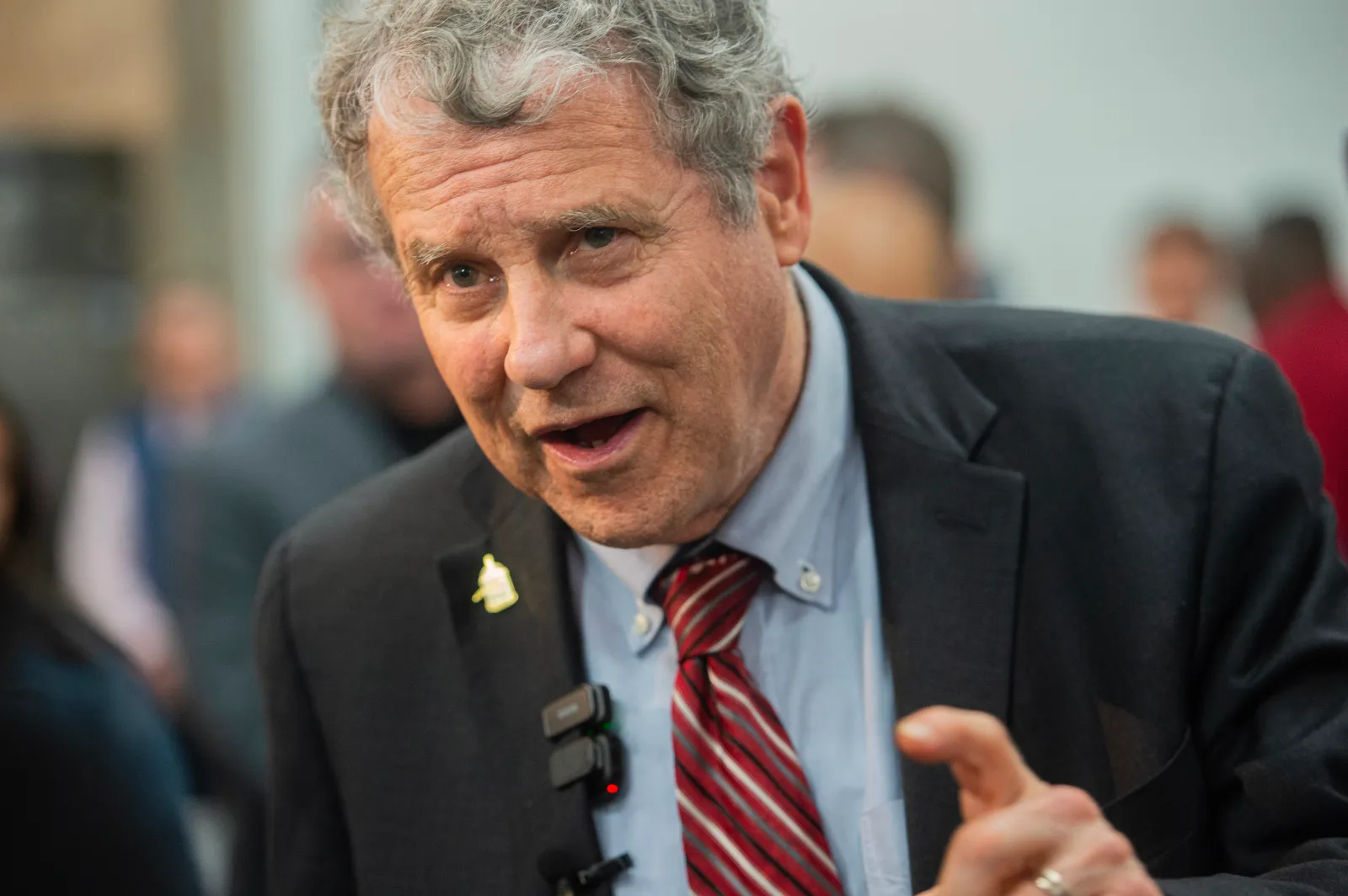
Two years later, Brown is hoping to score a comeback to make Ohio competitive once again. He is running to unseat Senator Jon Husted, a Republican appointed to fill the seat held by Vice President JD Vance in what has become one of the most hotly contested Senate battlegrounds.
...
Some indications are giving Democrats hope about winning this race. Brown has led in polls and fundraising, and Trump’s declining national approval rating has become a vulnerability for Republicans in close races.
Still, a Brown victory would require him to defy the pattern that has seen Ohio become more conservative year after year.
Brown’s populist message could be what makes a difference in this year’s elections, Robert Alexander, professor of political science at Bowling Green State University, told Newsweek.
Ohio is more of a “populist state than a partisan state,” and Brown “has a known populist brand that has played well with union households, rural voters, and independents.”
“Economic populism, resentment toward billionaires and the tech class are messages that resonate with a lot of Ohioans,” Alexander added. “The current backlash against data centers in the state crystallizes all of these concerns and we find that most voters believe that a candidate's stance on data centers is a really important factor in how they will vote.”
Newsweek reached out to the Brown and Husted campaigns for comment via email.
Sherrod Brown Leads Polls in Close Race
Brown has a narrow polling lead about a month out from Election Day. But the race is expected to be among the closest of the midterms, with forecasters like the Cook Political Report and Sabato’s Crystal Ball classifying the battle as a toss-up.
The Democratic candidate held a 3.1-point lead in RealClearPolitics’ polling average as of Tuesday. If that holds, the change would mark nearly a 15-point leftward shift from the 2024 presidential race.
Brown led by 3 points in the latest survey from The New York Times and Siena University, with 49 percent of respondents saying they planned to vote for him compared to 46 percent supporting Husted. It polled 616 likely voters from September 22 to October 1 and had a margin of error of plus or minus 4.5 percentage points.
A Suffolk University poll also gave Brown a 3-point lead, 47 percent to 44 percent. It surveyed 500 likely voters from September 23 to September 27, and had a margin of error of plus or minus 4.4 percentage points.
Brown had a more narrow lead in the latest survey from InsiderAdvantage, which showed him up a single point, 44 percent to 43 percent. It polled 1,200 likely voters on September 28 and September 29, with a margin of error of plus or minus 2.83 percentage points.
While Democrats are hopeful about Brown’s lead, polls have underestimated Republicans in the past. In 2024, polls in Ohio showed a modest Democratic bent. Trump was up 7.7 points in 270toWin’s average prior to Election Day, but went on to win by just over 11 points.
Brown has also raised significant funds. The Friends of Sherrod Brown campaign committee raised more than $14 million in the second quarter, according to Federal Election Commission (FEC) filings reviewed by Newsweek. His campaign also touted an additional $3 million to other affiliated fundraising committees.
Husted’s campaign said he raised $7.7 million across all affiliated committees, including $3.4 million in his principal campaign committee.
Ohio’s Race to the Right
Trump’s 11-point win in 2024 was the largest Republican margin in decades, underscoring the rightward shift in the state. Obama won it by more than 4 points in 2008 and about 3 points in 2012, before it flipped to Republicans, backing Trump by about 8 points in 2016 and 2020.
That trend has been driven by Trump’s inroads with white working-class voters who were previously more politically mixed. His gains came from rural counties as well as the northeastern region near Cleveland.
Democrats have gained some ground in Cincinnati and Columbus suburbs, but not enough to offset Republicans' momentum in the rural areas.
If Brown wins, he would do so by building a different coalition than the one that backed him in previous races, David Niven, professor at the University of Cincinnati's School of Public and International Affairs, told Newsweek.
“The map in Ohio is changing,” Niven said. “Democrats are less dependent on their traditional industrial base and are increasingly counting on a growing suburban base. Places like Delaware County — affluent, educated, white. Delaware has not voted for a Democrat for president since Woodrow Wilson. But that is the kind of place to keep an eye on for Democratic growth.”
Alexander said that Democrats will also need to narrow the margins among rural voters.
“Rural Ohioans have always voted for Republicans, but their margins of victory have exploded under Trump. This is one of the main areas I will be looking for in this election,” he said.
Can Sherrod Brown Reverse Trend?
Brown’s candidacy is a major test as to whether Democrats can win back voters in Ohio to stage a comeback in what was once one of the largest, most important swing states in the country.
Although he lost in 2024, his performance signals that he still has strength, Alexander said.
“Brown outperformed Kamala Harris by a pretty large margin in 2024. While she lost the state by 11 points, he lost by less than 4 points,” he said. “This fact illustrates Brown's crossover appeal as there were somewhere between 200,000 to 300,000 Ohioans who voted for both Donald Trump and Sherrod Brown. This is a remarkable feat in an increasingly polarized era.”
Trump not being on the ballot is a major difference, he said. “Trump's popularity is not what it was even two years ago. While he may be able to rally the base, it is worth watching whether his presence stimulates turnout among disillusioned independent voters for Brown.”
Data Centers Become Flash Point in Election
Artificial intelligence (AI) data centers have become a core issue in Ohio's U.S. Senate race. Husted’s positioning on the centers has become a line of attack for Brown. Husted, as lieutenant governor, was more supportive of data center development in the state. According to the Ohio Capital Journal, he played a role in bringing them there and supported tax breaks for past projects.
But he has pushed for some regulations, introducing the Ratepayer Protection Act, which failed to pass the Senate last week. If enacted, it would have required states to consider adopting standards under which large electricity users, including data centers, would pay for the incremental costs of generation, transmission and distribution infrastructure needed to serve them. Democrats opposed the bill, arguing it did not go far enough to address data center concerns.
Newsweek's AI Policy Scorecard rates Husted as having a “mixed” viewpoint on AI.
Meanwhile Brown has cast himself as a data center skeptic, making standing up to Big Tech a cornerstone of his campaign. “Ohioans are worried about the number of data centers entering our state – I am too. I’m running to take on the big corporations raising our utility bills, defend our resources, and protect our communities,” Brown wrote in a September 19 post on X.
Brown’s position on the data centers could be an electoral boon, Niven said. “Brown is benefiting from taking a clear stance opposing data centers, while taking every opportunity to spotlight Husted's long advocacy for data centers. Brown has also tied Husted to political corruption, especially to a bribery case in which Ohioans wound up paying more for electricity because a utility bribed state officials.”
Why Ohio Senate Race Matters for 2026 Midterms
The Ohio Senate race is among a handful of toss-ups that could determine the balance of power in the Senate. Republicans hold a 53-47 majority that is seen as increasingly at risk in November. Democrats must flip four seats to win a majority, as Vice President JD Vance would serve as the tiebreaker in a 50-50 Senate.
Democrats need to flip two seats in states that Trump won by double digits in the 2024 election to secure a majority, and Ohio is viewed as one of those states that could potentially flip to Democrats this year.
If Democrats win Ohio, their path to winning a Senate majority becomes more feasible. But if Husted wins, that means they would need to win in some of those other states to regain control of the upper chamber.
What Happens Next
The Ohio U.S. Senate race will continue to be watched as one of the most competitive of the 2026 midterm elections, as both parties view the seat as crucial come November.
Newsweek’s reporters and editors used Martyn, our AI assistant, to produce this story. Learn more about Martyn here. Contact Newsweek editors on this story: Jason Lemon and Edward T. Cummins
View 0 Comments
Submit Correction
View Editorial & AI Guidelines