...

By Anna Skinner
Associate News Editor
0
Share
Newsweek is a Trust Project member
See more of our trusted coverage when you search.Prefer Newsweek on Googleto see more of our trusted coverage when you search.
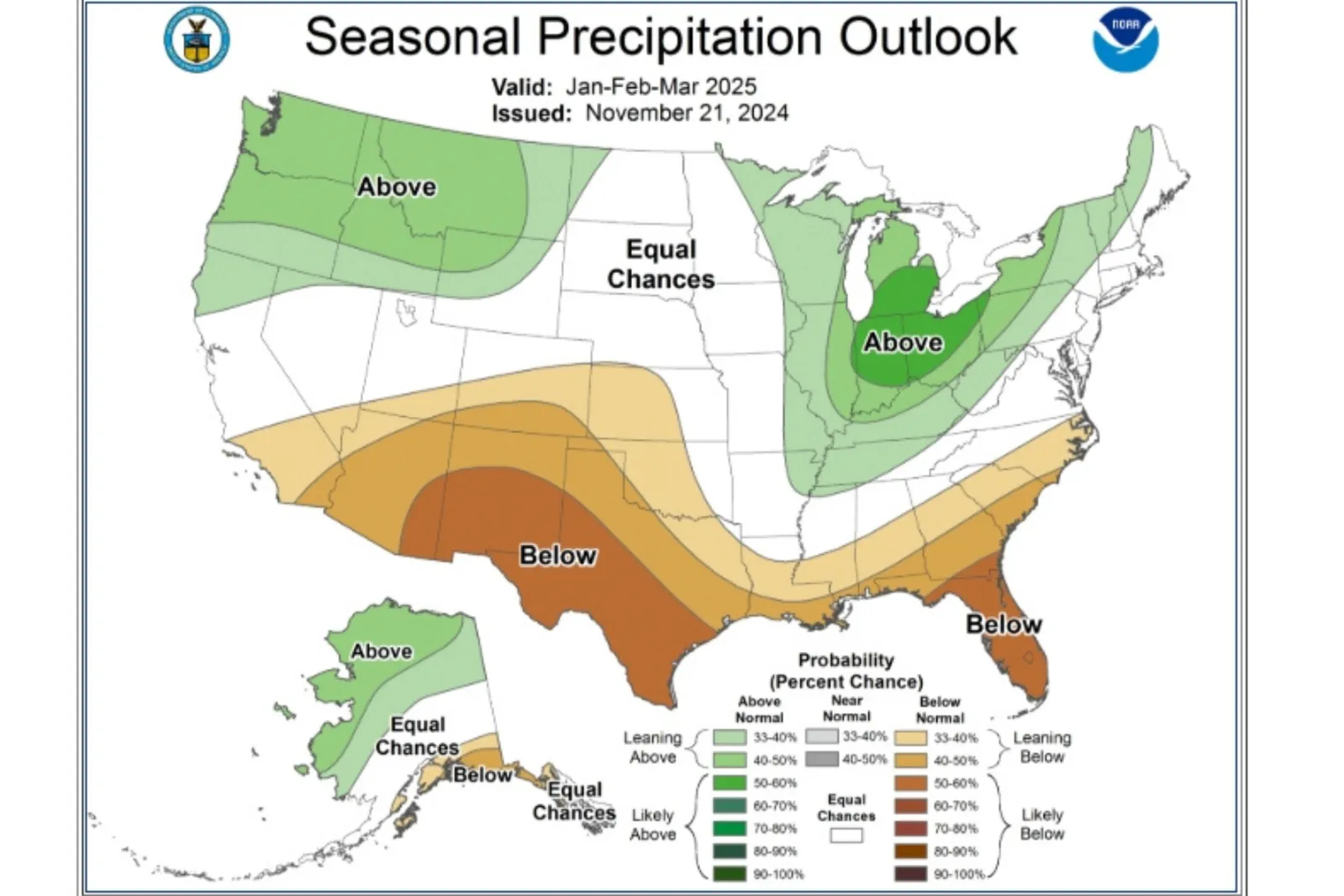
A new seasonal outlook published by the National Weather Service (NWS) Climate Prediction Center on Thursday has forecast which states will see above-average precipitation this winter, some of which will fall in the form of snow.
With La Niña conditions were expected to develop this fall, storms will adopt a more northerly track across the U.S. during the winter months, according to a previous forecast from the NWS.
This means that states in the Pacific Northwest and the Great Lakes region are expecting above-average precipitation—which could come in the form of snow, given low winter temperatures—whereas Southern states are more likely to be drier and warmer than average.
Read More on U.S.
More From Newsweek Vault: 5 Steps to Build an Emergency Fund Today
"La Niña is most likely to emerge in October-December 2024 (57% chance) and is expected to persist through January-March 2025. A #LaNina Watch remains in effect," the NWS Climate Prediction Center posted on X, formerly Twitter, last week.
...
States Expecting a Wet Winter From January Through March
States and regions forecast to have up to a 40 to 50 percent chance of above-average precipitation from January through March include Washington, northern Oregon, northern and central Idaho, much of western Montana, northwestern Wyoming, and northwestern Alaska, as well as parts of Minnesota, most of Wisconsin, all of Illinois, parts of Iowa, Missouri, Arkansas and Tennessee, all of Kentucky, Indiana, Ohio and Michigan, much of West Virginia, Pennsylvania, New York, Vermont, New Hampshire and Maine.
More From Newsweek Vault: Online Banks vs. Traditional Banks: Learn the Differences
Meanwhile, chances are higher, at up to 60 percent, for above-average precipitation in northern and central Indiana, northwestern Ohio and the southern half of Michigan.
However, not all precipitation will fall as snow, Climate Prediction Center meteorologist Matthew Rosencrans told Newsweek.
"Our seasonal outlook total precipitation doesn't make the delineation between snowfall and [rain], but you can infer from looking at our temperature outlooks, it implies more snowpack over the northern Pacific Northwest and northern Rockies," he said.
More From Newsweek Vault: What Is an Emergency Fund?
However, above-average temperatures along the East Coast could mean several winter storms producing more rain than snow, or a mix of the two, even in high-elevation parts of the Appalachian Mountains.
"In upstate New York, New England, Michigan and Wisconsin, it's typically cold enough for mostly snowfall," Rosencrans said.
States Expecting Below-Average Precipitation
The greatest chances for below-average precipitation are in southeastern Arizona, southern New Mexico, southwestern Texas, southeastern Georgia and nearly all of Florida. Lower chances at below-average precipitation are in place as far northeast as North Carolina, as far into the central U.S. as Nebraska and as far west as southern California.
However, those states could still see snowfall.
"Winter weather will likely impact the areas it normally does," Rosencrans said, adding that people should take the necessary measures to prepare.
Temperature Forecast
The Climate Prediction Center anticipates that the highest chances for a colder-than-average winter will occur in the northwestern U.S., with a warmer-than-average winter expected across the entire eastern U.S. and much of the South, meaning if precipitation does fall, it might come in the form of rain rather than snow.
The forecast is released as the central and eastern U.S. saw its first measurable snowfall on Thursday, with winter weather advisories issued across a slew of states. Meanwhile, a bomb cyclone and atmospheric river has funneled excessive moisture in the form of rain and snow over the Pacific Northwest.
View 0 Comments
Submit Correction
View Editorial & AI Guidelines