...

By Suzanne Blake
Reporter
0
Share
Newsweek is a Trust Project member
See more of our trusted coverage when you search.Prefer Newsweek on Googleto see more of our trusted coverage when you search.
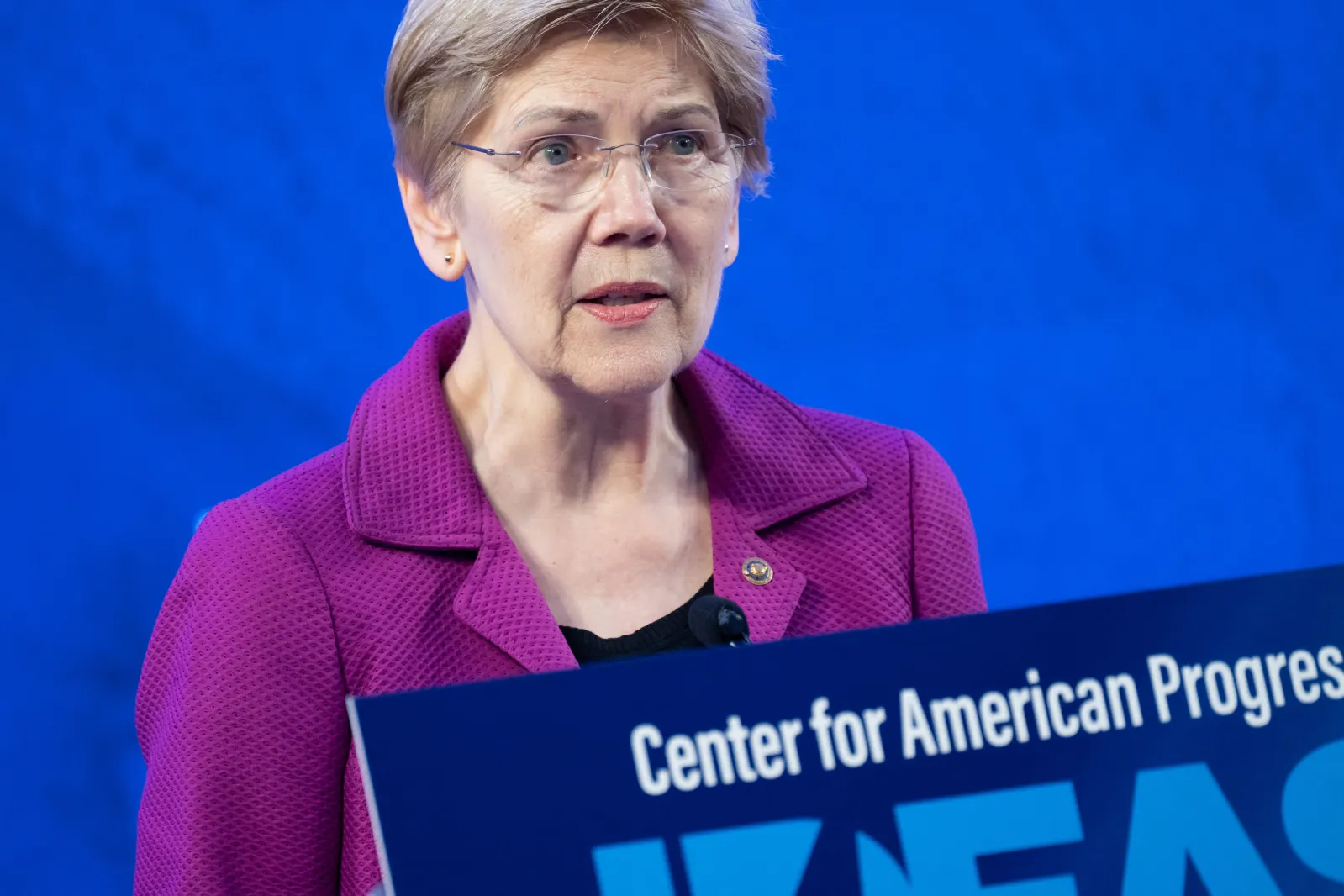
Senator Elizabeth Warren and other Democrats warn that proposals to raise the retirement age floated by some Republicans could result in significant benefit cuts for millions of Americans.
It comes as Congress faces pressure to address Social Security’s looming funding shortfall.
“Republicans have a history of attempting to increase the retirement age, privatize Social Security, or otherwise cut Social Security benefits, and some Congressional Republicans have called to raise the retirement age or means-test benefits as the 'solution' to this problem,” Warren and Senators Tammy Duckworth and Richard Blumenthal wrote in the new letter to President Donald Trump.
Read More on Politics
They added: “Raising the retirement age – or otherwise cutting benefits – only worsens the looming retirement income crisis, and… doing so hurts older Americans, cutting monthly benefits and forcing millions into poverty.”
Why It Matters
Social Security’s financial outlook is worsening. The program’s main trust fund is now projected to become insolvent by 2032, at which point it would only be able to pay about 78 percent of scheduled benefits without congressional action.
That reality has sparked conversations in Washington about reforms, including politically controversial options such as raising the retirement age.
...
Has Retirement Age Increased in the Past?
Yes. In the United States, the full retirement age for Social Security has been gradually increased.
- Original retirement age of 65: The Social Security program initially set the full retirement age (FRA) at 65 when it was created in the 1930s.
- 1983 legislation raising the age: Congress passed the Social Security Amendments of 1983, which gradually increased the FRA from 65 to 67.
- Gradual phase‑in to age 67: The increase was phased in by birth year, reaching age 67 for people born in 1960 or later.
- Why the change happened (longer life expectancy + financial pressure): Policymakers raised the age in part because people were living longer and to improve Social Security’s financial outlook.
Kevin Thompson, the CEO of 9i Capital Group and the host of the 9innings podcast, said it’s likely the retirement age will eventually increase, much like it has in the past.
“Whether it's raising the retirement age or bringing back conversations around privatization that we saw during the George W. Bush administration, Democrats are concerned that despite campaign promises not to touch entitlement programs, discussions are taking place that could impact millions of current retirees and future beneficiaries,” Thompson told Newsweek.
Global Trend for Retirement Age
Across many countries, retirement ages have been raised for similar reasons—aging populations, longer life expectancy, and strain on pension systems.
The U.K. and Germany, for example, are increasing their retirement ages to match the current United States age of 67, implementing these changes gradually over the coming years.
Denmark, the Netherlands & Italy are all set to raise their retirement age to 70 or higher.
What Have Republicans Actually Said About Raising the Retirement Age?
The senators’ concerns stem in part from public comments by administration officials and GOP lawmakers, including:
- Social Security Administration Commissioner Frank Bisignano, who said “everything’s being considered” when asked whether raising the retirement age was on the table, later walking back the remark.
- Centers for Medicare and Medicaid Services Administrator Mehmet Oz, who suggested Americans could work longer before retiring. Warren said this as a “veiled attempt” to raise the retirement age.
- House Speaker Mike Johnson, who has indicated Republicans intend to address spending on major entitlement programs in future policy discussions.
Republican policy proposals in recent years have explored raising the full retirement age to as high as 69 to bring down long-term costs.
But these changes would effectively cut benefits by forcing Americans to wait longer to collect full payments, Thompson said.
“While life expectancy may be increasing on average, people age very differently,” Thompson said. “We know that as individuals get older, their risk of the major killers; cancer, heart disease, dementia, and other chronic illnesses, rises significantly. Raising the retirement age is, in effect, a benefit cut, and those cuts would disproportionately impact lower-income Americans.”
How Much Could Retirees Lose?
Warren’s letter cites estimates that a two-year increase in the retirement age could reduce monthly benefits by 17 to 35 percent, depending on when retirees claim.
That amounts to monthly benefit losses of $345 to $741 for the median retiree.
What Polls Show
Public support for raising the retirement age is low.
A Ronald Reagan Institute survey from May of this year found 74 percent of voters oppose raising the retirement age, with only 26 percent in support.
However, the same poll found even stronger opposition to benefit cuts more broadly, with 90 percent of registered voters opposed.
Likely due to the insolvency date set for 2032, a large majority of Americans are concerned that Social Security could run short of funds, but the main proposals to stop the funding gap usually gain little public support.
“There have been dozens of proposals on potential solutions to the looming insolvency of Social Security's trust fund, with most centering around raising taxes or moving funding from other sources to at least partially pay for the program or replenish some of the trust fund,” Alex Beene, a financial literacy instructor for the University of Tennessee at Martin, told Newsweek.
“Little has been stated on increasing the full retirement age, which currently sits at 67 for those born in or after 1960, and that's for a good reason: it has proven to be political poison in the past for any official who recommended it.”
Are Americans Able to Retire on Time?
Many Americans are already struggling to retire at the current age, according to a recent Pew survey. The labor force participation rate for older residents increased by 2 percentage points nationwide from 2013 to 2023, from roughly 17 to 19 percent.
But among Americans age 65 and above, Social Security remains a critical income source, with 87 percent of older households receiving benefits as part of their income.
The AARP also found 40 percent of people age 65 and older rely on Social Security for at least half of their income, and a smaller share depend on it almost entirely.
While raising the retirement age would be one option to solve the insolvency problem, it could also disproportionately affect lower-income workers and those in physically demanding jobs who may not be able to continue working longer.
Why Is Social Security Running Out of Money?
The SSA’s projected shortfall has various contributing factors:
- An aging population is drawing benefits for longer.
- Fewer workers relative to retirees are paying into the system.
- Lower birth rates and reduced immigration have also exacerbated the problem.
If the trust fund is depleted, there would be automatic across-the-board benefit cuts at around 20 percent or more.
What Lawmakers Are Proposing Instead of Raising Retirement Age
While some Republicans have suggested raising the retirement age, other bipartisan efforts are attempting to sidestep direct benefit cuts.
A newly introduced bill, the Bipartisan Social Security Commission Act, would create a formal process to develop long-term solutions before insolvency triggers automatic reductions.
The legislation looks to establish a bipartisan commission to craft reform recommendations and would then require Congress to vote on a solvency plan to prevent the impending cuts in 2032.
“While it's highly unlikely the current administration in a midterms election year would even make the suggestion, concerns linger that the topic could be on the table the next two years as Congress looks for a solution to the solvency issue,” Beene said. “Ultimately, it's very unlikely age qualifications for retirement are raised, as virtually everyone in D.C. realizes how unpopular the move would be.”
What Happens Next
Social Security is expected to remain a central policy issue heading into the next legislative cycle.
For now, many Democrats are pushing for reassurance that raising the retirement age will not be part of the solution, while Republicans and some policy experts continue to weigh it among a range of possible reforms.
View 0 Comments
Submit Correction
View Editorial & AI Guidelines