
...

By Aliss Higham
Reporter
0
Share
Newsweek is a Trust Project member
See more of our trusted coverage when you search.Prefer Newsweek on Googleto see more of our trusted coverage when you search.
America's growing and aging population has led financial experts to raise concerns over the impact on the Social Security system, for which the number of claimants is also rising.
The U.S. population has increased by over 103 million over the last five decades, and data from the Social Security Administration (SSA) shows that the proportion of Social Security claimants has risen by more than seven percent in this time.
Read more: Checking Account vs. Savings Account: Which is Best for You?
Read More on News
The SSA told Newsweek it expects there to be 89.9 million beneficiaries in 2053, compared to the 67 million beneficiaries at the end of 2023. "That 22.8 million [increase] specifically accounts for the aging of the baby boom generation past the ages at which retirement benefits are typically claimed (62-70) and the subsequent lower birth rates after 1964," an SSA spokesperson said.
Compared to a projected U.S. population of 393 million, the ratio of beneficiaries to population would be 22.9 percent, up from 15.7 percent at the end of 2023.
And the increasing number of claimants, particularly those who are out of work and retired, means there are fewer workers paying taxes that go into the coffers that fund the SSA.
Read more: Best Place for Short-Term Investing: CD vs. High-Yield Savings Account
Chris Orestis, president of Retirement Genius, told Newsweek: "Historically it has required about two workers to support one retiree on Social Security, but the ratio has been disrupted and the fiscal strength of the program is being undermined."
"A large number of retirees is not a problem in itself; the proportion of retirees to new workers is the problem," Ron Hetrick, senior labor economist at market analytics firm Lightcast, told Newsweek. "That's because when people retire, their demand for goods and services remains high, but now we will have significantly fewer people to provide those goods and services moving forward."
...
The number of retired claimants has increased from 16.5 million in 1970 to 52.7 million in 2023—an increase from 8.2 percent to 15.7 percent of the population. The U.S. Census Bureau has also predicted that by 2030, one in five Americans will be older than 65. It says that beyond 2030, "the U.S. population is projected to grow slowly, to age considerably, and to become more racially and ethnically diverse" in line with increasing immigration.
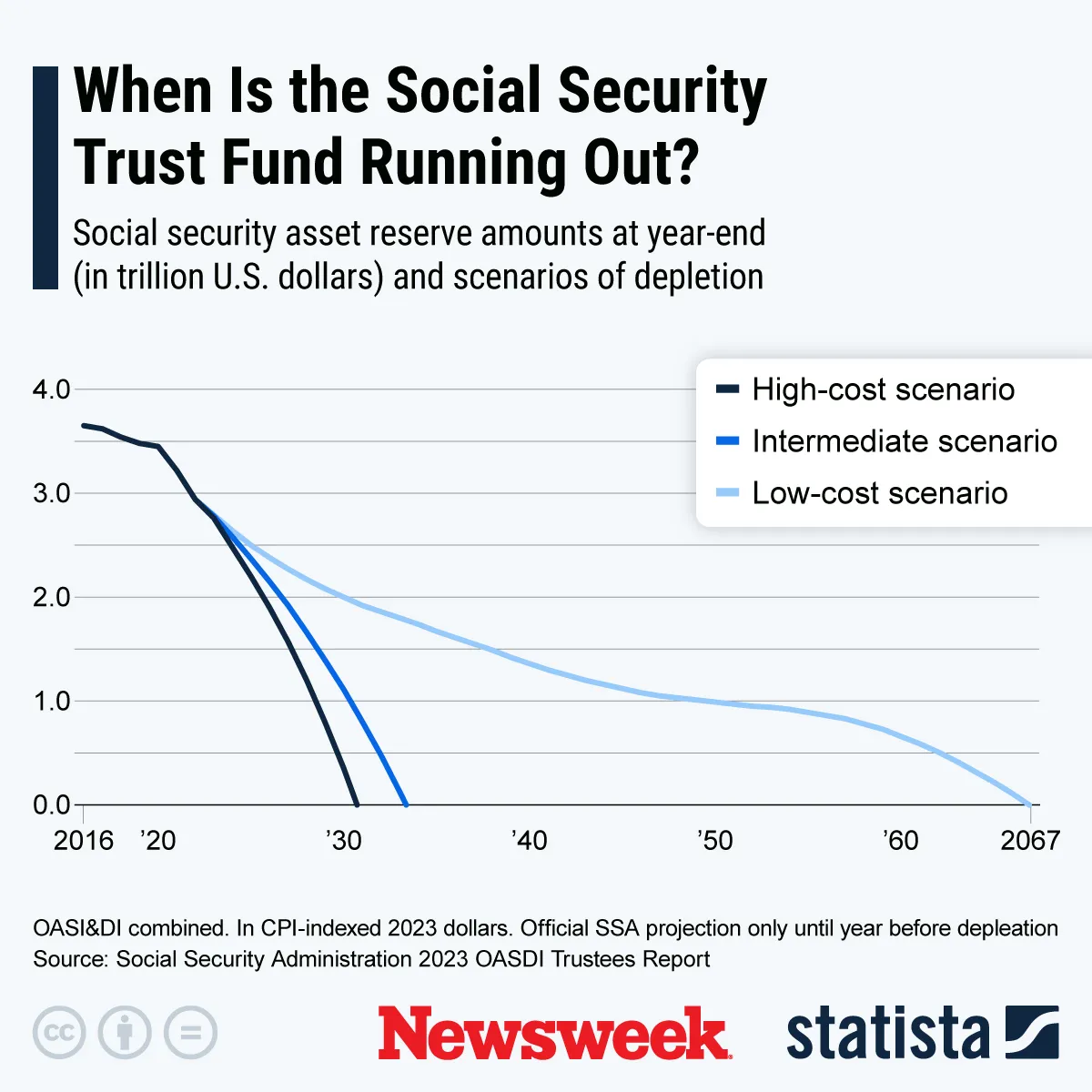
The increase in claimants that naturally comes with an aging population comes at a time when the SSA is already facing a funding knife-edge in just over a decade. The expected depletion date of the program's Old-Age, Survivors, and Disability Insurance (OASDI) fund has now been pushed back to 2035, based on the combined reserves of the retirement and disability benefit trusts—one year later than previously projected.
If the funds run out, meaning benefits will only be paid using tax receipts, the SSA predicts that in 2035 there would only be enough money to pay 83 percent of scheduled benefits at current rates.
"It is possible that if the number of retirees continues to increase at a higher rate than anticipated, the funding cliff could happen earlier than 2034/5," Michael Collins, CFA and founder and CEO of WinCap Financial, told Newsweek. "This would depend on a few factors such as the pace of retiree population growth, changes in Social Security eligibility and benefits, and market conditions as a whole."
Stephen Kates, principal financial analyst for RetireGuide.com, said the booming number of retirees "is unlikely to accelerate the funding shortfall" given that it anticipates "this growth in retirees and Social Security claimants" based on current assumptions regarding "tax revenue, average age of claims, disability claims, and longevity of benefit recipients." However, he warned that "if any of these assumptions change, it will impact the projections."
...
In 1970, the total number of Social Security claimants was 25,700,924—amounting to 12.6 percent of all U.S. residents. In 2023, the number of claimants hit 67,076,966. A midpoint (June 1) population prediction from the U.S. Census Bureau suggests that 20 percent of the population—or a fifth of all Americans—are currently receiving benefits.
Across 2023, the SSA spent $1.4 trillion in direct payments to beneficiaries. The Population Reference Bureau estimates that Social Security and Medicare expenditures will increase from a combined 9.1 percent of gross domestic product in 2023 to 11.5 percent by 2035 because of the "large share of older adults" in the population.
Update 06/16/24 11:04 a.m. ET: This article was updated with comment from the SSA.
View 0 Comments
Submit Correction
View Editorial & AI Guidelines