...

By Jess Thomson
Science Reporter
0
Share
Newsweek is a Trust Project member
See more of our trusted coverage when you search.Prefer Newsweek on Googleto see more of our trusted coverage when you search.
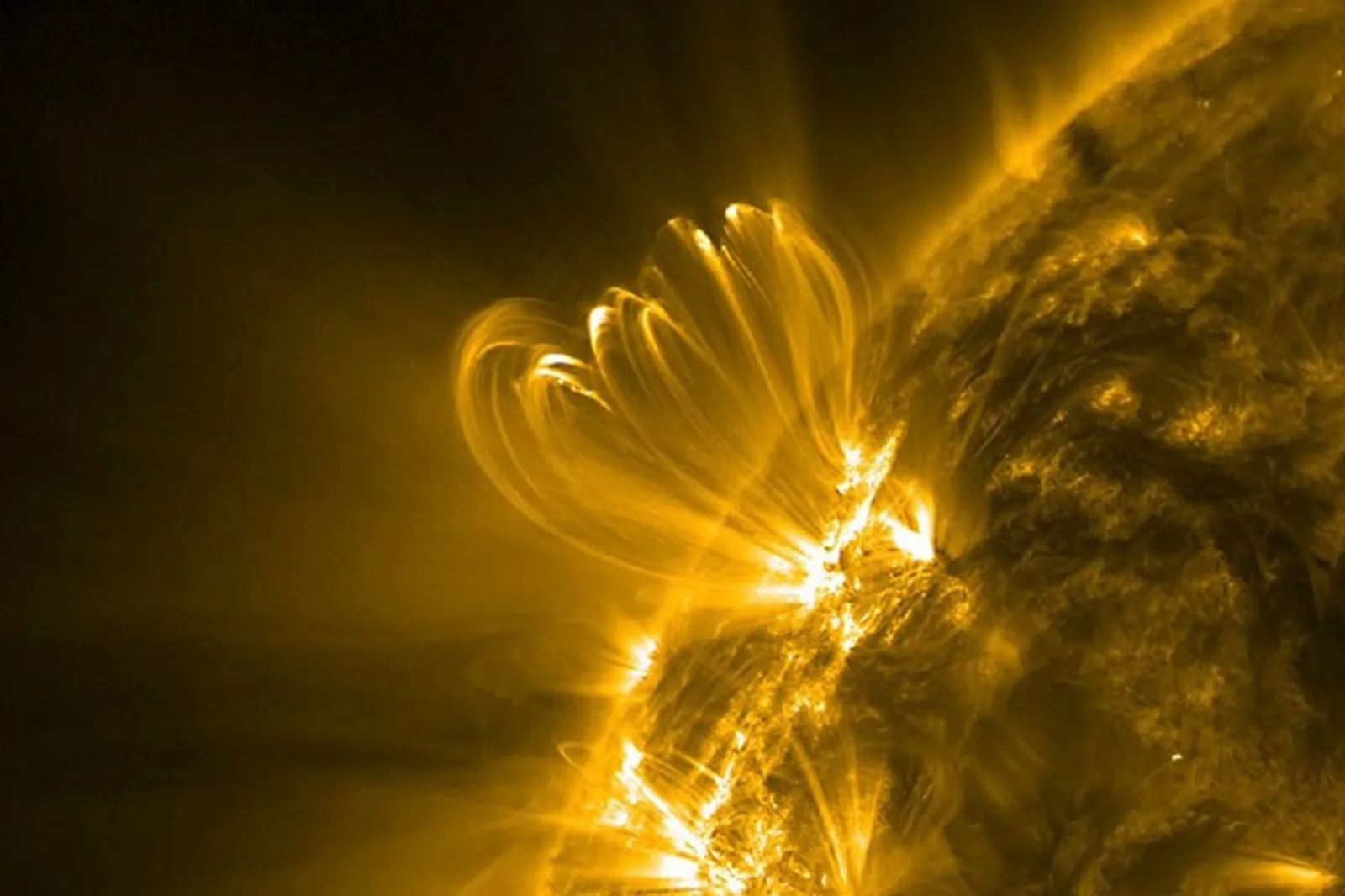
As the sun geared up to spit a powerful solar flare into space, NASA scientists snapped huge loops of plasma leaping from the sun's surface.
These spectacular solar structures, known as coronal loops, could help us predict when a solar flare may be about to head our way, according to a new paper in the Astrophysical Journal Letters.
Having an early-warning system for solar flares could help us protect infrastructure and technology here on Earth as well as astronauts in space from the effects of the high-energy solar radiation.
Read More on Science
Flares can ionize the Earth's ionosphere, disrupting high-frequency radio signals and causing radio blackouts—and they can also damage spacecraft electronics, reduce the accuracy of GPS signals, induce dangerous currents in power grids and increase the radiation exposure of astronauts.
...
Solar flares are sudden, intense bursts of energy—often in the form of X-rays and ultraviolet light—that explode from the sun's surface. They occur in regions of the sun with strong magnetic fields, usually near sunspots and are more frequent during the solar maximum, when the sun is at its most active.
"The sun, like our own planet, has motions inside it that generate a magnetic field," Martin Connors, a professor of space science and physics at Canada's Athabasca University, told Newsweek. "The sun's field reverses every 11 years or so and at this time the sunspots are near maximum."
Coronal loops are structures of glowing, superheated plasma that follow magnetic field lines in the sun's atmosphere, or corona. They form as magnetic field lines trap and guide plasma, and can vary from hundreds to hundreds of thousands of miles in size. Coronal loops are also more common during the solar maximum.
The researchers studied how the brightness of coronal loops varied in the hours before a strong solar flare was emitted—and compared this to loops observed in areas where no flare was released.
They discovered that the coronal loops behaved strangely just before a solar flare was released, flickering in a more chaotic way.
"We found that some of the extreme ultraviolet light above active regions flickers erratically for a few hours before a solar flare," study co-author Emily Mason, a heliophysicist at Predictive Sciences Inc. in San Diego, California, said in a statement.
"The results are really important for understanding flares and may improve our ability to predict dangerous space weather."
There was also some indication that the flickering peaks earlier if the flare about to be released is stronger, though this needs more research to confirm.
The researchers hope that these flickering variations of the coronal loops could be between 60 to 80 percent accurate in predicting the occurrence of a flare in the next two–six hours.
"The Sun's corona is a dynamic environment, and each solar flare is like a snowflake — every single flare is unique," study co-author Kara Kniezewski, a graduate student at the Air Force Institute of Technology, said in the statement.
"We find that searching for periods of 'chaotic' behavior in the coronal loop emission, rather than specific trends, provide a much more consistent metric and may also correlate with how strong a flare will be."
Being able to predict a coming solar flare could help us guard against impacts to astronauts, spacecraft, electrical grids and other technology that may be affected by a flare.
Do you have a tip on a science story that Newsweek should be covering? Do you have a question about solar flares? Let us know via science@newsweek.com.
References
Kniezewski, K. L., Mason, E. I., Uritsky, V. M., & Garland, S. H. (2024). 131 and 304 Å Emission Variability Increases Hours Prior to Solar Flare Onset. The Astrophysical Journal Letters, 977(1), L29. https://doi.org/10.3847/2041-8213/ad94dd
View 0 Comments
Submit Correction
View Editorial & AI Guidelines