...

By Anna Skinner
Associate News Editor
0
Share
Newsweek is a Trust Project member
See more of our trusted coverage when you search.Prefer Newsweek on Googleto see more of our trusted coverage when you search.
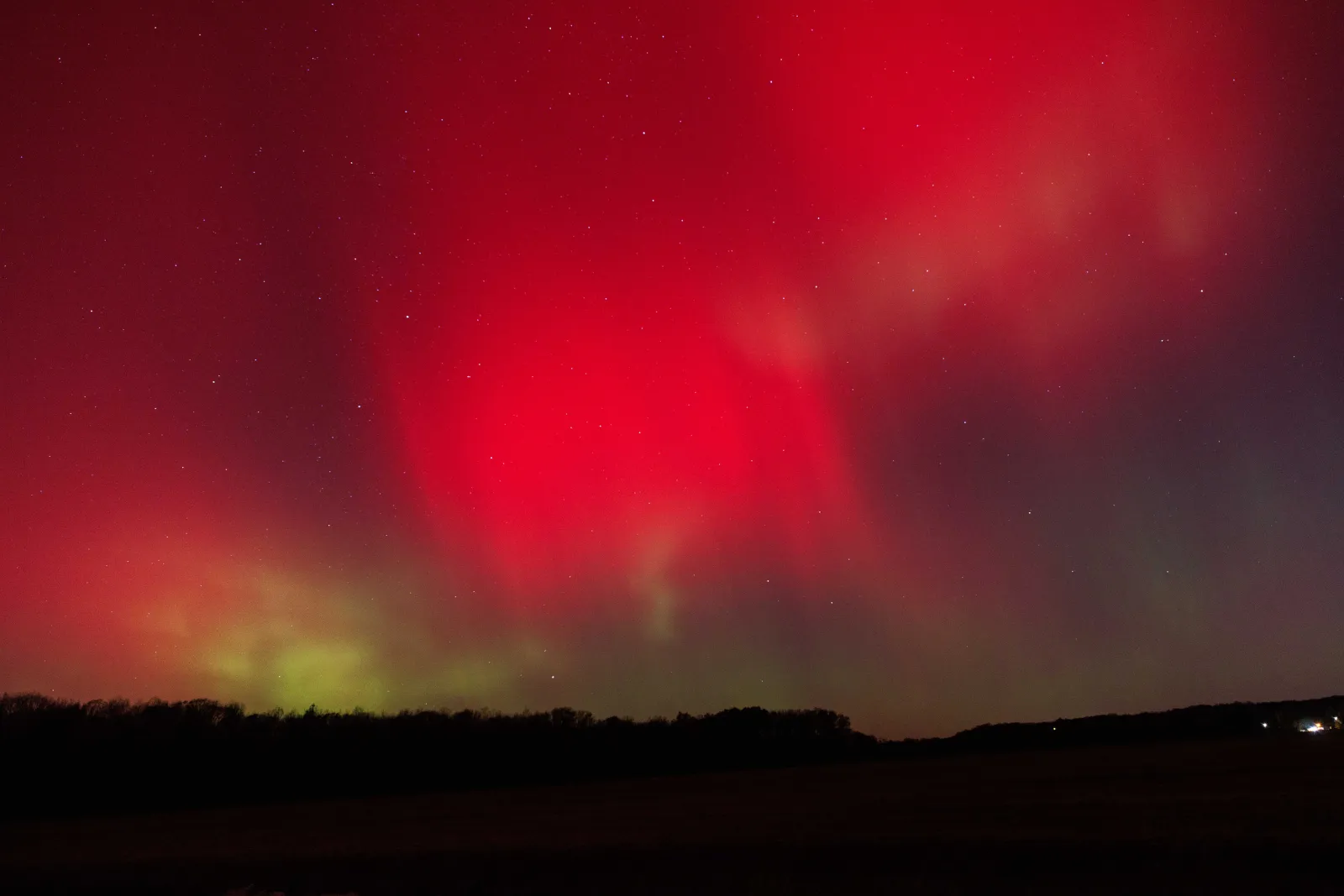
People in dozens of states have a chance to see the Taurid meteor shower and the Northern Lights on Wednesday night, potentially at the same time.
Why It Matters
Wednesday night's sky over the United States presents a rare celestial spectacle: the potential for the Northern Lights—also known as the aurora borealis—to be visible as far south as Alabama and possibly even beyond, coinciding with the peak of the Taurid meteor shower. A severe geomagnetic storm, driven by recent solar activity, is creating unique conditions for millions of Americans to witness phenomena typically reserved for more northern latitudes. Such widespread auroral visibility and a prominent meteor shower provide remarkable opportunities for stargazers and scientists alike while also testing the resilience of technological infrastructure because of solar-induced geomagnetic activity.
Read More on U.S.
"While not unprecedented, is it quite unusual for the aurora to be visible at these low latitudes, probably only occurring once or twice per solar cycle," a National Oceanic and Atmospheric Administration (NOAA) Space Weather Prediction Center (SWPC) spokesperson told Newsweek.
...
What To Know
The SWPC has issued a severe G4 geomagnetic storm watch through Wednesday, following multiple powerful solar eruptions that produced coronal mass ejections (CMEs). These CMEs can cause bright auroras and, in rare cases, make the northern lights visible in regions far away from the polar circles.
Experts suggest the best time to view the northern lights will be between 10 p.m. and 2 a.m. local time, with the optimal experience obtained from dark, open areas far from city lights. Long-exposure photography or the use of smartphone cameras may also reveal auroral colors and patterns invisible to the naked eye.
The Taurid meteor shower will also peak Wednesday night, adding extra brilliance to the night sky and increasing the odds for viewers across the U.S. to see auroras and meteors. The Taurids are renowned for producing slow-moving fireballs, making them easier to spot even in areas affected by light pollution.
States With Highest Likelihood Of Seeing The Northern Lights
According to forecasts from NOAA and multiple reports, states with the highest probability of seeing the aurora borealis Wednesday night:
- Alaska
- Washington
- Oregon
- Idaho
- Montana
- North Dakota
- South Dakota
- Minnesota
- Wisconsin
- Nebraska
- Michigan
- Illinois
- Iowa
- New York
- Maine
- Vermont
- New Hampshire
- Wyoming
Other states with possible, though lower, chances—especially if conditions are favorable—include parts of Nebraska, Indiana, Ohio, Pennsylvania, Massachusetts, Colorado and, even on rare occasions during the strongest storm periods, locales as far south as Alabama, California, Texas, Kentucky and Virginia.
Meteorologists note, however, that cloudy skies may interfere with aurora viewing, and people are encouraged to monitor forecasts before hunting for the lights.
Taurid Meteor Shower: What Viewers Should Expect
The Taurid meteor shower, which peaks Wednesday night, is visible across the entire United States and is recognized for producing bright, slow meteors. This year, viewing conditions are ideal for much of the U.S. because the shower coincides with the moon in its last quarter, resulting in darker skies. The best time to observe the Taurids is from late evening through the pre-dawn hours.
What People Are Saying
The SWPC spokesperson told Newsweek: "We don't have any specific details on the Taurid meteor shower, but that activity does peak November 11-12, so some folks may be able to see both aurora and meteor showers tonight, assuming skies are favorable [clear]."
SWPC, on X: "G3 conditions are currently being observed. G4 conditions with a chance for higher levels remain possible throughout the day as another CME is expected to arrive midday (EST)."
MyRadarWX senior meteorologist Matthew Cappucci, on X: "A SEVERE (G4) or EXTREME (G5) geomagnetic storm remains POSSIBLE TONIGHT – Wednesday, November 12, 2025. Make plans now to hunt for the aurora borealis with your loved ones! This would be realized if we have favorable timing with the “grand finale” CME, or coronal mass ejection — a magnetic shockwave. If it hits too early, we might only get the tail end of the geomagnetic storm at dark. You might also catch a rogue Taurid meteor! The meteor shower doesn’t produce many meteors, but rather a few sporadic shooting stars that can be fairly bright!"
What Happens Next
Stargazers looking to glimpse the aurora or spot Taurid meteors on Wednesday night should check for updated forecasts and seek dark, open viewing locations. The convergence of these phenomena offers an extraordinary opportunity to experience two of nature’s most dazzling sky shows on the same night.
The event may also affect radio, GPS and satellite operations because of geomagnetic disturbances, though widespread technical disruptions are not guaranteed. Observers and infrastructure managers are advised to follow updates from the SWPC and local meteorological offices.
View 0 Comments
Submit Correction
View Editorial & AI Guidelines