...

By Micah McCartney
Reporter
0
Share
Newsweek is a Trust Project member
See more of our trusted coverage when you search.Prefer Newsweek on Googleto see more of our trusted coverage when you search.
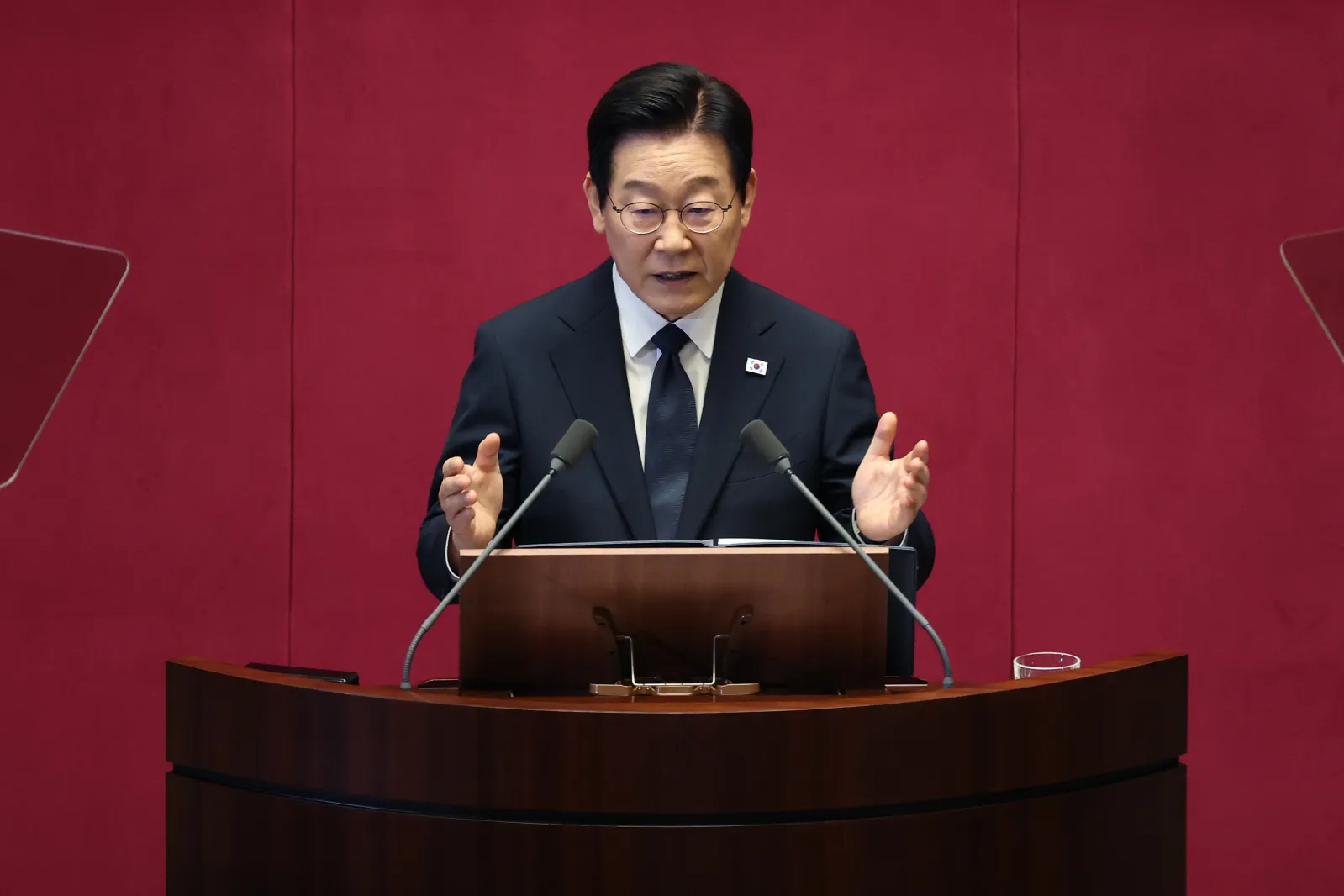
South Korean President Lee Jae-myung has directed police to play a key role in a crackdown on hate speech online, arguing such behavior “crosses the boundary of freedom of expression.”
Why It Matters
Lee’s remarks come during a wave of anti-foreigner sentiment. Chinese nationals, in particular, were the primary focus of large-scale demonstrations by conservative groups in the lead-up to the Asia-Pacific Economic Cooperation summit in Busan last month.
Read More on World
The number of foreigners nationals staying at least three months in South Korea reached a record 2.58 million last year—or roughly 5 percent of the population. The recent protests highlight increased anxieties over rapid demographic change in what has historically been one of the world's most homogenous societies.
Newsweek has reached out to the South Korean Embassy in the U.S. via email with a request for comment.
What To Know
Lee, a member of the left-leaning Democratic Party of Korea who took office in June, said during a Cabinet meeting Tuesday morning that hate speech targeting specific groups and the spread of disinformation are “rampant,” particularly on social media.
“Acts such as distorting or manipulating facts, spreading racial hatred or discrimination—the circulation of such false information is an act that threatens democracy, and because it threatens the daily lives of our citizens, it must be regarded as a crime,” he said. Lee called this “crossing the boundary of freedom of expression” and said police should play a “particularly important role.”
...
Asked by Gender Equality Minister Won Min-kyung whether the head of the National Human Rights Commission could also be penalized for hate speech, Lee said all senior officials would be held to the same standards as other public officials regarding hate speech.
The current chair, Ahn Chang-ho, has faced criticism for anti-LGBTQ+ remarks, including statements made during his confirmation hearing last year expressing concerns that anti-discrimination laws could be exploited by “Marxists” to “start a communist revolution” and could result in “reverse discrimination.”
Lee also approved a proposal by Personnel Management Minister Choi Dong-suk to allow for the immediate dismissal of civil servants found to have engaged in hate speech, saying the rule should be adopted as soon as possible, according to the Korea Times.
What People Are Saying
Dai Bing, Chinese ambassador to South Korea, said during a forum in Seoul Tuesday, according to the Korea JoogAng Daily: "Far-right forces in Korea are spreading disinformation about China and organizing anti-China protests, which not only damage the friendship between our two countries but also tarnish Korea’s national image.”
What Happens Next
South Korea and Japan are the only two countries among the Organization for Economic Co-operation and Development group of developed economies without a comprehensive anti-discrimination law on the books.
During Tuesday’s meeting, Lee voiced support for Justice Minister Jung Sung-ho’s push for parliamentary debate on such a law, modeled after similar legislation in Japan and Europe, the Korea Times reported
Lee also said the country should push to abolish a clause in its criminal defamation law that allows for factual statements to be punished, arguing that such disputes should be settled in civil court.
View 0 Comments
Submit Correction
View Editorial & AI Guidelines