NASA/JPL-Caltech/Keith Miller (Caltech/IPAC)

By Ian Randall
Deputy Science Editor
0
Share
Newsweek is a Trust Project member
See more of our trusted coverage when you search.Prefer Newsweek on Googleto see more of our trusted coverage when you search.
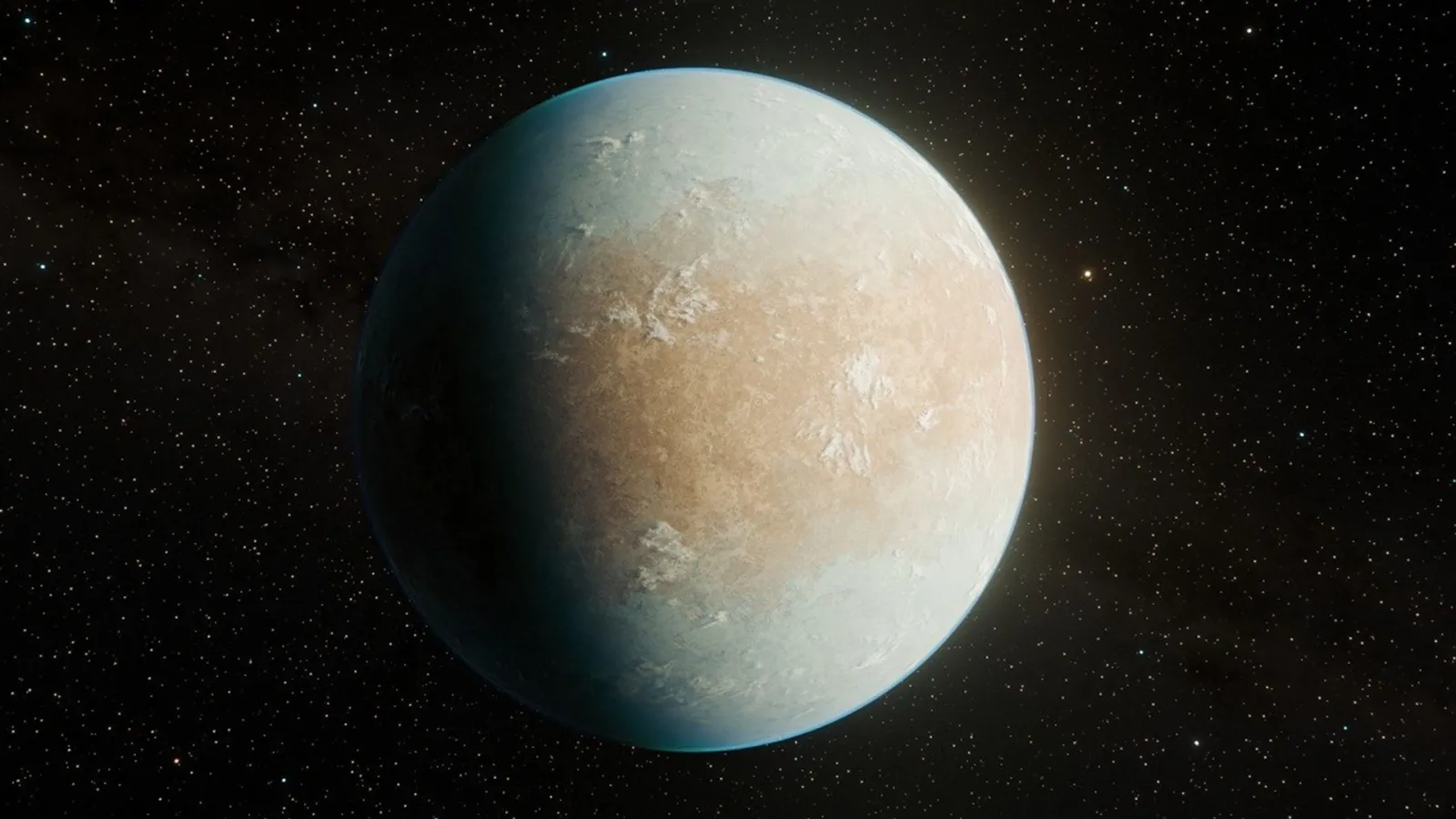
Astronomers may have discovered a new Earth-sized exoplanet orbiting a Sunlike star just 146 light-years away. Before you pack a suitcase, however, there’s a catch: even if the find is confirmed, the world is likely to be a bit chilly.
The surface temperature of catchily dubbed HD 137010 b likely doesn’t get much higher than -90 degrees Fahrenheit.
This is even colder than the average temperature on perpetually frozen Mars. Unlike the Red Planet, however, which today has an incredibly thin atmosphere that can’t retain heat, the problem with HD 137010 b lies in its star, HD 137010.
Read More on Science
Despite being the same stellar type as the Sun, HD 137010 is much cooler and dimmer. So even though the new world likely takes a year to circle its star, just like Earth, its orbit probably lies much closer to the outer edge of the "habitable zone" and gets less than a third of the light and heat that the Earth does from the Sun.
This is the range of orbital distances at which liquid water can potentially form on a planet’s surface, given a suitable atmosphere.
...
Despite the risk of HD 137010 b being a frozen world, the researchers say that there is a chance it could still turn out to be either a temperate or even watery world.
For this to be the case, however, the planet would need to have an atmosphere much richer in carbon dioxide than our own—a trait that would help it retain heat much in the same way that such greenhouse emissions here on Earth are warming up our world.
The scientists’ exploration of HD 137010 b’s possible atmospheres gives it a 40 percent chance of falling with a "conservative" habitable zone around its star, and a 51 percent chance of falling in a more "optimistic" habitable zone.
The corollary of this, of course, is that there are even odds that the world will fall outside of the habitable zone entirely.

...
HD 137010 b was identified as an exoplanet candidate in data collected by NASA’s Kepler Space Telescope, which was retired in 2018, but continues to surprise.
The reason HD 137010 b is only a candidate—rather than a confirmed discovery—is that it was identified based only on a single "transit," the temporary dimming of the light from HD 137010 that could indicate that a planet passed between the star and Kepler.
Further observations will be required to confirm the exact nature of HD 137010 b. Fortunately, if it is a world, it could turn out to be the first earthlike exoplanet orbiting a star close enough and bright enough for meaningful follow-up investigations.
Do you have a tip on a science story that Newsweek should be covering? Do you have a question about exoplanets? Let us know via science@newsweek.com.
Reference
Venner, A., Vanderburg, A., Huang, C. X., Dholakia, S., Schwengeler, H. M., Howell, S. B., Wittenmyer, R. A., Kristiansen, M. H., Omohundro, M., & Terentev, I. A. (2026). A Cool Earth-sized Planet Candidate Transiting a Tenth Magnitude K-dwarf From K2. The Astrophysical Journal Letters, 997(2). https://doi.org/10.3847/2041-8213/adf06f
View 0 Comments
Submit Correction
View Editorial & AI Guidelines