...

By Lauren Giella
Senior Reporter
0
Share
Newsweek is a Trust Project member
See more of our trusted coverage when you search.Prefer Newsweek on Googleto see more of our trusted coverage when you search.
As the fall semester comes to a close, students are finalizing their common applications and personal essays to send off to admissions offices around the country. There are many factors that students consider when applying to colleges, including location, size, sports conference and dining hall options. But for young women filling out their applications, there are often unique considerations they make when deciding where to spend the next four years.
For the first time, Newsweek is releasing its ranking for America's Best Colleges for Women 2026 to help women choose the right school for them. This ranking intends to provide additional information about university leadership, staffing, safety, diversity and other funding and recognition measures to support women in school and beyond. Its purpose is to be one of the many tools prospective students use when they are considering where to attend college.
“Newsweek is committed to publishing rankings that help students make smarter, more personal college choices,” Newsweek’s Global Head of Research Duncan Ross said in a statement. “America’s Best Colleges for Women offers a vital perspective by measuring the conditions that shape women’s success in higher education.”
Read More on News
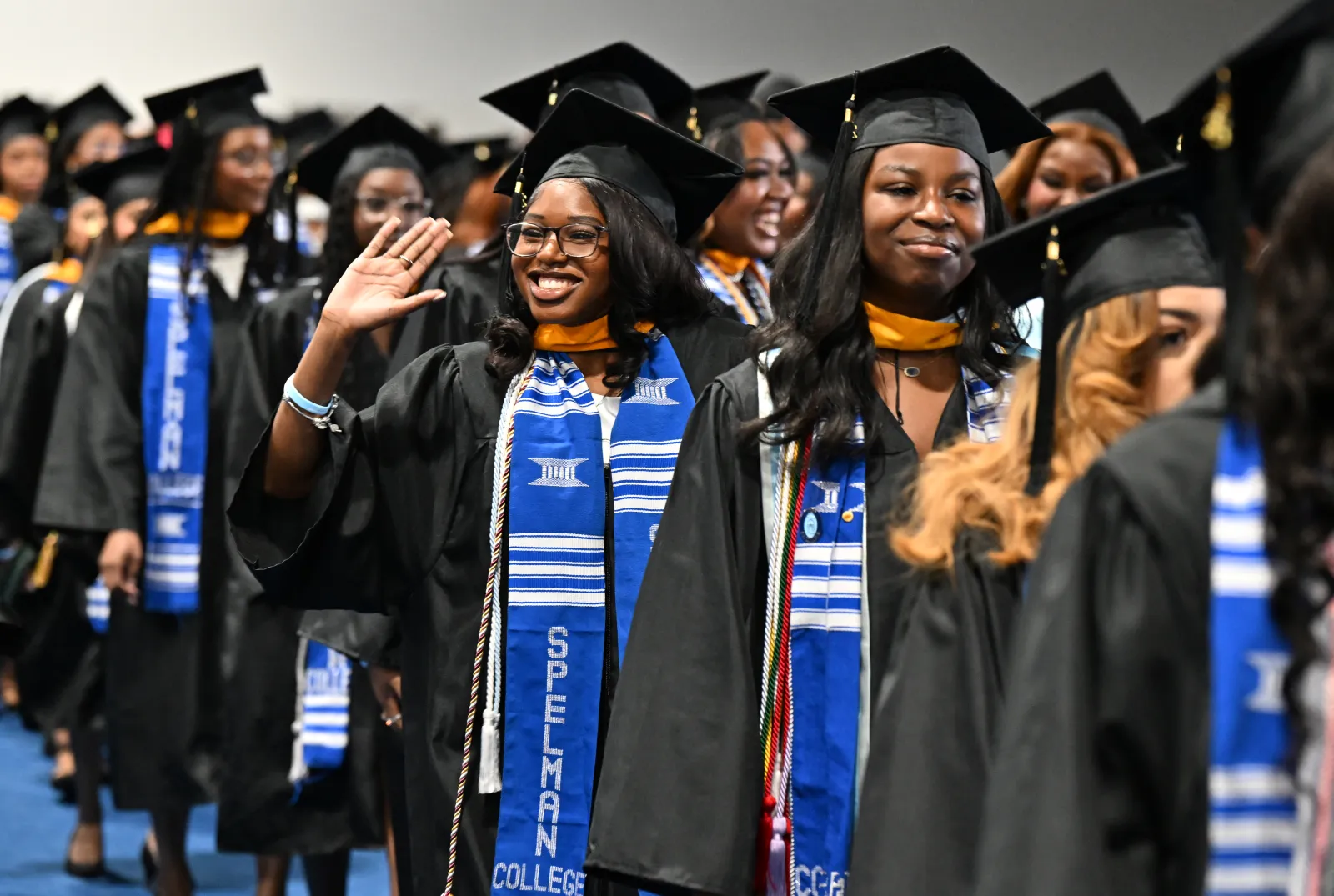
The top school on the list was Spelman College, a historically Black women’s liberal arts college in Atlanta, Georgia. Spelman College's placement reflects its strong performance across the four core measurements, leadership, pay, safety and opportunity, and emphasizes the school's long-standing commitment to support women leaders in equitable and safe academic environments.
Other top colleges include St. Catherine University, Thomas Jefferson University, Miami Dade College, California State University – Los Angeles and CUNY York College.
"Spelman College is thrilled to be ranked as one of Newsweek’s America’s Best Colleges for Women," the college told Newsweek in a statement. "This is a tremendous honor and a reflection of our commitment to leadership development, student access and opportunity and campus safety. We are proud of our legacy as a global leader in the education of women of African descent and remain dedicated to fostering an inclusive, modernized living and learning environment for our students."

Photo-illustration by Newsweek/Getty
Newsweek partnered with Gender Fair, which provides rankings to colleges, companies and nonprofits based on the equality and accountability to gender parity to inform consumers and promote accountability. The company was founded to “unleash women’s consumer power,” Gender Fair founder Amy Cross told Newsweek. This year, the company shifted focus to rank colleges.
“Gender Fair emphasizes that women have tremendous economic power, which they can use to exert influence and bring about the social and economic change that they want in the world in their lifetime,” Cross said. “Every dollar you give to a college, company, nonprofit or stockbroker is a vote about your values, and you can choose to support organizations that promote equality [and] fairness.”
This same power, she added, can extend to economic decisions related to education. Cross said female students pay just under $2 billion for their education annually, which equals a lot of influence. If education is one of the biggest expenses in life, Cross believes young women should be informed to ensure they have a more equal experience— seeing women in academic leadership, not being at risk of violence and receiving equal opportunity from their school.
“Despite the numerous college rankings and ratings available, and the fact that women have made up half of the student body since the 1980s, colleges haven’t really been evaluated through a gender lens before, which, personally, I find astonishing," she said.
The grading for this ranking is roughly based on the United Nations’ Women’s Empowerment Principles (WEP), which were created as a framework to advance gender equality in the private sector, and a federal database that tracks violence against women, including sexual assault and hate crimes.
“Women deserve to know whether the organizations, institutions or companies they give money to merit their support; Gender Fair provides data so people can use their economic power to support organizations that actively promote equality,” Cross said. "If you pay tuition, send donations or make purchases, Gender Fair believes you deserve to know how well any organization serves women — and we provide that information.”
The ranking considered co-educational colleges in all 50 states and Washington, D.C. that employ at least 20 women in academic roles, have a minimum of 1,000 students and offer bachelor’s degrees.
Each school’s rating is based on four main categories: Leadership, pay and policies, safety and opportunity. The data comes from two main sources from the U.S. Department of Education – the Integrated Postsecondary Education Data System (IPEDS) and the Campus Safety and Security Database. The ranking also incorporates desk research and data from the Center for Reproductive Rights to measure how local and state politics might impact their college experience.
IPEDS gathers information from every college, university, technical and vocational institutions that participate in the federal student financial aid program. The data describes and analyzes trends in higher education, with metrics for students enrolled, staff employees, budgets and degrees.
Leadership considers women in visible roles from the president to assistant professors who can offer female students support and guidance during their academic journey. Full-time professors, associate professors and assistant professors are all considered in this category. This makes up the largest percentage of the total score at 35 percent.
Pay and policies consider whether the women on staff are recognized and compensated fairly. This category measures the ratio of average pay between women and men, average pay for women in academic roles and the presence of a daycare facility on-site to support working parents. This makes up 25 percent of the total score.
Safety is a major concern for women on college campuses. The Campus Safety Database is a federally mandated data collection tool that aims to provide a safe environment for students at colleges and universities across the country and keep students and families informed about campus safety. This ranking considers public data on crimes against women and hate crimes reported, making up 20 percent of the total score.
Finally, this ranking considered the opportunities the schools provide for women from different backgrounds, which makes up the last 20 percent of the total score. This includes the racial diversity of professors and the proportion of students receiving Pell Grants.
CUNY Interim Executive Vice Chancellor and University Provost Alicia Alvero told Newsweek that the university system's commitment to supporting female students, faculty and staff is key to advancing its mission and priorities.
"Since its founding in 1847 and more than two decades later when Hunter College opened as the first public-tuition-free women’s college in the nation, CUNY has offered an array of high-impact programs, services and resources that promote gender equity and inclusion," she said. "CUNY’s history merges head-on with the history of women who have fought for equality and liberation, with the University educating such trailblazers as Antonia Pantoja, Pauli Murray, Shirley Chisholm, Audrey Lorde and shattering glass ceilings by employing female faculty like groundbreaking physicist Myriam P. Sarachik when women were seldom considered for such roles. CUNY remains at the vanguard of upholding women’s rights to this day."
Alvero added that CUNY has Women's Centers at 10 campuses, hosts an annual Women's Conference Week to promote career development and mentorship opportunities for women and invests in building a pipeline for diverse faculty members.
"CUNY is one of the most diverse universities in the country," she said. "We are fortunate to have a community of students and staff that brings a wide array of viewpoints and experiences that help to enrich the experience of all, both in and out of the classroom. Leveraging our community’s strengths is one of the ways CUNY is working to become a more inclusive and equitable university."
The ranking itself highlights the top 200 colleges ranked individually, with the remaining institutions banded together by a small score range in sections from 201-300, 301-400, 401-500, 501-750 and 750+.
Each school is listed with its rank, total score, state, score for the four main categories and a rating on its state reproductive protections, ranging from four, meaning services such as abortion are protected under state law, to one, which means abortion is prohibited by law and/or subject to criminal penalties. There is also an option to sort the top universities by state.
This ranking is not only useful for prospective students, Gender Fair’s Amy Cross told Newsweek. School administrators can use the results to identify ways to improve, potential hires can understand a school’s environment and potential for advancement and alumni can assess whether to invest their support.
"This is an idea I want people to take throughout their lives," Cross said. "Whenever you exchange your dollar to any organization, you have a right to ask for more fairness."
Update on 12/10/2025 at 10:40 a.m.: This story was updated with comment from CUNY.
View 0 Comments
Submit Correction
View Editorial & AI Guidelines