...

By Jordan King
Reporter
0
Share
Newsweek is a Trust Project member
See more of our trusted coverage when you search.Prefer Newsweek on Googleto see more of our trusted coverage when you search.
Texas and Florida's populations have grown the most in the four years between 2020 and 2024, new data shows.
Why It Matters
The U.S. experienced its slowest population growth (0.1 percent) in decades during the pandemic years 2020 and 2021, according to the U.S. Census Bureau.
Read More on News
Population growth has since started to recover from this, although often through immigration, expanding by 0.77 percent, 2.6 million people, in the 2023-2024 year.
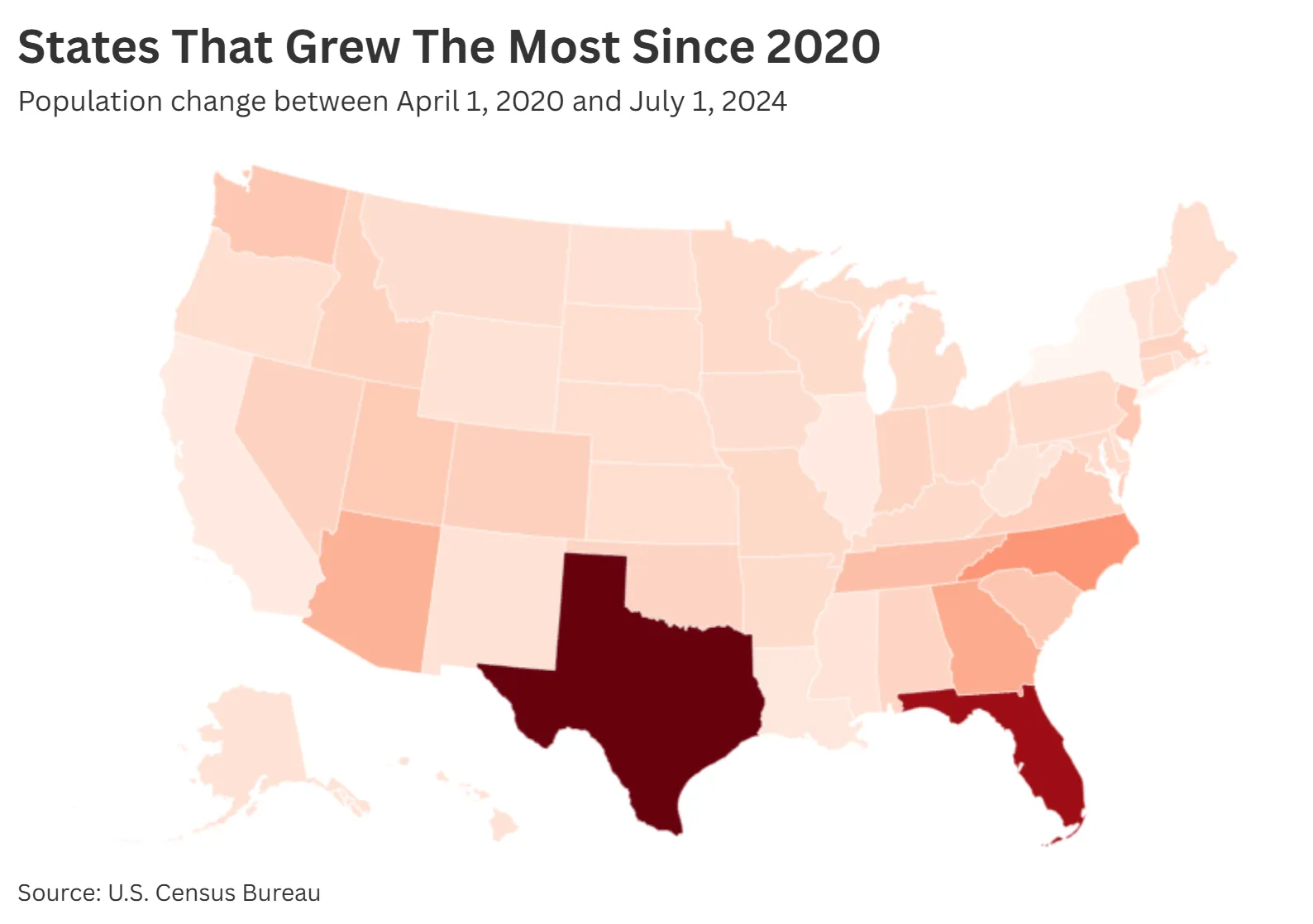
Newsweek has created a map to show which states have seen the highest population growth, based on Census Bureau data as of July 1, 2024.
What To Know
Accounting for births, deaths and migration, the U.S. grew by around 8.5 million people between 2020 and 2024—around 5 million less than the entire population of Switzerland.
Texas and Florida saw the largest population jumps—with the former on top with the change by number of people and the latter No. 1 for the largest percentage increase; Texas grew by 2.1 million people (7 percent) and Florida by 1.8 million people (8.2 percent).
These states are followed by North Carolina, which increased by 596,000 (5.7 percent); Georgia, which grew by 448,000 (4.2 percent); and Arizona, which went up by 395,000 (5.5 percent).
The last three states that saw high population gains are South Carolina, up by 347,000 (6.8 percent); Tennessee, up by 300,000 (4.3 percent); and Washington, up by 231,000 (3 percent).
Conversely, New York saw the largest population decline, losing 238,000 people (1.2 percent), followed by California (91,000—0.2 percent) and Illinois (89,000—0.7 percent).
U.S. Population Projections Drop
The United States population is projected to grow more slowly than previously anticipated over the next three decades, according to the Congressional Budget Office's latest forecast released in 2025.
The CBO reduced its 30-year projection by 11 million people, estimating a U.S. population of 372 million by 2055. The new annual growth rate is expected to average just 0.2 percent over the next 30 years——less than a quarter of the rate recorded between 1975 and 2024.
This decline is driven by a lower fertility rate, now projected to average 1.60 births per woman over the next three decades. This is well below the replacement level of 2.1 births per woman required to maintain a stable population without immigration.
What People Are Saying
Population Reference Bureau's senior program director, Beth Jarosz, previously told Newsweek: "Next year, the country will be a bit older, the total number of births will be a bit lower, and people will still have trouble finding housing that meets their needs."
What Happens Next
The U.S. is one of several countries struggling with population growth, and William Frey, a demographer and senior fellow at the Brookings Institution, told Newsweek there will be "low population growth" in 2025, "with immigration accounting for most of the growth."
...
View 0 Comments
Submit Correction
View Editorial & AI Guidelines