10
Loading video...

By Ellie Cook
Senior Defense Reporter
0
Share
Newsweek is a Trust Project member
See more of our trusted coverage when you search.Prefer Newsweek on Googleto see more of our trusted coverage when you search.
President Donald Trump has ordered the U.S. Navy to ditch newer, advanced systems that launch jets from aircraft carriers, instead returning to the steam catapults previously used on board the vast warships.
The fourth aircraft carrier in the Ford*-*class, which is currently being built, won't have the Electromagnetic Aircraft Launch Systems (EMALS) installed on the first three Ford-class carriers, according to a national security memorandum published on Thursday.
Trump directed the Navy to replace EMALS with steam catapults on the USS Doris Miller, in a change likely to cost the U.S. taxpayer millions of dollars.
Read More on World
The president has for years complained about EMALS and has pushed for a return to steam catapults.
...
EMALS are "very complicated," Trump said during a visit to the USS Gerald R. Ford aircraft carrier in 2017. "You have to be Albert Einstein to figure it out."
In an interview with Time magazine in the same year, he said the system was “not good” and “doesn't have the power” of the older steam systems.
The U.S. military previously said EMALS were more reliable and efficient than steam catapults, needing fewer people to man them, which ultimately means they are cheaper and easier to maintain.
They also mean sailors on board the carrier have "quieter and cooler work and living spaces," according to the U.S. Naval Air Systems Command.
"A decision to revert to steam catapults is illogical, inefficient and a waste of money," said Mark Montgomery, a retired U.S. Navy rear admiral now with the Foundation for Defense of Democracies (FDD) research institute.
EMALs propel the aircraft forward more smoothly, meaning there is less wear and tear, Montgomery said, adding that they also use far less energy and, crucially, water—a scarce resource on a ship.
"It would be foolish and expensive to revert to steam catapults," Montgomery told Newsweek.
Related Story

Is Pete Hegseth Checking the USS Abraham Lincoln’s Testosterone?
Related Story

Don’t Fear The Reaper
General Atomics, the defense giant that manufactures EMALS, said the decision not to use these designs on the USS Doris Miller needed "careful consideration," particularly with nearly half of production already completed.
"Changing course now would introduce significant cost, schedule, and integration risks," General Atomics said in a statement carried by Reuters.
The Doris Miller is expected to be handed over to the U.S. Navy in 2034 after years of delays attributed to "constraints" in shipyards.
The U.S. will also scrap Advanced Weapons Elevators (AWE) installed on the Ford-class carriers, and replace them with hydraulic systems, Trump said. AWEs bring bombs, missiles and other weapons up from storage to the flight deck.
The memorandum also said the Navy will be able to utilize a small number of vessels made overseas, with U.S. shipyards unable to keep pace with current orders and planned projects falling behind.
"An atrophied shipbuilding industrial base, coupled with diminished adjacent supplier bases, has expanded delays and increased costs," Trump said.
The U.S. shipbuilding industry has long struggled to meet its laid-out time scales and budgets, and the U.S. Navy itself has acknowledged "shipbuilding challenges."
The industrial capacity of the U.S., including its shipyards and the backlogs in keeping vessels in working order, is a real concern, retired U.S. Vice Admiral Robert Murrett previously told Newsweek.
What Are EMALS and How Do They Compare To Steam Catapults?
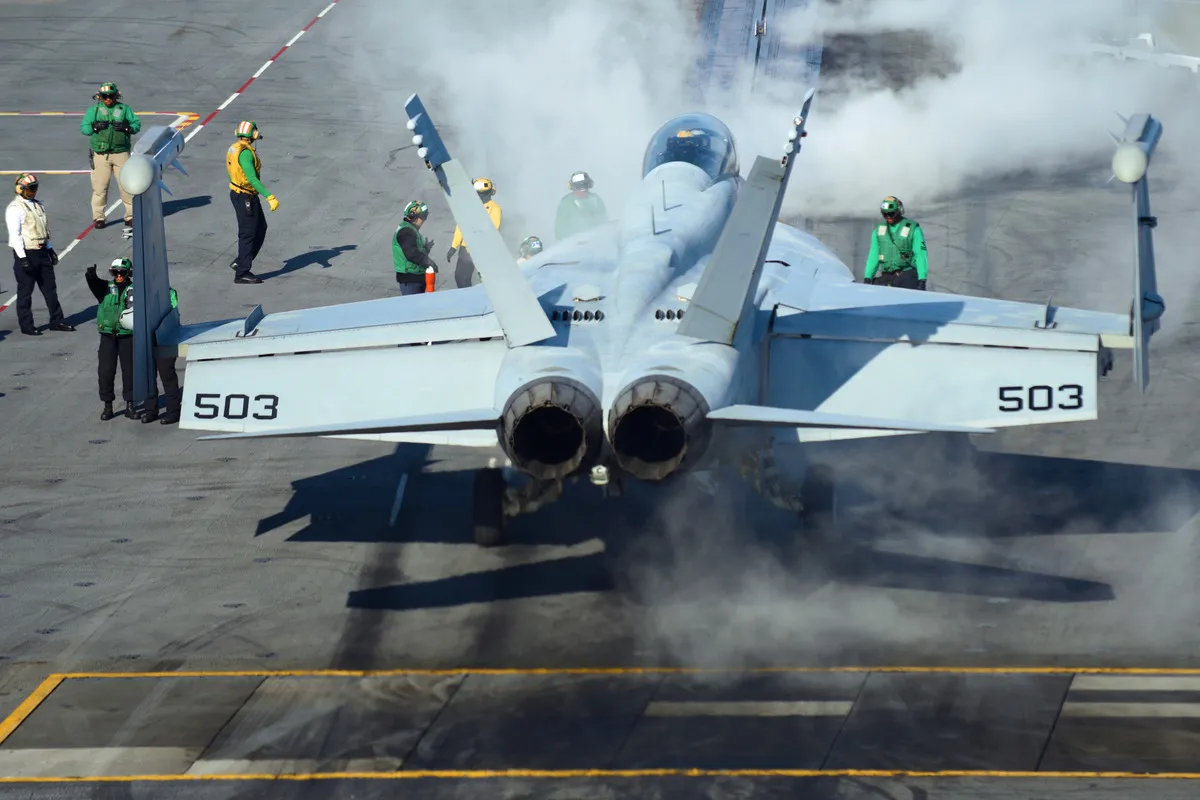
Both EMALS and steam catapults do the same job; they make sure fighter jets accelerate very quickly over a very short distance so they can launch from the deck of an aircraft carrier, rather than needing a long runway.
But rather than using steam pistons to get the jets to the right takeoff speed in very short periods of time, EMALS use a linear induction motor, which uses power from nuclear reactors on a carrier to release a magnetic pulse and propel the aircraft forward.
Steam catapults feed steam into cylinders below the deck which each contain a piston. High-pressure steam forces the piston forward, and because the piston is linked up to a launch shuttle on the flight deck, this drags the aircraft along so it can launch.
China's newest operational aircraft carrier, the Type 003 Fujian, uses EMALS, whereas France's Charles de Gaulle carrier uses U.S.-designed steam catapults. But Paris reportedly plans to use EMALS in its future aircraft carriers.

...
EMALS are lauded as putting less stress on the aircraft they're launching, and can be ready to go very quickly when aircraft need to get airborne rapidly.
But EMALS are a much newer technology than steam catapults, and the U.S. Navy has had decades of experience with steam catapults. EMALS had some teething problems, including during early tests on the Gerald R. Ford, but have been widely used for launches since.
Trump said Pentagon and other U.S. officials had 60 days to come up with a plan for replacing the electromagnetic launch systems and weapons elevators with steam and hydraulic systems.
"I have determined that it is in the national security interest of the United States to increase domestic shipbuilding capacity," Trump said.
Contact Newsweek editors on this story: John Fitzpatrick, Tony Phillips and Mike Hirst.
Update 8/17/2026 at 12:25 p.m. ET: This article was updated with additional comments from retired Rear Admiral Mark Montgomery.
View 0 Comments
Submit Correction
View Editorial & AI Guidelines