...

By Maria Azzurra Volpe
Reporter
0
Share
Newsweek is a Trust Project member
See more of our trusted coverage when you search.Prefer Newsweek on Googleto see more of our trusted coverage when you search.
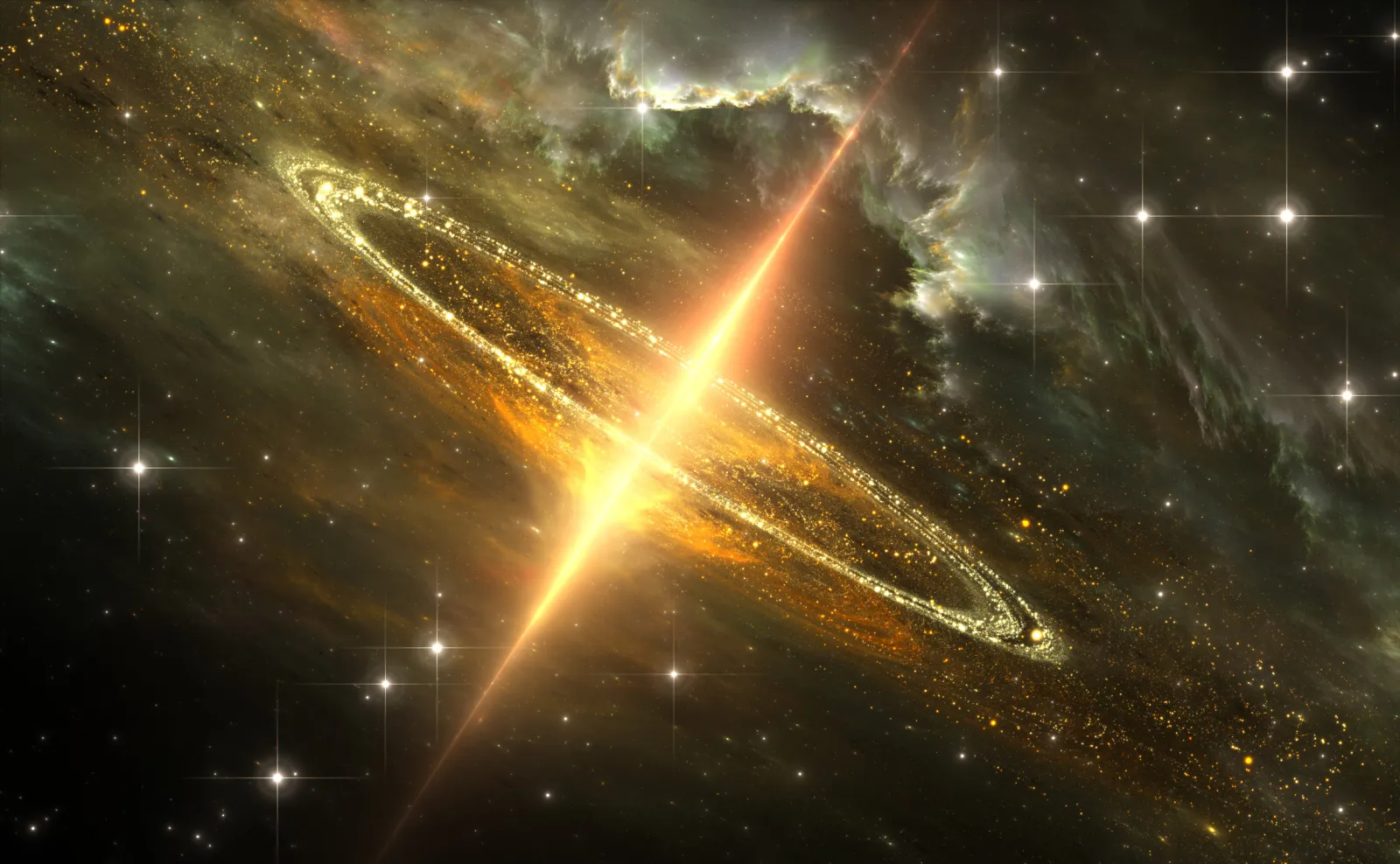
Scientists at Dartmouth and the University of Exeter have discovered that radiation emitted by supermassive black holes can have a surprising, nurturing effect on life.
According to NASA, supermassive black holes—often found at the heart of galaxies—are astronomical objects with a gravitational pull so strong that not even light can escape it that are so large they can "shape the evolution of galaxies and influence the formation of stars and planets."
But while they are normally thought of as a destructive force, it turns out that under the right conditions, they can actually help life grow and thrive.
Read More on Science
While pulling matter in, some active galactic nuclei (AGN) release ultraviolet (UV) radiation, which can reach nearby planets similarly to how the sun's radiation reaches Earth.
The study published in The Astrophysical Journal explored via computer simulations how this UV radiation might transform a planet's atmosphere to help or hinder life.
...
The researchers simulated the effects of AGN radiation on Earth, and on Earth-like planets of varying atmospheric composition.
They found that when oxygen was already present, the radiation would set off chemical reactions causing the planet's protective ozone layer to grow.
This is due to the way UV radiation reacts with oxygen, splitting the molecules into single atoms that recombine to form ozone, which deflects dangerous radiation back into space.
Kendall Sippy, lead author of the study, explains that once life exists, and has already oxygenated the atmosphere, radiation from AGNs becomes "less devastating and possibly even a good thing."
"Once that bridge is crossed, the planet becomes more resilient to UV radiation and protected from potential extinction events," she says.
However, for AGN radiation to be beneficial to the ozone, planets must be distant enough from the source of radiation.
The study looked at what might happen to Earth-like plants in older galaxies like "red nugget relics", where stars are all clustered near the black hole, and found out that in this case, the AGN radiation would be too strong and deadly for life.
In bigger galaxies like our own, stars are spread farther apart, distant enough from the black hole to be safe from its dangerous radiation.
While Earth is too far from Sagittarius A*, the Milky Way's central supermassive black hole, to feel its effects, scientists involved in the study wanted to see what would happen to life on Earth if we were much closer to a hypothetical AGN, and so exposed to radiation billions of times greater.
They surprisingly found out that with modern oxygen levels, the ozone layer would grow and shield us from dangerous radiation in just a matter of days.

...
Ozone is a gas made up of three oxygen atoms, which occurs naturally in small amounts in the stratosphere, protecting Earth from the sun's UV radiation, which would otherwise make the surface of our planet sterile.
Back in the 70s, scientists discovered that chemicals used in the production of items such as aerosol sprays, foam-blowing agents, solvents, and refrigerants, had created a hole in the ozone over the Antarctic spring.
In 1987, countries worldwide signed the Montreal Protocol, agreeing to phase out these harmful chemicals for the good of our planet. Since then, our ozone layer has been on a healing process, and scientists estimate it could fully recover by 2066.
Do you have a tip on a science story that Newsweek should be covering? Do you have a question about black holes? Let us know via science@newsweek.com.
Sippy, K. I., Eager-Nash, J. K., Hickox, R. C., Mayne, N. J., & Brumback, M. C. (2025). Impacts of UV Radiation from an AGN on Planetary Atmospheres and Consequences for Galactic Habitability. The Astrophysical Journal, 980(2), 221. https://doi.org/10.3847/1538-4357/adac5d
View 0 Comments
Submit Correction
View Editorial & AI Guidelines